

110
Types of Polyhydroxyalkanoates
The first discovered polyhydroxyalkanoate was poly(3-hydroxybutyrate) back in
1926 from Bacillus megaterium as it is an abundant homopolymer (Castilho et al.
2009). Since then, a wide range of homo- and co-polymers have been discovered.
Polyhydroxyalkanoates are frequently classified into three groups based on the
number of carbon atoms within the monomer. Chains with three to five carbon
atoms are classified as short chain length (scl) and are more common, while chains
with six to 14 carbons are medium chain length (mcl), for which Pseudomonas are
prominent producers (Lutke-Eversloh and Steinbuchel 2004). Chains with more
than 14 carbons are classified as long-chain-length (lcl) polyhydroxyalkanoates
(Troschl et al. 2017).
The two most common types of polyhydroxyalkanoates are polyhydroxybutyrate
and poly(hydroxyvalerate) and are both classified as scl-polyhydroxyalkanoates.
Their copolymers such as poly(3-hydroxybutyrate-co-3-hydroxyvalerate) and
poly(3-hydroxybutyrate-co-4-hydroxybutyrate) are also scl- polyhydroxyalkanoates.
The most common mcl-polyhydroxyalkanoate is poly(3-hydroxybutyrate-co-3-hydroxyhexanoate). In general, many factors are involved in the development of the
structural composition of polyhydroxyalkanoates including the substrate, strains of
bacteria and environment properties, although both wild-type and recombinant bacteria have the ability to produce scl- and mcl-polyhydroxyalkanoates (Tan et al.
2014; Dietrich et al. 2017).
Polyhydroxyalkanoates Properties
The combination of high functionality with the low environmental impact that polyhydroxyalkanoates display makes them promising candidates for sustainable polymer production (Dietrich et al. 2017). Due to the diversity of polyhydroxyalkanoates,
its properties and subsequent uses are various and depend on factors such as type(s)
of monomers and producing strains of bacteria among others (Castilho et al. 2009).
For instance, scl-polyhydroxyalkanoates are usually employed in one-time-use
plastics for food packaging, while the mcl-polyhydroxyalkanoates are suitable for
applications in the medical field such as sutures and implants due to their characterization as elastomers (Kourmentza et al. 2017). Polyhydroxybutyrate is known for
its low oxygen permeability, moisture and ultraviolet light resistance, optical purity,
and similar thermoplastic properties to polyethylene and polypropylene (Salehizadeh
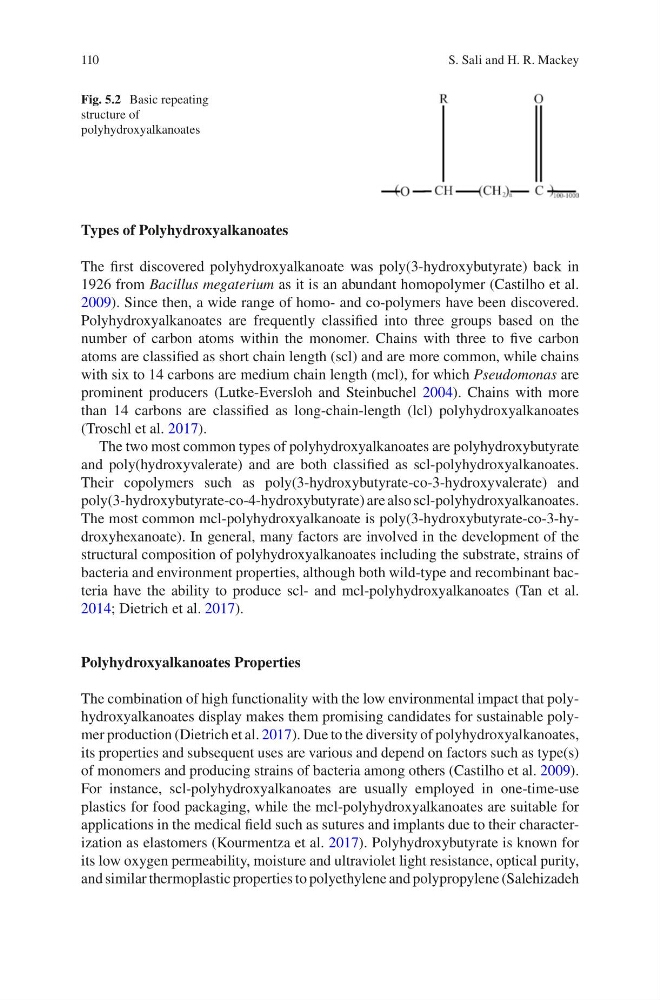
Fig. 5.2 Basic repeating
structure of
polyhydroxyalkanoates
S. Sali and H. R. Mackey
Types of Polyhydroxyalkanoates
The first discovered polyhydroxyalkanoate was poly(3-hydroxybutyrate) back in
1926 from Bacillus megaterium as it is an abundant homopolymer (Castilho et al.
2009). Since then, a wide range of homo- and co-polymers have been discovered.
Polyhydroxyalkanoates are frequently classified into three groups based on the
number of carbon atoms within the monomer. Chains with three to five carbon
atoms are classified as short chain length (scl) and are more common, while chains
with six to 14 carbons are medium chain length (mcl), for which Pseudomonas are
prominent producers (Lutke-Eversloh and Steinbuchel 2004). Chains with more
than 14 carbons are classified as long-chain-length (lcl) polyhydroxyalkanoates
(Troschl et al. 2017).
The two most common types of polyhydroxyalkanoates are polyhydroxybutyrate
and poly(hydroxyvalerate) and are both classified as scl-polyhydroxyalkanoates.
Their copolymers such as poly(3-hydroxybutyrate-co-3-hydroxyvalerate) and
poly(3-hydroxybutyrate-co-4-hydroxybutyrate) are also scl- polyhydroxyalkanoates.
The most common mcl-polyhydroxyalkanoate is poly(3-hydroxybutyrate-co-3-hydroxyhexanoate). In general, many factors are involved in the development of the
structural composition of polyhydroxyalkanoates including the substrate, strains of
bacteria and environment properties, although both wild-type and recombinant bacteria have the ability to produce scl- and mcl-polyhydroxyalkanoates (Tan et al.
2014; Dietrich et al. 2017).
Polyhydroxyalkanoates Properties
The combination of high functionality with the low environmental impact that polyhydroxyalkanoates display makes them promising candidates for sustainable polymer production (Dietrich et al. 2017). Due to the diversity of polyhydroxyalkanoates,
its properties and subsequent uses are various and depend on factors such as type(s)
of monomers and producing strains of bacteria among others (Castilho et al. 2009).
For instance, scl-polyhydroxyalkanoates are usually employed in one-time-use
plastics for food packaging, while the mcl-polyhydroxyalkanoates are suitable for
applications in the medical field such as sutures and implants due to their characterization as elastomers (Kourmentza et al. 2017). Polyhydroxybutyrate is known for
its low oxygen permeability, moisture and ultraviolet light resistance, optical purity,
and similar thermoplastic properties to polyethylene and polypropylene (Salehizadeh
Fig. 5.2 Basic repeating
structure of
polyhydroxyalkanoates
S. Sali and H. R. Mackey