

Cellulose is the most abundant renewable carbon source and a potentially vital
source for production of industrial products (Muthuvelayudham and Viruthagiri
2006, 2007). Enzymatic hydrolysis is an economic process in the conversion of
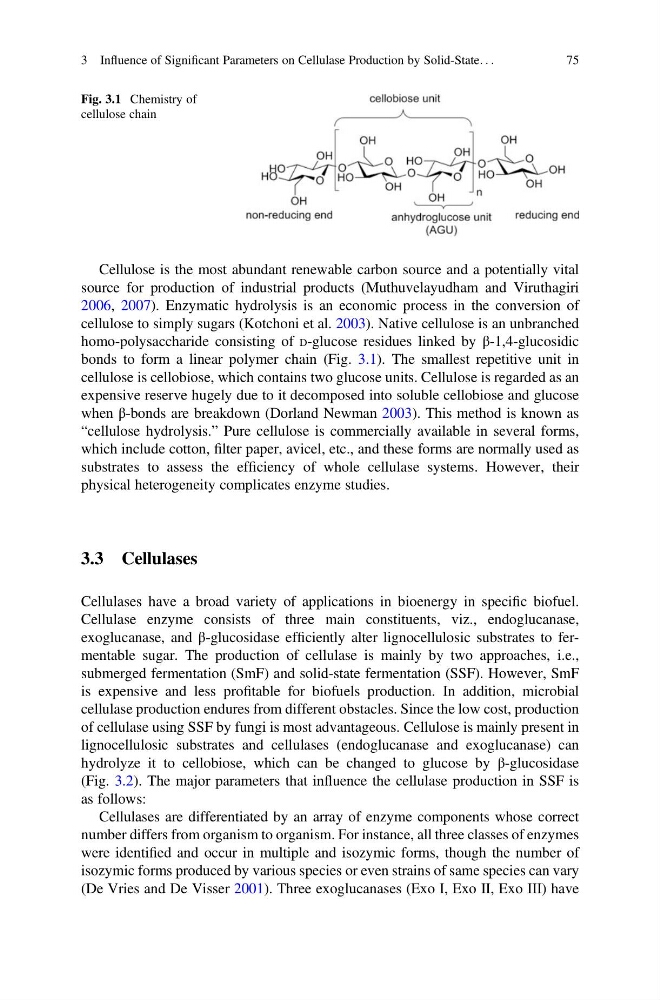
cellulose to simply sugars (Kotchoni et al. 2003). Native cellulose is an unbranched
homo-polysaccharide consisting of D-glucose residues linked by β-1,4-glucosidic
bonds to form a linear polymer chain (Fig. 3.1). The smallest repetitive unit in
cellulose is cellobiose, which contains two glucose units. Cellulose is regarded as an
expensive reserve hugely due to it decomposed into soluble cellobiose and glucose
when β-bonds are breakdown (Dorland Newman 2003). This method is known as
“cellulose hydrolysis.” Pure cellulose is commercially available in several forms,
which include cotton, filter paper, avicel, etc., and these forms are normally used as
substrates to assess the efficiency of whole cellulase systems. However, their
physical heterogeneity complicates enzyme studies.
3.3 Cellulases
Cellulases have a broad variety of applications in bioenergy in specific biofuel.
Cellulase enzyme consists of three main constituents, viz., endoglucanase,
exoglucanase, and β-glucosidase efficiently alter lignocellulosic substrates to fermentable sugar. The production of cellulase is mainly by two approaches, i.e.,
submerged fermentation (SmF) and solid-state fermentation (SSF). However, SmF
is expensive and less profitable for biofuels production. In addition, microbial
cellulase production endures from different obstacles. Since the low cost, production
of cellulase using SSF by fungi is most advantageous. Cellulose is mainly present in
lignocellulosic substrates and cellulases (endoglucanase and exoglucanase) can
hydrolyze it to cellobiose, which can be changed to glucose by β-glucosidase
(Fig. 3.2). The major parameters that influence the cellulase production in SSF is
as follows:
Cellulases are differentiated by an array of enzyme components whose correct
number differs from organism to organism. For instance, all three classes of enzymes
were identified and occur in multiple and isozymic forms, though the number of
isozymic forms produced by various species or even strains of same species can vary
(De Vries and De Visser 2001). Three exoglucanases (Exo I, Exo II, Exo III) have
Fig. 3.1 Chemistry of
cellulose chain
3 Influence of Significant Parameters on Cellulase Production by Solid-State. . .
75
source for production of industrial products (Muthuvelayudham and Viruthagiri
2006, 2007). Enzymatic hydrolysis is an economic process in the conversion of
cellulose to simply sugars (Kotchoni et al. 2003). Native cellulose is an unbranched
homo-polysaccharide consisting of D-glucose residues linked by β-1,4-glucosidic
bonds to form a linear polymer chain (Fig. 3.1). The smallest repetitive unit in
cellulose is cellobiose, which contains two glucose units. Cellulose is regarded as an
expensive reserve hugely due to it decomposed into soluble cellobiose and glucose
when β-bonds are breakdown (Dorland Newman 2003). This method is known as
“cellulose hydrolysis.” Pure cellulose is commercially available in several forms,
which include cotton, filter paper, avicel, etc., and these forms are normally used as
substrates to assess the efficiency of whole cellulase systems. However, their
physical heterogeneity complicates enzyme studies.
3.3 Cellulases
Cellulases have a broad variety of applications in bioenergy in specific biofuel.
Cellulase enzyme consists of three main constituents, viz., endoglucanase,
exoglucanase, and β-glucosidase efficiently alter lignocellulosic substrates to fermentable sugar. The production of cellulase is mainly by two approaches, i.e.,
submerged fermentation (SmF) and solid-state fermentation (SSF). However, SmF
is expensive and less profitable for biofuels production. In addition, microbial
cellulase production endures from different obstacles. Since the low cost, production
of cellulase using SSF by fungi is most advantageous. Cellulose is mainly present in
lignocellulosic substrates and cellulases (endoglucanase and exoglucanase) can
hydrolyze it to cellobiose, which can be changed to glucose by β-glucosidase
(Fig. 3.2). The major parameters that influence the cellulase production in SSF is
as follows:
Cellulases are differentiated by an array of enzyme components whose correct
number differs from organism to organism. For instance, all three classes of enzymes
were identified and occur in multiple and isozymic forms, though the number of
isozymic forms produced by various species or even strains of same species can vary
(De Vries and De Visser 2001). Three exoglucanases (Exo I, Exo II, Exo III) have
Fig. 3.1 Chemistry of
cellulose chain
3 Influence of Significant Parameters on Cellulase Production by Solid-State. . .
75