

by-products and also forest residues. Fischer-Tropsch (FT) process is the most
common process for the synthesis of syngas to liquid fuels such as bioethanol.
The process requires application various metal catalysts such as cobalt, nickel, etc.
The main limitations of syngas fermentation by Fischer-Tropsch (FT) process are the
application of expensive catalysts, sensitivity of the catalysts with the inert gases
such as sulphur and high pressure.
Biological method of fermentation of syngas leads to production of alcohols and
organic acids with the use of microorganisms. The main advantages of biological
production of syngas over FT process are the low reaction temperature, less sensitivity to inert gases, high specificity in terms of microorganisms and no metal
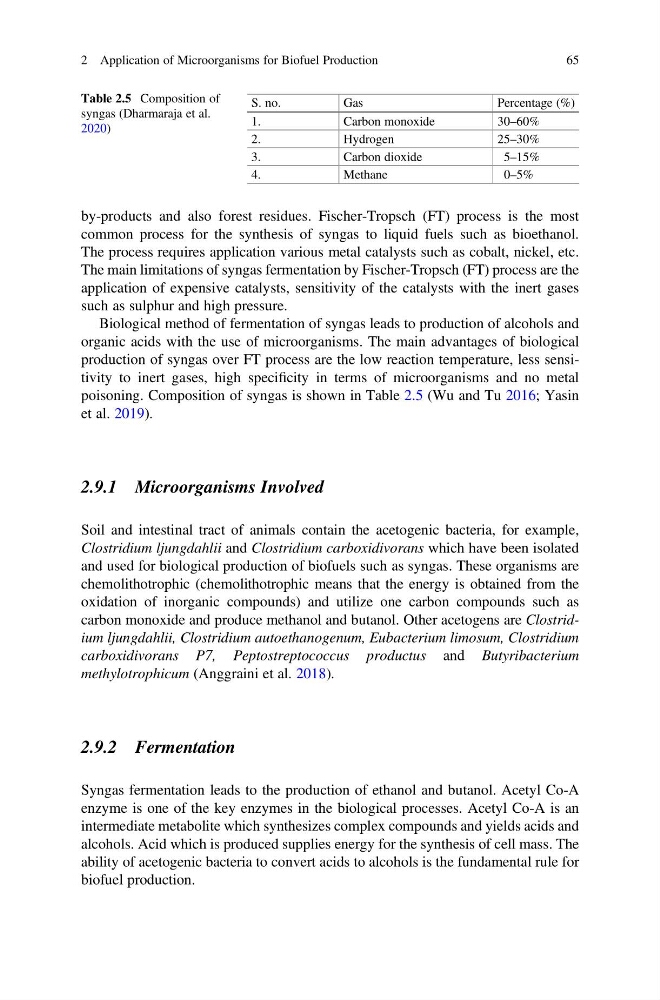
poisoning. Composition of syngas is shown in Table 2.5 (Wu and Tu 2016; Yasin
et al. 2019).
2.9.1 Microorganisms Involved
Soil and intestinal tract of animals contain the acetogenic bacteria, for example,
Clostridium ljungdahlii and Clostridium carboxidivorans which have been isolated
and used for biological production of biofuels such as syngas. These organisms are
chemolithotrophic (chemolithotrophic means that the energy is obtained from the
oxidation of inorganic compounds) and utilize one carbon compounds such as
carbon monoxide and produce methanol and butanol. Other acetogens are Clostridium ljungdahlii, Clostridium autoethanogenum, Eubacterium limosum, Clostridium
carboxidivorans P7, Peptostreptococcus productus and Butyribacterium
methylotrophicum (Anggraini et al. 2018).
2.9.2 Fermentation
Syngas fermentation leads to the production of ethanol and butanol. Acetyl Co-A
enzyme is one of the key enzymes in the biological processes. Acetyl Co-A is an
intermediate metabolite which synthesizes complex compounds and yields acids and
alcohols. Acid which is produced supplies energy for the synthesis of cell mass. The
ability of acetogenic bacteria to convert acids to alcohols is the fundamental rule for
biofuel production.
Table 2.5 Composition of
syngas (Dharmaraja et al.
2020)
S. no.
Gas
Percentage (%)
1.
Carbon monoxide
30–60%
2.
Hydrogen
25–30%
3.
Carbon dioxide
5–15%
4.
Methane
0–5%
2 Application of Microorganisms for Biofuel Production
65
common process for the synthesis of syngas to liquid fuels such as bioethanol.
The process requires application various metal catalysts such as cobalt, nickel, etc.
The main limitations of syngas fermentation by Fischer-Tropsch (FT) process are the
application of expensive catalysts, sensitivity of the catalysts with the inert gases
such as sulphur and high pressure.
Biological method of fermentation of syngas leads to production of alcohols and
organic acids with the use of microorganisms. The main advantages of biological
production of syngas over FT process are the low reaction temperature, less sensitivity to inert gases, high specificity in terms of microorganisms and no metal
poisoning. Composition of syngas is shown in Table 2.5 (Wu and Tu 2016; Yasin
et al. 2019).
2.9.1 Microorganisms Involved
Soil and intestinal tract of animals contain the acetogenic bacteria, for example,
Clostridium ljungdahlii and Clostridium carboxidivorans which have been isolated
and used for biological production of biofuels such as syngas. These organisms are
chemolithotrophic (chemolithotrophic means that the energy is obtained from the
oxidation of inorganic compounds) and utilize one carbon compounds such as
carbon monoxide and produce methanol and butanol. Other acetogens are Clostridium ljungdahlii, Clostridium autoethanogenum, Eubacterium limosum, Clostridium
carboxidivorans P7, Peptostreptococcus productus and Butyribacterium
methylotrophicum (Anggraini et al. 2018).
2.9.2 Fermentation
Syngas fermentation leads to the production of ethanol and butanol. Acetyl Co-A
enzyme is one of the key enzymes in the biological processes. Acetyl Co-A is an
intermediate metabolite which synthesizes complex compounds and yields acids and
alcohols. Acid which is produced supplies energy for the synthesis of cell mass. The
ability of acetogenic bacteria to convert acids to alcohols is the fundamental rule for
biofuel production.
Table 2.5 Composition of
syngas (Dharmaraja et al.
2020)
S. no.
Gas
Percentage (%)
1.
Carbon monoxide
30–60%
2.
Hydrogen
25–30%
3.
Carbon dioxide
5–15%
4.
Methane
0–5%
2 Application of Microorganisms for Biofuel Production
65