

criterion). Co-solvent extraction has numerous examples; in 1959, Bligh and Dyer
developed one process. The solvents are chloroform and alcohol, and mostly
chloroform stage achieved better lipids dissolution. The interfaces consist of water
and methanol>methanol and chloroform>lipid and chloroform. Co-solvents of
other combinations includes: (1) hexane/and sopropanol, (2) dimethyl sulfoxide
(DMSO) and petroleum ether, and (3) hexane and ethanol.
1.5.2 Supercritical Extraction
It is equivalent to a solvent extraction technique. The biggest distinction includes
that the solvent is sustained until predefined temperature or pressure specifications
are achieved in respect solvent properties and enable extraction of the constituents.
This is often applied on minor scale, and might not be of industry interest. Supercritical fluid extraction facilitates extraction of one solvent from another using a
supercritical fluid, for example, carbon dioxide. The separable part is the extractant,
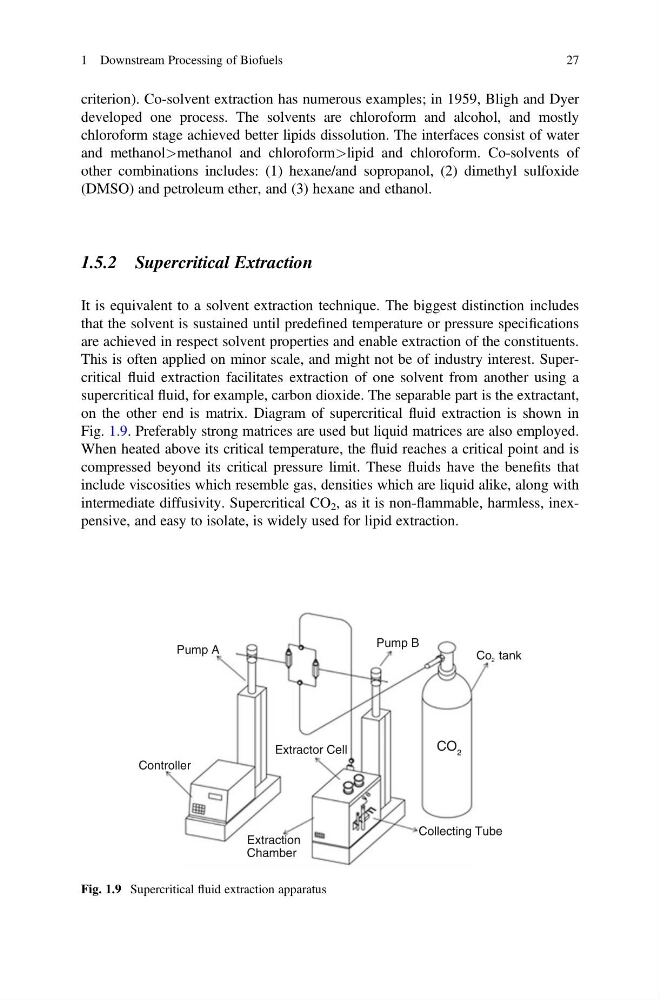
on the other end is matrix. Diagram of supercritical fluid extraction is shown in
Fig. 1.9. Preferably strong matrices are used but liquid matrices are also employed.
When heated above its critical temperature, the fluid reaches a critical point and is
compressed beyond its critical pressure limit. These fluids have the benefits that
include viscosities which resemble gas, densities which are liquid alike, along with
intermediate diffusivity. Supercritical CO 2 , as it is non-flammable, harmless, inexpensive, and easy to isolate, is widely used for lipid extraction.
Pump A
Pump B
Controller
Extraction
Extractor Cell
tank
Chamber
Collecting Tube
CO 2
Co 2
Fig. 1.9 Supercritical fluid extraction apparatus
1 Downstream Processing of Biofuels
27
developed one process. The solvents are chloroform and alcohol, and mostly
chloroform stage achieved better lipids dissolution. The interfaces consist of water
and methanol>methanol and chloroform>lipid and chloroform. Co-solvents of
other combinations includes: (1) hexane/and sopropanol, (2) dimethyl sulfoxide
(DMSO) and petroleum ether, and (3) hexane and ethanol.
1.5.2 Supercritical Extraction
It is equivalent to a solvent extraction technique. The biggest distinction includes
that the solvent is sustained until predefined temperature or pressure specifications
are achieved in respect solvent properties and enable extraction of the constituents.
This is often applied on minor scale, and might not be of industry interest. Supercritical fluid extraction facilitates extraction of one solvent from another using a
supercritical fluid, for example, carbon dioxide. The separable part is the extractant,
on the other end is matrix. Diagram of supercritical fluid extraction is shown in
Fig. 1.9. Preferably strong matrices are used but liquid matrices are also employed.
When heated above its critical temperature, the fluid reaches a critical point and is
compressed beyond its critical pressure limit. These fluids have the benefits that
include viscosities which resemble gas, densities which are liquid alike, along with
intermediate diffusivity. Supercritical CO 2 , as it is non-flammable, harmless, inexpensive, and easy to isolate, is widely used for lipid extraction.
Pump A
Pump B
Controller
Extraction
Extractor Cell
tank
Chamber
Collecting Tube
CO 2
Co 2
Fig. 1.9 Supercritical fluid extraction apparatus
1 Downstream Processing of Biofuels
27