

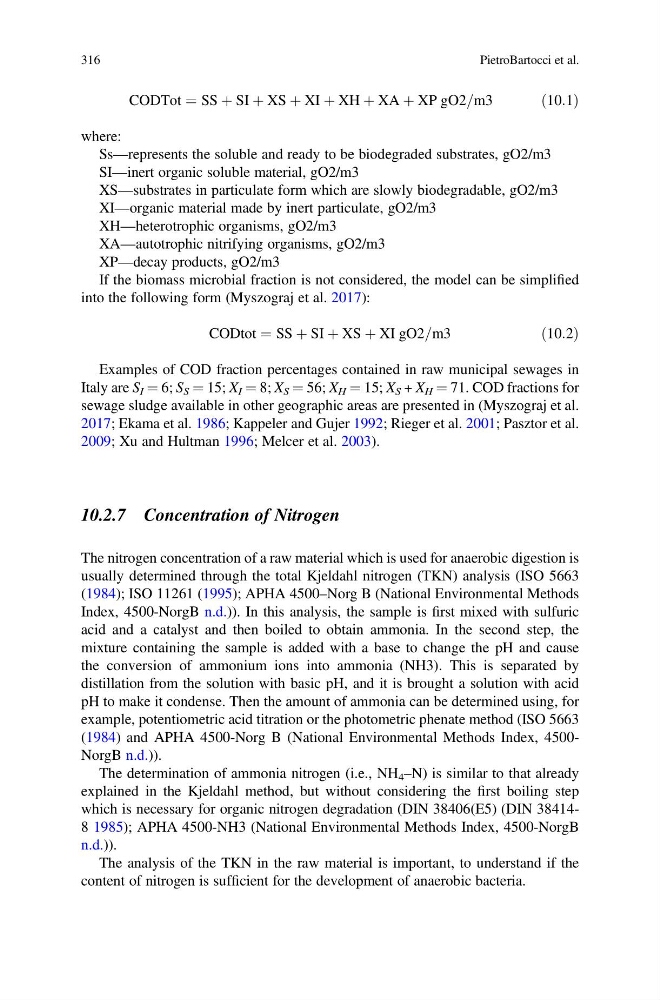
CODTot ¼ SS þ SI þ XS þ XI þ XH þ XA þ XP gO2=m3
ð10:1Þ
where:
Ss—represents the soluble and ready to be biodegraded substrates, gO2/m3
SI—inert organic soluble material, gO2/m3
XS—substrates in particulate form which are slowly biodegradable, gO2/m3
XI—organic material made by inert particulate, gO2/m3
XH—heterotrophic organisms, gO2/m3
XA—autotrophic nitrifying organisms, gO2/m3
XP—decay products, gO2/m3
If the biomass microbial fraction is not considered, the model can be simplified
into the following form (Myszograj et al. 2017):
CODtot ¼ SS þ SI þ XS þ XI gO2=m3
ð10:2Þ
Examples of COD fraction percentages contained in raw municipal sewages in
Italy are S I ¼ 6; S S ¼ 15; X I ¼ 8; X S ¼ 56; X H ¼ 15; X S + X H ¼ 71. COD fractions for
sewage sludge available in other geographic areas are presented in (Myszograj et al.
2017; Ekama et al. 1986; Kappeler and Gujer 1992; Rieger et al. 2001; Pasztor et al.
2009; Xu and Hultman 1996; Melcer et al. 2003).
10.2.7 Concentration of Nitrogen
The nitrogen concentration of a raw material which is used for anaerobic digestion is
usually determined through the total Kjeldahl nitrogen (TKN) analysis (ISO 5663
(1984); ISO 11261 (1995); APHA 4500–Norg B (National Environmental Methods
Index, 4500-NorgB n.d.)). In this analysis, the sample is first mixed with sulfuric
acid and a catalyst and then boiled to obtain ammonia. In the second step, the
mixture containing the sample is added with a base to change the pH and cause
the conversion of ammonium ions into ammonia (NH3). This is separated by
distillation from the solution with basic pH, and it is brought a solution with acid
pH to make it condense. Then the amount of ammonia can be determined using, for
example, potentiometric acid titration or the photometric phenate method (ISO 5663
(1984) and APHA 4500-Norg B (National Environmental Methods Index, 4500NorgB n.d.)).
The determination of ammonia nitrogen (i.e., NH 4 –N) is similar to that already
explained in the Kjeldahl method, but without considering the first boiling step
which is necessary for organic nitrogen degradation (DIN 38406(E5) (DIN 384148 1985); APHA 4500-NH3 (National Environmental Methods Index, 4500-NorgB
n.d.)).
The analysis of the TKN in the raw material is important, to understand if the
content of nitrogen is sufficient for the development of anaerobic bacteria.
316
PietroBartocci et al.
ð10:1Þ
where:
Ss—represents the soluble and ready to be biodegraded substrates, gO2/m3
SI—inert organic soluble material, gO2/m3
XS—substrates in particulate form which are slowly biodegradable, gO2/m3
XI—organic material made by inert particulate, gO2/m3
XH—heterotrophic organisms, gO2/m3
XA—autotrophic nitrifying organisms, gO2/m3
XP—decay products, gO2/m3
If the biomass microbial fraction is not considered, the model can be simplified
into the following form (Myszograj et al. 2017):
CODtot ¼ SS þ SI þ XS þ XI gO2=m3
ð10:2Þ
Examples of COD fraction percentages contained in raw municipal sewages in
Italy are S I ¼ 6; S S ¼ 15; X I ¼ 8; X S ¼ 56; X H ¼ 15; X S + X H ¼ 71. COD fractions for
sewage sludge available in other geographic areas are presented in (Myszograj et al.
2017; Ekama et al. 1986; Kappeler and Gujer 1992; Rieger et al. 2001; Pasztor et al.
2009; Xu and Hultman 1996; Melcer et al. 2003).
10.2.7 Concentration of Nitrogen
The nitrogen concentration of a raw material which is used for anaerobic digestion is
usually determined through the total Kjeldahl nitrogen (TKN) analysis (ISO 5663
(1984); ISO 11261 (1995); APHA 4500–Norg B (National Environmental Methods
Index, 4500-NorgB n.d.)). In this analysis, the sample is first mixed with sulfuric
acid and a catalyst and then boiled to obtain ammonia. In the second step, the
mixture containing the sample is added with a base to change the pH and cause
the conversion of ammonium ions into ammonia (NH3). This is separated by
distillation from the solution with basic pH, and it is brought a solution with acid
pH to make it condense. Then the amount of ammonia can be determined using, for
example, potentiometric acid titration or the photometric phenate method (ISO 5663
(1984) and APHA 4500-Norg B (National Environmental Methods Index, 4500NorgB n.d.)).
The determination of ammonia nitrogen (i.e., NH 4 –N) is similar to that already
explained in the Kjeldahl method, but without considering the first boiling step
which is necessary for organic nitrogen degradation (DIN 38406(E5) (DIN 384148 1985); APHA 4500-NH3 (National Environmental Methods Index, 4500-NorgB
n.d.)).
The analysis of the TKN in the raw material is important, to understand if the
content of nitrogen is sufficient for the development of anaerobic bacteria.
316
PietroBartocci et al.