

10.1 Biogas Raw Materials Characteristics
Anaerobic digestion is the technology usually employed for the treatment of liquid
animal effluents (e.g., pig, poultry, and cattle), compost, and sewage sludge obtained
from wastewater treatment plants working in aerobic conditions. In the 1970’s
ecological and environmental movement, the need for a sustainable waste management is joined together with the development of renewable energy forms. In this
framework, the use of anaerobic digestion became more and more diffuse for
treating both municipal and industrial wastes. Thus, biogas plants have been
constructed to stabilize the organic fraction of municipal solid waste (OFMSW)
and semi-solid and solid wastes and have grown in numbers as an alternative to
landfills or aerobic composting (Steffen et al. 1998). The advantage of the treatment
is to produce two useful products which are: energy and a fertilizer.
Different raw materials are currently fed to anaerobic digestion plants to obtain
biogas and digestate, with different composition and chemical and physical characteristics. Here we take into consideration pig slurry, cow manure, chicken manure,
farmyard manure, agricultural residues, energy crops, and wastewaters.
Pig breeding farms with usually more than 1000 animals produce a liquid slurry
with a total solid content between 2 and 10 wt%.
Cow slurry is usually gathered by a scraper system from feedlots. The addition of
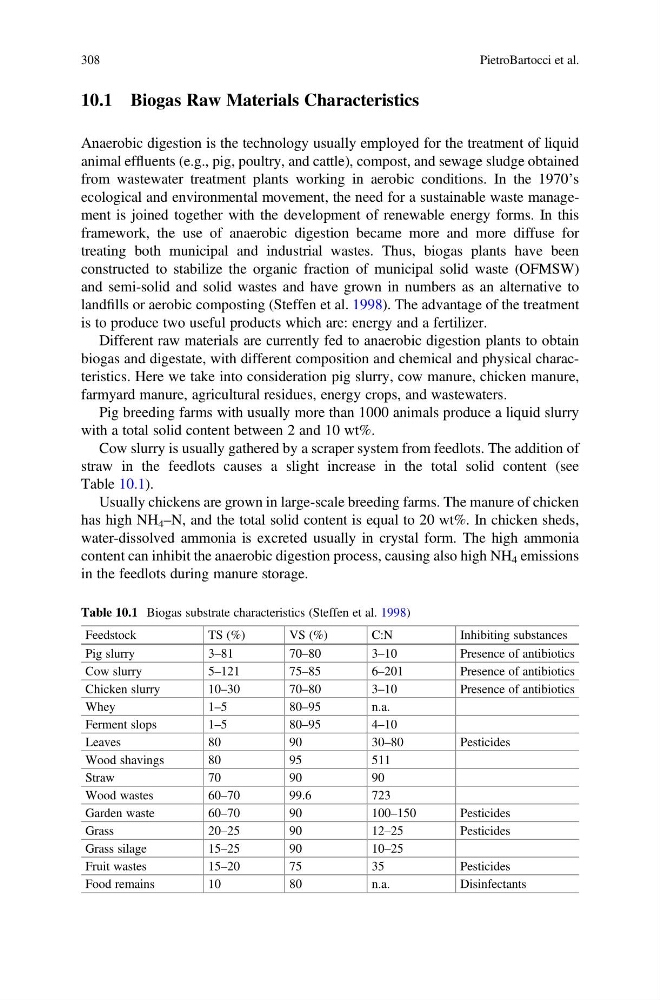
straw in the feedlots causes a slight increase in the total solid content (see
Table 10.1).
Usually chickens are grown in large-scale breeding farms. The manure of chicken
has high NH 4 –N, and the total solid content is equal to 20 wt%. In chicken sheds,
water-dissolved ammonia is excreted usually in crystal form. The high ammonia
content can inhibit the anaerobic digestion process, causing also high NH 4 emissions
in the feedlots during manure storage.
Table 10.1 Biogas substrate characteristics (Steffen et al. 1998)
Feedstock
TS (%)
VS (%)
C:N
Inhibiting substances
Pig slurry
3–81
70–80
3–10
Presence of antibiotics
Cow slurry
5–121
75–85
6–201
Presence of antibiotics
Chicken slurry
10–30
70–80
3–10
Presence of antibiotics
Whey
1–5
8 0 –95
n.a.
Ferment slops
1–5
8 0 –95
4–10
Leaves
80
90
30–80
Pesticides
Wood shavings
80
95
511
Straw
70
90
90
Wood wastes
60–70
99.6
723
Garden waste
60–70
90
100–150
Pesticides
Grass
20–25
90
12–25
Pesticides
Grass silage
15–25
90
10–25
Fruit wastes
15–20
75
35
Pesticides
Food remains
10
80
n.a.
Disinfectants
308
PietroBartocci et al.
Anaerobic digestion is the technology usually employed for the treatment of liquid
animal effluents (e.g., pig, poultry, and cattle), compost, and sewage sludge obtained
from wastewater treatment plants working in aerobic conditions. In the 1970’s
ecological and environmental movement, the need for a sustainable waste management is joined together with the development of renewable energy forms. In this
framework, the use of anaerobic digestion became more and more diffuse for
treating both municipal and industrial wastes. Thus, biogas plants have been
constructed to stabilize the organic fraction of municipal solid waste (OFMSW)
and semi-solid and solid wastes and have grown in numbers as an alternative to
landfills or aerobic composting (Steffen et al. 1998). The advantage of the treatment
is to produce two useful products which are: energy and a fertilizer.
Different raw materials are currently fed to anaerobic digestion plants to obtain
biogas and digestate, with different composition and chemical and physical characteristics. Here we take into consideration pig slurry, cow manure, chicken manure,
farmyard manure, agricultural residues, energy crops, and wastewaters.
Pig breeding farms with usually more than 1000 animals produce a liquid slurry
with a total solid content between 2 and 10 wt%.
Cow slurry is usually gathered by a scraper system from feedlots. The addition of
straw in the feedlots causes a slight increase in the total solid content (see
Table 10.1).
Usually chickens are grown in large-scale breeding farms. The manure of chicken
has high NH 4 –N, and the total solid content is equal to 20 wt%. In chicken sheds,
water-dissolved ammonia is excreted usually in crystal form. The high ammonia
content can inhibit the anaerobic digestion process, causing also high NH 4 emissions
in the feedlots during manure storage.
Table 10.1 Biogas substrate characteristics (Steffen et al. 1998)
Feedstock
TS (%)
VS (%)
C:N
Inhibiting substances
Pig slurry
3–81
70–80
3–10
Presence of antibiotics
Cow slurry
5–121
75–85
6–201
Presence of antibiotics
Chicken slurry
10–30
70–80
3–10
Presence of antibiotics
Whey
1–5
8 0 –95
n.a.
Ferment slops
1–5
8 0 –95
4–10
Leaves
80
90
30–80
Pesticides
Wood shavings
80
95
511
Straw
70
90
90
Wood wastes
60–70
99.6
723
Garden waste
60–70
90
100–150
Pesticides
Grass
20–25
90
12–25
Pesticides
Grass silage
15–25
90
10–25
Fruit wastes
15–20
75
35
Pesticides
Food remains
10
80
n.a.
Disinfectants
308
PietroBartocci et al.