

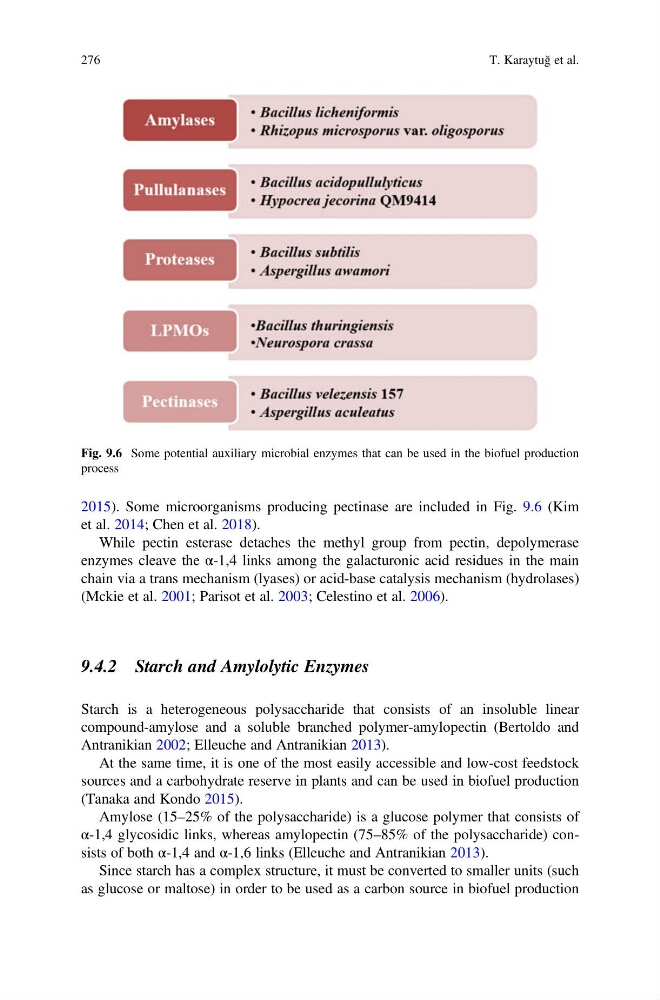
2015). Some microorganisms producing pectinase are included in Fig. 9.6 (Kim
et al. 2014; Chen et al. 2018).
While pectin esterase detaches the methyl group from pectin, depolymerase
enzymes cleave the α-1,4 links among the galacturonic acid residues in the main
chain via a trans mechanism (lyases) or acid-base catalysis mechanism (hydrolases)
(Mckie et al. 2001; Parisot et al. 2003; Celestino et al. 2006).
9.4.2 Starch and Amylolytic Enzymes
Starch is a heterogeneous polysaccharide that consists of an insoluble linear
compound-amylose and a soluble branched polymer-amylopectin (Bertoldo and
Antranikian 2002; Elleuche and Antranikian 2013).
At the same time, it is one of the most easily accessible and low-cost feedstock
sources and a carbohydrate reserve in plants and can be used in biofuel production
(Tanaka and Kondo 2015).
Amylose (15–25% of the polysaccharide) is a glucose polymer that consists of
α-1,4 glycosidic links, whereas amylopectin (75–85% of the polysaccharide) consists of both α-1,4 and α-1,6 links (Elleuche and Antranikian 2013).
Since starch has a complex structure, it must be converted to smaller units (such
as glucose or maltose) in order to be used as a carbon source in biofuel production
Fig. 9.6 Some potential auxiliary microbial enzymes that can be used in the biofuel production
process
276
T. Karaytuğ et al.
et al. 2014; Chen et al. 2018).
While pectin esterase detaches the methyl group from pectin, depolymerase
enzymes cleave the α-1,4 links among the galacturonic acid residues in the main
chain via a trans mechanism (lyases) or acid-base catalysis mechanism (hydrolases)
(Mckie et al. 2001; Parisot et al. 2003; Celestino et al. 2006).
9.4.2 Starch and Amylolytic Enzymes
Starch is a heterogeneous polysaccharide that consists of an insoluble linear
compound-amylose and a soluble branched polymer-amylopectin (Bertoldo and
Antranikian 2002; Elleuche and Antranikian 2013).
At the same time, it is one of the most easily accessible and low-cost feedstock
sources and a carbohydrate reserve in plants and can be used in biofuel production
(Tanaka and Kondo 2015).
Amylose (15–25% of the polysaccharide) is a glucose polymer that consists of
α-1,4 glycosidic links, whereas amylopectin (75–85% of the polysaccharide) consists of both α-1,4 and α-1,6 links (Elleuche and Antranikian 2013).
Since starch has a complex structure, it must be converted to smaller units (such
as glucose or maltose) in order to be used as a carbon source in biofuel production
Fig. 9.6 Some potential auxiliary microbial enzymes that can be used in the biofuel production
process
276
T. Karaytuğ et al.