

separated from the aqueous cycle, typically by gravity settlement or continuous
centrifugation. Energy requirement of different systems for recovery of biofuels is
discussed in Table 1.4.
1.2.2 In Situ/In-Stream Recovery Techniques
This method involves extracting discriminatory reaction products while fermenting.
There are diverse methods for the creation of an integrated recovery method for
products. This system comprises of a fermentation unit, coupled with a separation
unit for the product shown in Fig. 1.6 (Woodley et al. 2008). Although the solutes
that are inhibitory in nature are extracted straight into the solvent process in this
system, certain authors also suggest that in situ substance removal also known as
extractive fermentation may not be suitable for large-scale production (Kraemer
et al. 2011).
• Poor mass alteration (relatively slow than butanol production) through
solvent phase
• Emulsion formation done with agitation
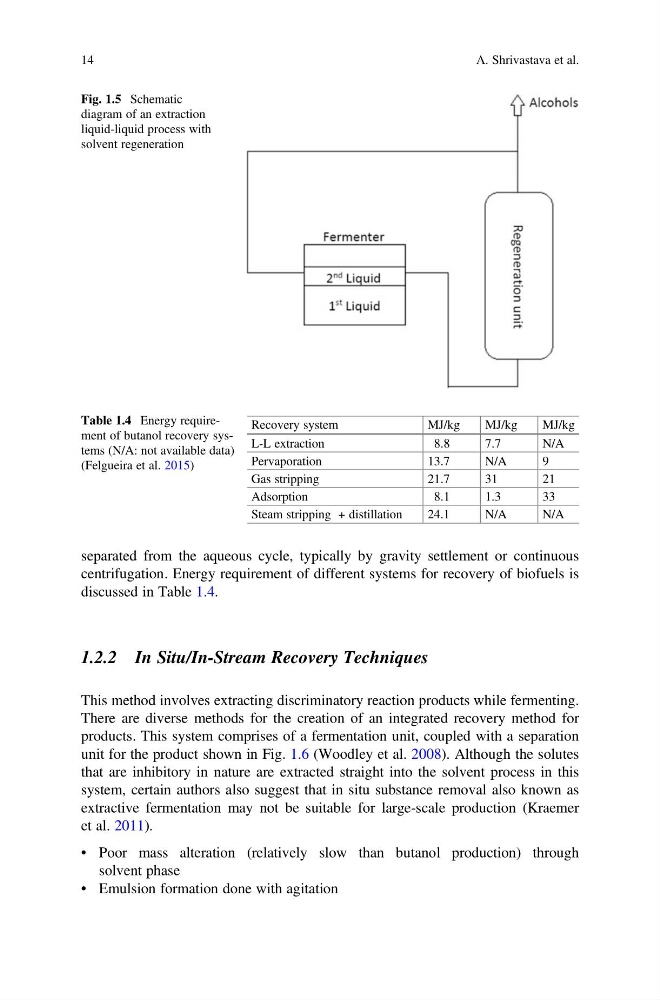
Fig. 1.5 Schematic
diagram of an extraction
liquid-liquid process with
solvent regeneration
Table 1.4 Energy requirement of butanol recovery systems (N/A: not available data)
(Felgueira et al. 2015)
Recovery system
MJ/kg
MJ/kg
MJ/kg
L-L extraction
8.8
7.7
N/A
Pervaporation
13.7
N/A
9
Gas stripping
21.7
31
21
Adsorption
8.1
1.3
33
Steam stripping + distillation
24.1
N/A
N/A
14
A. Shrivastava et al.
centrifugation. Energy requirement of different systems for recovery of biofuels is
discussed in Table 1.4.
1.2.2 In Situ/In-Stream Recovery Techniques
This method involves extracting discriminatory reaction products while fermenting.
There are diverse methods for the creation of an integrated recovery method for
products. This system comprises of a fermentation unit, coupled with a separation
unit for the product shown in Fig. 1.6 (Woodley et al. 2008). Although the solutes
that are inhibitory in nature are extracted straight into the solvent process in this
system, certain authors also suggest that in situ substance removal also known as
extractive fermentation may not be suitable for large-scale production (Kraemer
et al. 2011).
• Poor mass alteration (relatively slow than butanol production) through
solvent phase
• Emulsion formation done with agitation
Fig. 1.5 Schematic
diagram of an extraction
liquid-liquid process with
solvent regeneration
Table 1.4 Energy requirement of butanol recovery systems (N/A: not available data)
(Felgueira et al. 2015)
Recovery system
MJ/kg
MJ/kg
MJ/kg
L-L extraction
8.8
7.7
N/A
Pervaporation
13.7
N/A
9
Gas stripping
21.7
31
21
Adsorption
8.1
1.3
33
Steam stripping + distillation
24.1
N/A
N/A
14
A. Shrivastava et al.