

means of adding bicarbonate into the digester to keep the pH stable (Boe 2006;
Lahav and Morgan 2004). Otherwise there would be a sudden pH drop in the
digester. The ratio between fatty acids and total alkalinity is taken into consideration while adjusting the pH of the digester (Deublein and Steinhauser 2011).
The ratio should be typically between 0.2 and 0.6, while high pH can also result
from the production of ammonia which is mainly seen during the digestion of the
protein waste. Methanogenic organisms present in the digester are sensitive to
the levels of ammonia. Reducing the input of high protein wastes and addition of
iron oxide and clay minerals are reported to reduce the levels of ammonia
produced during the process of digestion (Clemens 2013). Sanchez et al.
(1996) have reported that iron, nickel, cobalt, copper, and zinc can be responsible for inhibition and cause the failure of the digester. Heavy metals at higher
concentration than 10À4 M are inhibitory in nature. This could be due to
replacement of metal ions bound with enzymes as prosthetic groups with these
ions, causing enzyme inactivation (Chen et al. 2017). The input waste should be
properly segregated before the digester is loaded so that any industrial wastes
containing metals as such will be separated. The level of EC should be 25–30
dS/m for better operation of the digester. Higher levels of electrical conductivity
caused due to the presence of salts can be controlled by dilution with water. The
presence of higher amounts of organic matter in the waste material being
digested in the reactor can lead to acidification decreasing methane production.
When the reactor is in the initial stages, organic loading rate should be increased
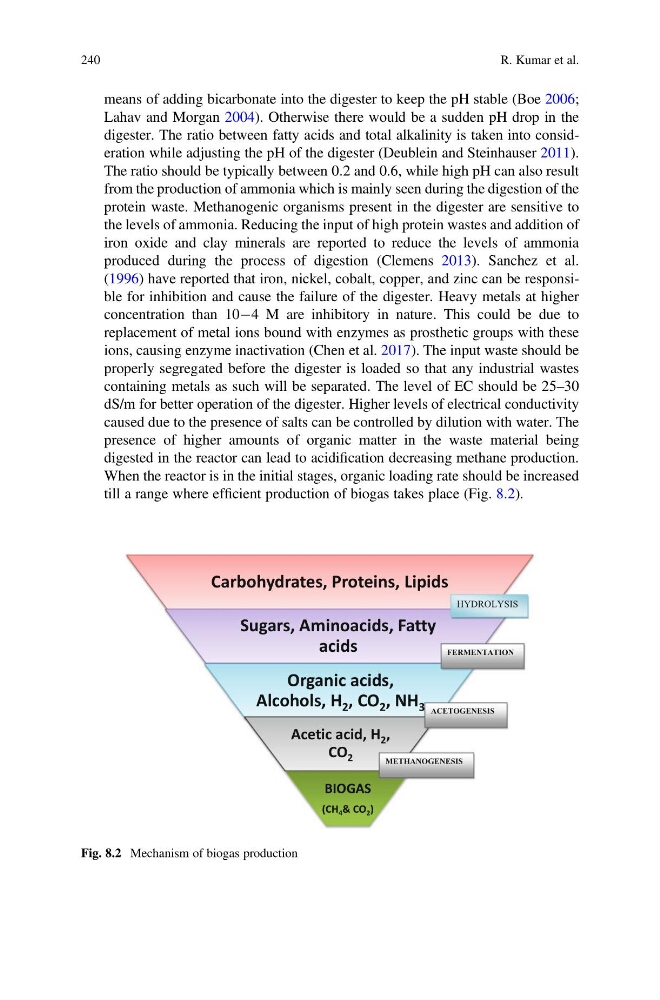
till a range where efficient production of biogas takes place (Fig. 8.2).
Carbohydrates, Proteins, Lipids
Sugars, Aminoacids, Fatty
acids
Organic acids,
Alcohols, H 2 , CO 2 , NH 3
Acetic acid, H 2 ,
CO 2
BIOGAS
(CH 4 & CO 2 )
HYDROLYSIS
FERMENTATION
ACETOGENESIS
METHANOGENESIS
Fig. 8.2 Mechanism of biogas production
240
R. Kumar et al.
Lahav and Morgan 2004). Otherwise there would be a sudden pH drop in the
digester. The ratio between fatty acids and total alkalinity is taken into consideration while adjusting the pH of the digester (Deublein and Steinhauser 2011).
The ratio should be typically between 0.2 and 0.6, while high pH can also result
from the production of ammonia which is mainly seen during the digestion of the
protein waste. Methanogenic organisms present in the digester are sensitive to
the levels of ammonia. Reducing the input of high protein wastes and addition of
iron oxide and clay minerals are reported to reduce the levels of ammonia
produced during the process of digestion (Clemens 2013). Sanchez et al.
(1996) have reported that iron, nickel, cobalt, copper, and zinc can be responsible for inhibition and cause the failure of the digester. Heavy metals at higher
concentration than 10À4 M are inhibitory in nature. This could be due to
replacement of metal ions bound with enzymes as prosthetic groups with these
ions, causing enzyme inactivation (Chen et al. 2017). The input waste should be
properly segregated before the digester is loaded so that any industrial wastes
containing metals as such will be separated. The level of EC should be 25–30
dS/m for better operation of the digester. Higher levels of electrical conductivity
caused due to the presence of salts can be controlled by dilution with water. The
presence of higher amounts of organic matter in the waste material being
digested in the reactor can lead to acidification decreasing methane production.
When the reactor is in the initial stages, organic loading rate should be increased
till a range where efficient production of biogas takes place (Fig. 8.2).
Carbohydrates, Proteins, Lipids
Sugars, Aminoacids, Fatty
acids
Organic acids,
Alcohols, H 2 , CO 2 , NH 3
Acetic acid, H 2 ,
CO 2
BIOGAS
(CH 4 & CO 2 )
HYDROLYSIS
FERMENTATION
ACETOGENESIS
METHANOGENESIS
Fig. 8.2 Mechanism of biogas production
240
R. Kumar et al.