

cultivate the algae in their own habitats rather than growing them in vitro and
introducing them to the field (Leite et al. 2013). Advantages are bioremediation
along with hydrogen production, while the disadvantages are nitrogen limitation and
pretreatment of sample (Mathews and Wang 2009). Radakovits et al. (2010) felt that
several technical needs have to be addressed before going for large-scale production
of these algae. According to Das and Veziroglu (2008), the efficiency of the process
is about 10%. Water molecule may be split by biophotolysis (Chlamydomonas
reinhardtii) generating hydrogen and oxygen from water. Marxen et al. (2005) and
Grima et al. (1999) have clearly elucidated the major challenges involved in the
production of hydrogen by algal systems which are as follows:
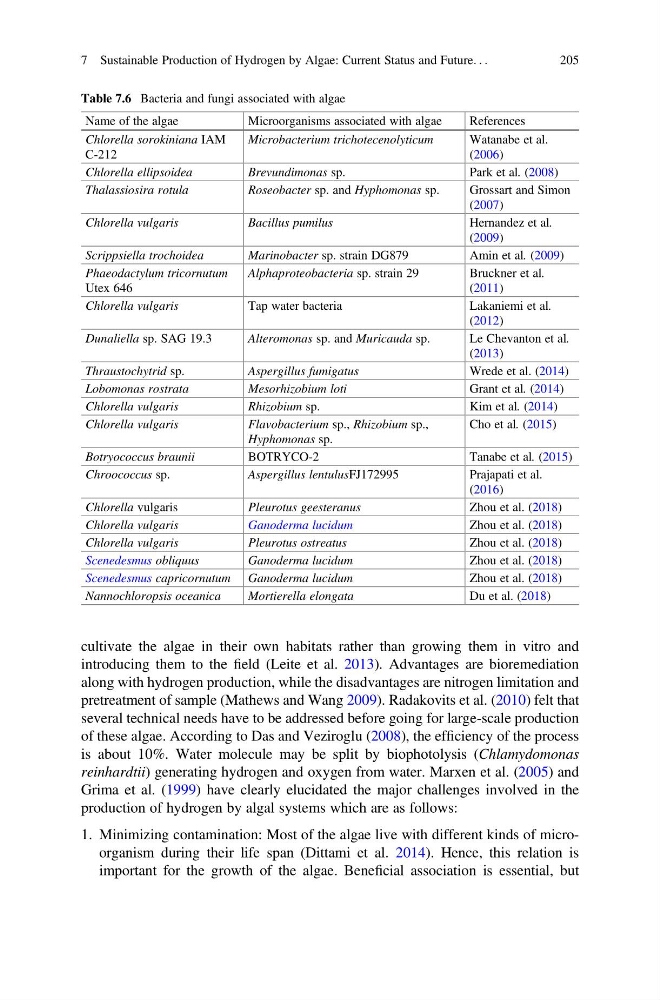
1. Minimizing contamination: Most of the algae live with different kinds of microorganism during their life span (Dittami et al. 2014). Hence, this relation is
important for the growth of the algae. Beneficial association is essential, but
Table 7.6 Bacteria and fungi associated with algae
Name of the algae
Microorganisms associated with algae
References
Chlorella sorokiniana IAM
C-212
Microbacterium trichotecenolyticum
Watanabe et al.
(2006)
Chlorella ellipsoidea
Brevundimonas sp.
Park et al. (2008)
Thalassiosira rotula
Roseobacter sp. and Hyphomonas sp.
Grossart and Simon
(2007)
Chlorella vulgaris
Bacillus pumilus
Hernandez et al.
(2009)
Scrippsiella trochoidea
Marinobacter sp. strain DG879
Amin et al. (2009)
Phaeodactylum tricornutum
Utex 646
Alphaproteobacteria sp. strain 29
Bruckner et al.
(2011)
Chlorella vulgaris
Tap water bacteria
Lakaniemi et al.
(2012)
Dunaliella sp. SAG 19.3
Alteromonas sp. and Muricauda sp.
Le Chevanton et al.
(2013)
Thraustochytrid sp.
Aspergillus fumigatus
Wrede et al. (2014)
Lobomonas rostrata
Mesorhizobium loti
Grant et al. (2014)
Chlorella vulgaris
Rhizobium sp.
Kim et al. (2014)
Chlorella vulgaris
Flavobacterium sp., Rhizobium sp.,
Hyphomonas sp.
Cho et al. (2015)
Botryococcus braunii
BOTRYCO-2
Tanabe et al. (2015)
Chroococcus sp.
Aspergillus lentulusFJ172995
Prajapati et al.
(2016)
Chlorella vulgaris
Pleurotus geesteranus
Zhou et al. (2018)
Chlorella vulgaris
Ganoderma lucidum
Zhou et al. (2018)
Chlorella vulgaris
Pleurotus ostreatus
Zhou et al. (2018)
Scenedesmus obliquus
Ganoderma lucidum
Zhou et al. (2018)
Scenedesmus capricornutum Ganoderma lucidum
Zhou et al. (2018)
Nannochloropsis oceanica
Mortierella elongata
Du et al. (2018)
7 Sustainable Production of Hydrogen by Algae: Current Status and Future. . .
205
introducing them to the field (Leite et al. 2013). Advantages are bioremediation
along with hydrogen production, while the disadvantages are nitrogen limitation and
pretreatment of sample (Mathews and Wang 2009). Radakovits et al. (2010) felt that
several technical needs have to be addressed before going for large-scale production
of these algae. According to Das and Veziroglu (2008), the efficiency of the process
is about 10%. Water molecule may be split by biophotolysis (Chlamydomonas
reinhardtii) generating hydrogen and oxygen from water. Marxen et al. (2005) and
Grima et al. (1999) have clearly elucidated the major challenges involved in the
production of hydrogen by algal systems which are as follows:
1. Minimizing contamination: Most of the algae live with different kinds of microorganism during their life span (Dittami et al. 2014). Hence, this relation is
important for the growth of the algae. Beneficial association is essential, but
Table 7.6 Bacteria and fungi associated with algae
Name of the algae
Microorganisms associated with algae
References
Chlorella sorokiniana IAM
C-212
Microbacterium trichotecenolyticum
Watanabe et al.
(2006)
Chlorella ellipsoidea
Brevundimonas sp.
Park et al. (2008)
Thalassiosira rotula
Roseobacter sp. and Hyphomonas sp.
Grossart and Simon
(2007)
Chlorella vulgaris
Bacillus pumilus
Hernandez et al.
(2009)
Scrippsiella trochoidea
Marinobacter sp. strain DG879
Amin et al. (2009)
Phaeodactylum tricornutum
Utex 646
Alphaproteobacteria sp. strain 29
Bruckner et al.
(2011)
Chlorella vulgaris
Tap water bacteria
Lakaniemi et al.
(2012)
Dunaliella sp. SAG 19.3
Alteromonas sp. and Muricauda sp.
Le Chevanton et al.
(2013)
Thraustochytrid sp.
Aspergillus fumigatus
Wrede et al. (2014)
Lobomonas rostrata
Mesorhizobium loti
Grant et al. (2014)
Chlorella vulgaris
Rhizobium sp.
Kim et al. (2014)
Chlorella vulgaris
Flavobacterium sp., Rhizobium sp.,
Hyphomonas sp.
Cho et al. (2015)
Botryococcus braunii
BOTRYCO-2
Tanabe et al. (2015)
Chroococcus sp.
Aspergillus lentulusFJ172995
Prajapati et al.
(2016)
Chlorella vulgaris
Pleurotus geesteranus
Zhou et al. (2018)
Chlorella vulgaris
Ganoderma lucidum
Zhou et al. (2018)
Chlorella vulgaris
Pleurotus ostreatus
Zhou et al. (2018)
Scenedesmus obliquus
Ganoderma lucidum
Zhou et al. (2018)
Scenedesmus capricornutum Ganoderma lucidum
Zhou et al. (2018)
Nannochloropsis oceanica
Mortierella elongata
Du et al. (2018)
7 Sustainable Production of Hydrogen by Algae: Current Status and Future. . .
205