

bioelectricity. Pradhan et al. (2017) and Raheem et al. (2018) have studied the use of
microalgae for mitigation of carbon dioxide levels and biofuel production. Shuba
and Kifle (2018) and Adeniyi et al. (2018) have opined that microalgal biofuel can be
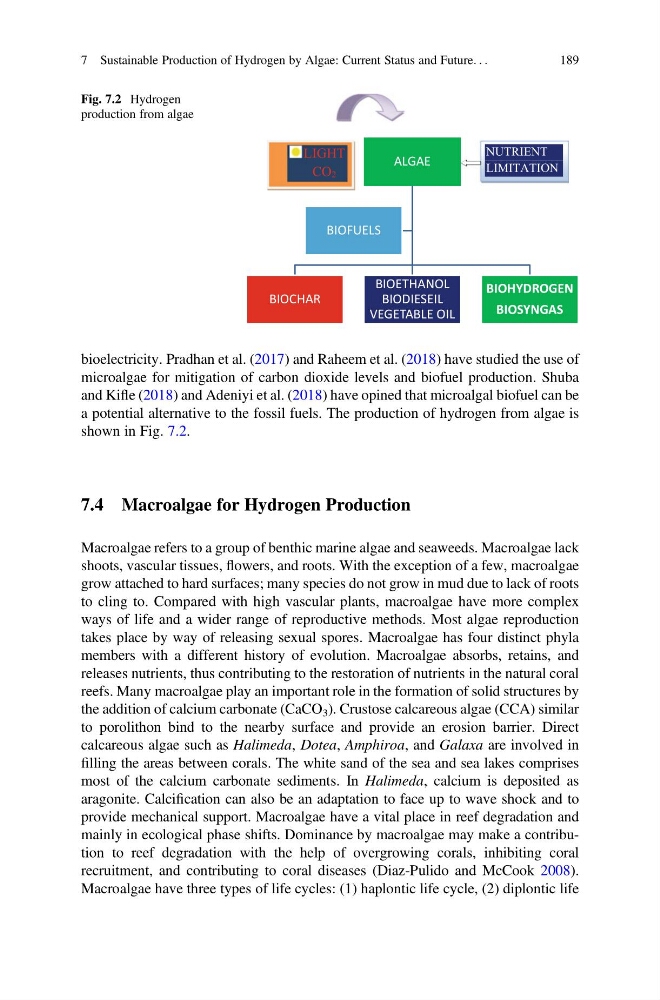
a potential alternative to the fossil fuels. The production of hydrogen from algae is
shown in Fig. 7.2.
7.4 Macroalgae for Hydrogen Production
Macroalgae refers to a group of benthic marine algae and seaweeds. Macroalgae lack
shoots, vascular tissues, flowers, and roots. With the exception of a few, macroalgae
grow attached to hard surfaces; many species do not grow in mud due to lack of roots
to cling to. Compared with high vascular plants, macroalgae have more complex
ways of life and a wider range of reproductive methods. Most algae reproduction
takes place by way of releasing sexual spores. Macroalgae has four distinct phyla
members with a different history of evolution. Macroalgae absorbs, retains, and
releases nutrients, thus contributing to the restoration of nutrients in the natural coral
reefs. Many macroalgae play an important role in the formation of solid structures by
the addition of calcium carbonate (CaCO 3 ). Crustose calcareous algae (CCA) similar
to porolithon bind to the nearby surface and provide an erosion barrier. Direct
calcareous algae such as Halimeda, Dotea, Amphiroa, and Galaxa are involved in
filling the areas between corals. The white sand of the sea and sea lakes comprises
most of the calcium carbonate sediments. In Halimeda, calcium is deposited as
aragonite. Calcification can also be an adaptation to face up to wave shock and to
provide mechanical support. Macroalgae have a vital place in reef degradation and
mainly in ecological phase shifts. Dominance by macroalgae may make a contribution to reef degradation with the help of overgrowing corals, inhibiting coral
recruitment, and contributing to coral diseases (Diaz-Pulido and McCook 2008).
Macroalgae have three types of life cycles: (1) haplontic life cycle, (2) diplontic life
ALGAE
BIOCHAR
BIOETHANOL
BIODIESEIL
VEGETABLE OIL
BIOHYDROGEN
BIOSYNGAS
BIOFUELS
NUTRIENT
LIMITATION
LIGHT
CO2
Fig. 7.2 Hydrogen
production from algae
7 Sustainable Production of Hydrogen by Algae: Current Status and Future. . .
189
microalgae for mitigation of carbon dioxide levels and biofuel production. Shuba
and Kifle (2018) and Adeniyi et al. (2018) have opined that microalgal biofuel can be
a potential alternative to the fossil fuels. The production of hydrogen from algae is
shown in Fig. 7.2.
7.4 Macroalgae for Hydrogen Production
Macroalgae refers to a group of benthic marine algae and seaweeds. Macroalgae lack
shoots, vascular tissues, flowers, and roots. With the exception of a few, macroalgae
grow attached to hard surfaces; many species do not grow in mud due to lack of roots
to cling to. Compared with high vascular plants, macroalgae have more complex
ways of life and a wider range of reproductive methods. Most algae reproduction
takes place by way of releasing sexual spores. Macroalgae has four distinct phyla
members with a different history of evolution. Macroalgae absorbs, retains, and
releases nutrients, thus contributing to the restoration of nutrients in the natural coral
reefs. Many macroalgae play an important role in the formation of solid structures by
the addition of calcium carbonate (CaCO 3 ). Crustose calcareous algae (CCA) similar
to porolithon bind to the nearby surface and provide an erosion barrier. Direct
calcareous algae such as Halimeda, Dotea, Amphiroa, and Galaxa are involved in
filling the areas between corals. The white sand of the sea and sea lakes comprises
most of the calcium carbonate sediments. In Halimeda, calcium is deposited as
aragonite. Calcification can also be an adaptation to face up to wave shock and to
provide mechanical support. Macroalgae have a vital place in reef degradation and
mainly in ecological phase shifts. Dominance by macroalgae may make a contribution to reef degradation with the help of overgrowing corals, inhibiting coral
recruitment, and contributing to coral diseases (Diaz-Pulido and McCook 2008).
Macroalgae have three types of life cycles: (1) haplontic life cycle, (2) diplontic life
ALGAE
BIOCHAR
BIOETHANOL
BIODIESEIL
VEGETABLE OIL
BIOHYDROGEN
BIOSYNGAS
BIOFUELS
NUTRIENT
LIMITATION
LIGHT
CO2
Fig. 7.2 Hydrogen
production from algae
7 Sustainable Production of Hydrogen by Algae: Current Status and Future. . .
189