

1.1.4 Biofuel Development Across the Globe
Internationally, the execution of a biofuels markets soon flickered a food contrasted
with fuel argument among critics. Whereas the supporters see biofuels as part of a
potential renewable and clean oil, some protested that fuel would not come from
edible plants. However, the demand for biofuels remained steady. The world market
for ethanol and biodiesel production and wholesale prices was sized at over USD
136 billion in 2016. The demand is projected to rise to nearly US $154 billion by
2024. India has a rising ethanol market which is further mature than the biodiesel
industry. Ethanol Blended Petrol (EBP) program was launched in India in 2003,
which approved 5% blending of ethanol with gasoline. In India biodiesel production
is focused primarily on non-edible sources, since there are less amounts of edible
sources. Such origins are not edible: jatropha, mahua, karanja, neem, etc. Global
energy demand is projected to increase by 28% by 2040 compared to 2015,
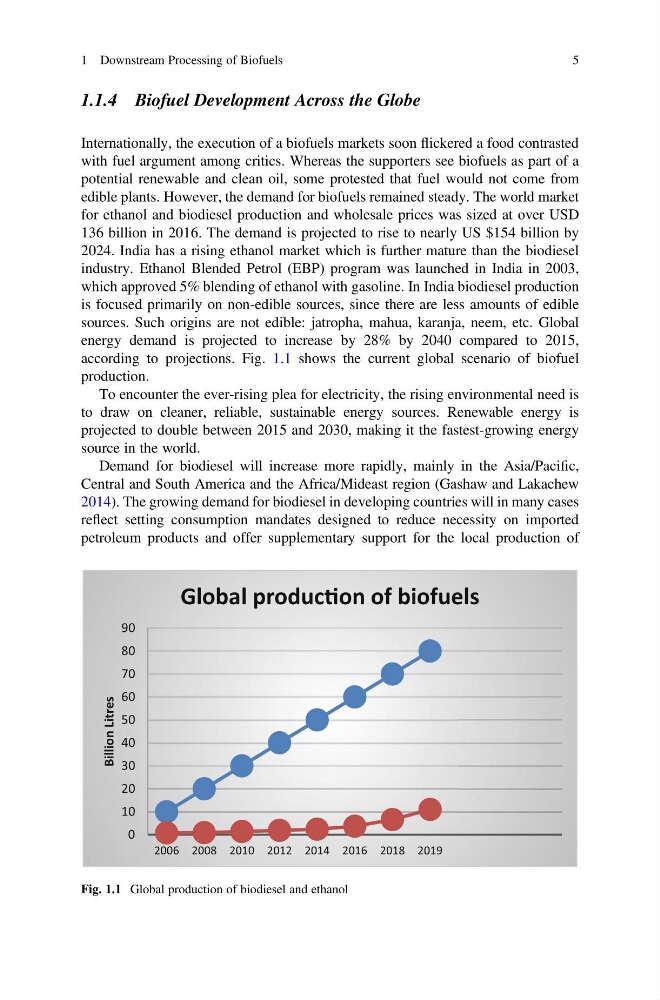
according to projections. Fig. 1.1 shows the current global scenario of biofuel
production.
To encounter the ever-rising plea for electricity, the rising environmental need is
to draw on cleaner, reliable, sustainable energy sources. Renewable energy is
projected to double between 2015 and 2030, making it the fastest-growing energy
source in the world.
Demand for biodiesel will increase more rapidly, mainly in the Asia/Pacific,
Central and South America and the Africa/Mideast region (Gashaw and Lakachew
2014). The growing demand for biodiesel in developing countries will in many cases
reflect setting consumption mandates designed to reduce necessity on imported
petroleum products and offer supplementary support for the local production of
0
10
20
30
40
50
60
70
80
90
2006 2008 2010 2012 2014 2016 2018 2019
Billion Litres
Global producƟon of biofuels
Fig. 1.1 Global production of biodiesel and ethanol
1 Downstream Processing of Biofuels
5
Internationally, the execution of a biofuels markets soon flickered a food contrasted
with fuel argument among critics. Whereas the supporters see biofuels as part of a
potential renewable and clean oil, some protested that fuel would not come from
edible plants. However, the demand for biofuels remained steady. The world market
for ethanol and biodiesel production and wholesale prices was sized at over USD
136 billion in 2016. The demand is projected to rise to nearly US $154 billion by
2024. India has a rising ethanol market which is further mature than the biodiesel
industry. Ethanol Blended Petrol (EBP) program was launched in India in 2003,
which approved 5% blending of ethanol with gasoline. In India biodiesel production
is focused primarily on non-edible sources, since there are less amounts of edible
sources. Such origins are not edible: jatropha, mahua, karanja, neem, etc. Global
energy demand is projected to increase by 28% by 2040 compared to 2015,
according to projections. Fig. 1.1 shows the current global scenario of biofuel
production.
To encounter the ever-rising plea for electricity, the rising environmental need is
to draw on cleaner, reliable, sustainable energy sources. Renewable energy is
projected to double between 2015 and 2030, making it the fastest-growing energy
source in the world.
Demand for biodiesel will increase more rapidly, mainly in the Asia/Pacific,
Central and South America and the Africa/Mideast region (Gashaw and Lakachew
2014). The growing demand for biodiesel in developing countries will in many cases
reflect setting consumption mandates designed to reduce necessity on imported
petroleum products and offer supplementary support for the local production of
0
10
20
30
40
50
60
70
80
90
2006 2008 2010 2012 2014 2016 2018 2019
Billion Litres
Global producƟon of biofuels
Fig. 1.1 Global production of biodiesel and ethanol
1 Downstream Processing of Biofuels
5