

recovery of chemicals. On the other hand, lignin can also be separated and used as
high-value feedstock to overcome the cost of pretreatment (Cherubini 2010).
By taking into consideration this aspect, combined pretreatment makes digestibility of LC biomass better, but also helps in recovering hemicellulose and lignin for
the production of high-value products.
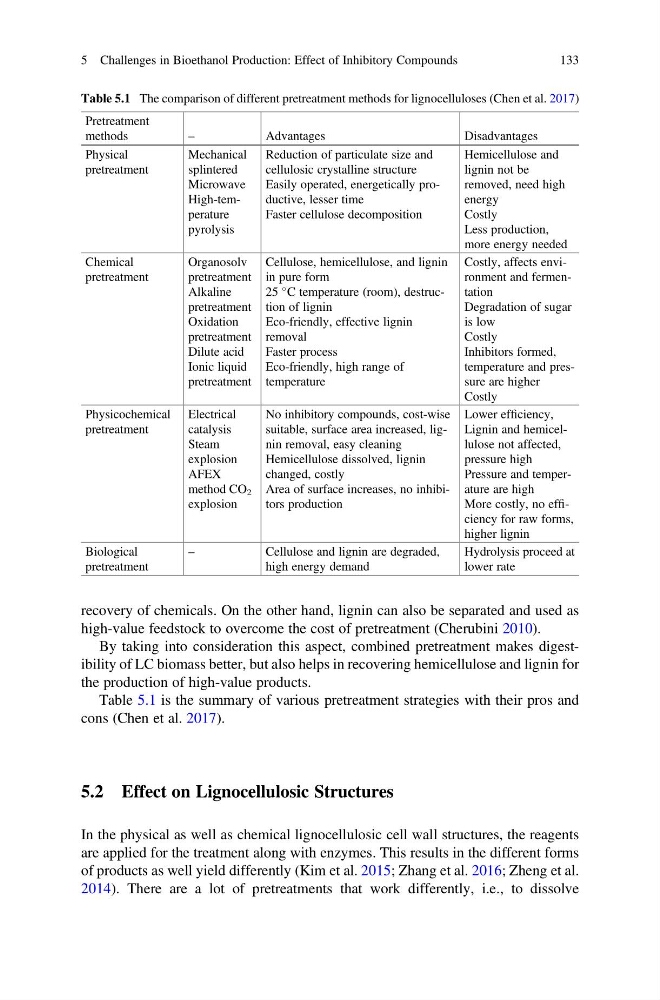
Table 5.1 is the summary of various pretreatment strategies with their pros and
cons (Chen et al. 2017).
5.2 Effect on Lignocellulosic Structures
In the physical as well as chemical lignocellulosic cell wall structures, the reagents
are applied for the treatment along with enzymes. This results in the different forms
of products as well yield differently (Kim et al. 2015; Zhang et al. 2016; Zheng et al.
2014). There are a lot of pretreatments that work differently, i.e., to dissolve
Table 5.1 The comparison of different pretreatment methods for lignocelluloses (Chen et al. 2017)
Pretreatment
methods
–
Advantages
Disadvantages
Physical
pretreatment
Mechanical
splintered
Microwave
High-temperature
pyrolysis
Reduction of particulate size and
cellulosic crystalline structure
Easily operated, energetically productive, lesser time
Faster cellulose decomposition
Hemicellulose and
lignin not be
removed, need high
energy
Costly
Less production,
more energy needed
Chemical
pretreatment
Organosolv
pretreatment
Alkaline
pretreatment
Oxidation
pretreatment
Dilute acid
Ionic liquid
pretreatment
Cellulose, hemicellulose, and lignin
in pure form
25
C temperature (room), destruction of lignin
Eco-friendly, effective lignin
removal
Faster process
Eco-friendly, high range of
temperature
Costly, affects environment and fermentation
Degradation of sugar
is low
Costly
Inhibitors formed,
temperature and pressure are higher
Costly
Physicochemical
pretreatment
Electrical
catalysis
Steam
explosion
AFEX
method CO 2
explosion
No inhibitory compounds, cost-wise
suitable, surface area increased, lignin removal, easy cleaning
Hemicellulose dissolved, lignin
changed, costly
Area of surface increases, no inhibitors production
Lower efficiency,
Lignin and hemicellulose not affected,
pressure high
Pressure and temperature are high
More costly, no efficiency for raw forms,
higher lignin
Biological
pretreatment
–
Cellulose and lignin are degraded,
high energy demand
Hydrolysis proceed at
lower rate
5 Challenges in Bioethanol Production: Effect of Inhibitory Compounds
133
high-value feedstock to overcome the cost of pretreatment (Cherubini 2010).
By taking into consideration this aspect, combined pretreatment makes digestibility of LC biomass better, but also helps in recovering hemicellulose and lignin for
the production of high-value products.
Table 5.1 is the summary of various pretreatment strategies with their pros and
cons (Chen et al. 2017).
5.2 Effect on Lignocellulosic Structures
In the physical as well as chemical lignocellulosic cell wall structures, the reagents
are applied for the treatment along with enzymes. This results in the different forms
of products as well yield differently (Kim et al. 2015; Zhang et al. 2016; Zheng et al.
2014). There are a lot of pretreatments that work differently, i.e., to dissolve
Table 5.1 The comparison of different pretreatment methods for lignocelluloses (Chen et al. 2017)
Pretreatment
methods
–
Advantages
Disadvantages
Physical
pretreatment
Mechanical
splintered
Microwave
High-temperature
pyrolysis
Reduction of particulate size and
cellulosic crystalline structure
Easily operated, energetically productive, lesser time
Faster cellulose decomposition
Hemicellulose and
lignin not be
removed, need high
energy
Costly
Less production,
more energy needed
Chemical
pretreatment
Organosolv
pretreatment
Alkaline
pretreatment
Oxidation
pretreatment
Dilute acid
Ionic liquid
pretreatment
Cellulose, hemicellulose, and lignin
in pure form
25
C temperature (room), destruction of lignin
Eco-friendly, effective lignin
removal
Faster process
Eco-friendly, high range of
temperature
Costly, affects environment and fermentation
Degradation of sugar
is low
Costly
Inhibitors formed,
temperature and pressure are higher
Costly
Physicochemical
pretreatment
Electrical
catalysis
Steam
explosion
AFEX
method CO 2
explosion
No inhibitory compounds, cost-wise
suitable, surface area increased, lignin removal, easy cleaning
Hemicellulose dissolved, lignin
changed, costly
Area of surface increases, no inhibitors production
Lower efficiency,
Lignin and hemicellulose not affected,
pressure high
Pressure and temperature are high
More costly, no efficiency for raw forms,
higher lignin
Biological
pretreatment
–
Cellulose and lignin are degraded,
high energy demand
Hydrolysis proceed at
lower rate
5 Challenges in Bioethanol Production: Effect of Inhibitory Compounds
133