

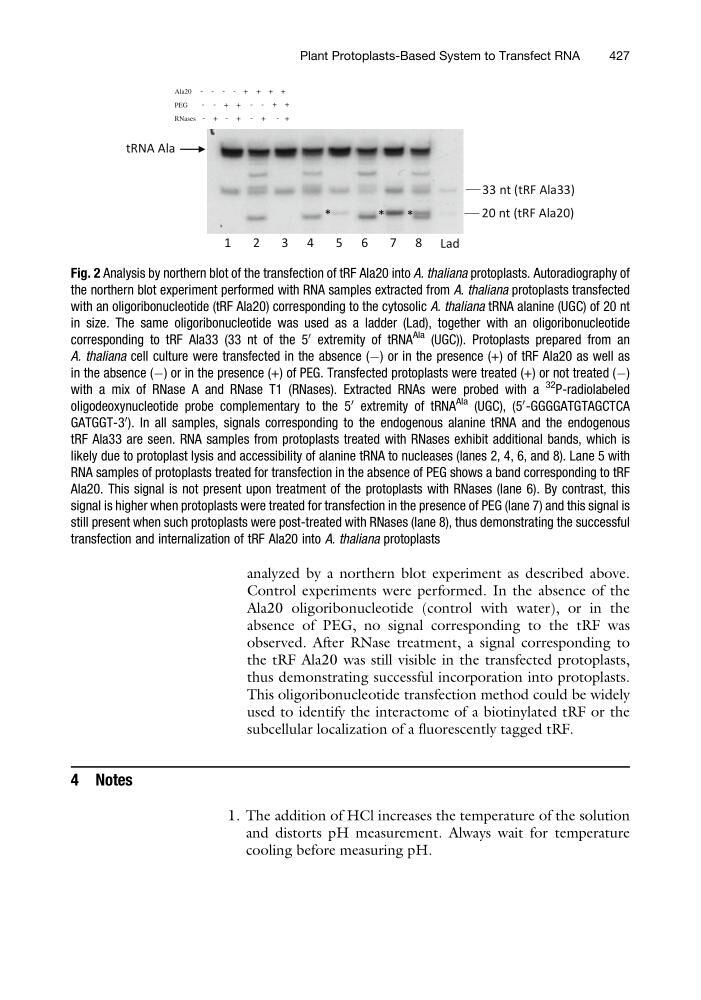
analyzed by a northern blot experiment as described above.
Control experiments were performed. In the absence of the
Ala20 oligoribonucleotide (control with water), or in the
absence of PEG, no signal corresponding to the tRF was
observed. After RNase treatment, a signal corresponding to
the tRF Ala20 was still visible in the transfected protoplasts,
thus demonstrating successful incorporation into protoplasts.
This oligoribonucleotide transfection method could be widely
used to identify the interactome of a biotinylated tRF or the
subcellular localization of a fluorescently tagged tRF.
4 Notes
1. The addition of HCl increases the temperature of the solution
and distorts pH measurement. Always wait for temperature
cooling before measuring pH.
33 nt (tRF Ala33)
20 nt (tRF Ala20)
tRNA Ala
*
*
*
1
2
3 4
5 6
7 8 Lad
Ala20
PEG
RNases
-
-
-
-
-
-
-
- - -
- -
+
+
+
+
+
+
+ +
+
+
+
+
Fig. 2 Analysis by northern blot of the transfection of tRF Ala20 into A. thaliana protoplasts. Autoradiography of
the northern blot experiment performed with RNA samples extracted from A. thaliana protoplasts transfected
with an oligoribonucleotide (tRF Ala20) corresponding to the cytosolic A. thaliana tRNA alanine (UGC) of 20 nt
in size. The same oligoribonucleotide was used as a ladder (Lad), together with an oligoribonucleotide
corresponding to tRF Ala33 (33 nt of the 5
0 extremity of tRNA
Ala (UGC)). Protoplasts prepared from an
A. thaliana cell culture were transfected in the absence (À) or in the presence (+) of tRF Ala20 as well as
in the absence (À) or in the presence (+) of PEG. Transfected protoplasts were treated (+) or not treated (À)
with a mix of RNase A and RNase T1 (RNases). Extracted RNAs were probed with a
32
P-radiolabeled
oligodeoxynucleotide probe complementary to the 5
0 extremity of tRNA
Ala (UGC), (5
0 -GGGGATGTAGCTCA
GATGGT-3
0 ). In all samples, signals corresponding to the endogenous alanine tRNA and the endogenous
tRF Ala33 are seen. RNA samples from protoplasts treated with RNases exhibit additional bands, which is
likely due to protoplast lysis and accessibility of alanine tRNA to nucleases (lanes 2, 4, 6, and 8). Lane 5 with
RNA samples of protoplasts treated for transfection in the absence of PEG shows a band corresponding to tRF
Ala20. This signal is not present upon treatment of the protoplasts with RNases (lane 6). By contrast, this
signal is higher when protoplasts were treated for transfection in the presence of PEG (lane 7) and this signal is
still present when such protoplasts were post-treated with RNases (lane 8), thus demonstrating the successful
transfection and internalization of tRF Ala20 into A. thaliana protoplasts
Plant Protoplasts-Based System to Transfect RNA
427
Control experiments were performed. In the absence of the
Ala20 oligoribonucleotide (control with water), or in the
absence of PEG, no signal corresponding to the tRF was
observed. After RNase treatment, a signal corresponding to
the tRF Ala20 was still visible in the transfected protoplasts,
thus demonstrating successful incorporation into protoplasts.
This oligoribonucleotide transfection method could be widely
used to identify the interactome of a biotinylated tRF or the
subcellular localization of a fluorescently tagged tRF.
4 Notes
1. The addition of HCl increases the temperature of the solution
and distorts pH measurement. Always wait for temperature
cooling before measuring pH.
33 nt (tRF Ala33)
20 nt (tRF Ala20)
tRNA Ala
*
*
*
1
2
3 4
5 6
7 8 Lad
Ala20
PEG
RNases
-
-
-
-
-
-
-
- - -
- -
+
+
+
+
+
+
+ +
+
+
+
+
Fig. 2 Analysis by northern blot of the transfection of tRF Ala20 into A. thaliana protoplasts. Autoradiography of
the northern blot experiment performed with RNA samples extracted from A. thaliana protoplasts transfected
with an oligoribonucleotide (tRF Ala20) corresponding to the cytosolic A. thaliana tRNA alanine (UGC) of 20 nt
in size. The same oligoribonucleotide was used as a ladder (Lad), together with an oligoribonucleotide
corresponding to tRF Ala33 (33 nt of the 5
0 extremity of tRNA
Ala (UGC)). Protoplasts prepared from an
A. thaliana cell culture were transfected in the absence (À) or in the presence (+) of tRF Ala20 as well as
in the absence (À) or in the presence (+) of PEG. Transfected protoplasts were treated (+) or not treated (À)
with a mix of RNase A and RNase T1 (RNases). Extracted RNAs were probed with a
32
P-radiolabeled
oligodeoxynucleotide probe complementary to the 5
0 extremity of tRNA
Ala (UGC), (5
0 -GGGGATGTAGCTCA
GATGGT-3
0 ). In all samples, signals corresponding to the endogenous alanine tRNA and the endogenous
tRF Ala33 are seen. RNA samples from protoplasts treated with RNases exhibit additional bands, which is
likely due to protoplast lysis and accessibility of alanine tRNA to nucleases (lanes 2, 4, 6, and 8). Lane 5 with
RNA samples of protoplasts treated for transfection in the absence of PEG shows a band corresponding to tRF
Ala20. This signal is not present upon treatment of the protoplasts with RNases (lane 6). By contrast, this
signal is higher when protoplasts were treated for transfection in the presence of PEG (lane 7) and this signal is
still present when such protoplasts were post-treated with RNases (lane 8), thus demonstrating the successful
transfection and internalization of tRF Ala20 into A. thaliana protoplasts
Plant Protoplasts-Based System to Transfect RNA
427