

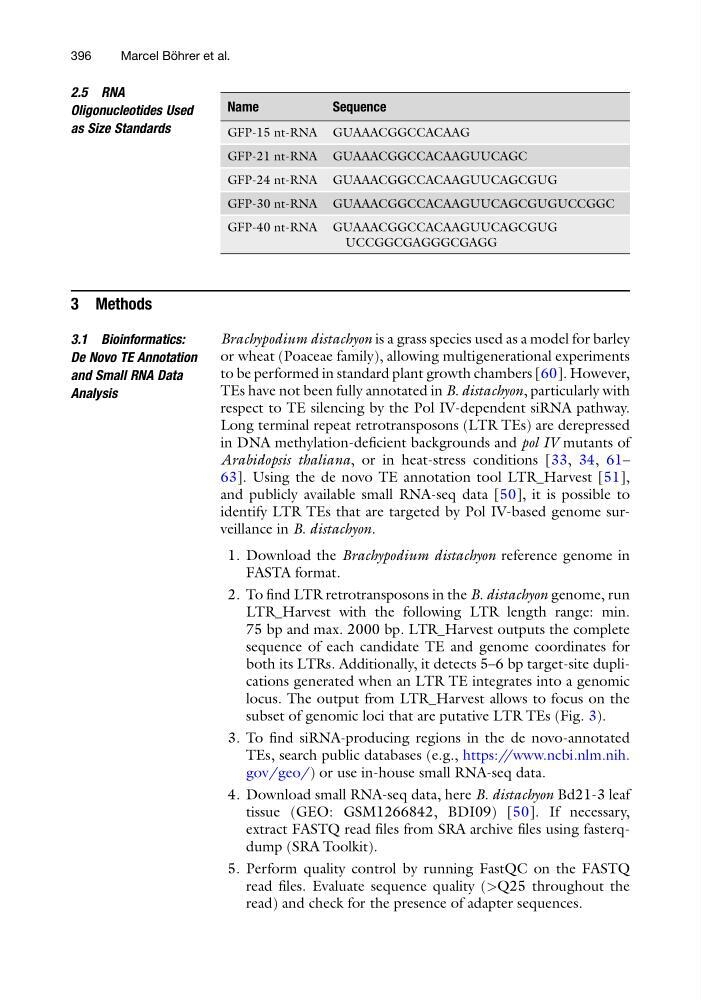
2.5 RNA
Oligonucleotides Used
as Size Standards
Name
Sequence
GFP-15 nt-RNA GUAAACGGCCACAAG
GFP-21 nt-RNA GUAAACGGCCACAAGUUCAGC
GFP-24 nt-RNA GUAAACGGCCACAAGUUCAGCGUG
GFP-30 nt-RNA GUAAACGGCCACAAGUUCAGCGUGUCCGGC
GFP-40 nt-RNA GUAAACGGCCACAAGUUCAGCGUG
UCCGGCGAGGGCGAGG
3 Methods
3.1 Bioinformatics:
De Novo TE Annotation
and Small RNA Data
Analysis
Brachypodium distachyon is a grass species used as a model for barley
or wheat (Poaceae family), allowing multigenerational experiments
to be performed in standard plant growth chambers [60]. However,
TEs have not been fully annotated in B. distachyon, particularly with
respect to TE silencing by the Pol IV-dependent siRNA pathway.
Long terminal repeat retrotransposons (LTR TEs) are derepressed
in DNA methylation-deficient backgrounds and pol IV mutants of
Arabidopsis thaliana, or in heat-stress conditions [33, 34, 61–
63]. Using the de novo TE annotation tool LTR_Harvest [51],
and publicly available small RNA-seq data [50], it is possible to
identify LTR TEs that are targeted by Pol IV-based genome surveillance in B. distachyon.
1. Download the Brachypodium distachyon reference genome in
FASTA format.
2. To find LTR retrotransposons in the B. distachyon genome, run
LTR_Harvest with the following LTR length range: min.
75 bp and max. 2000 bp. LTR_Harvest outputs the complete
sequence of each candidate TE and genome coordinates for
both its LTRs. Additionally, it detects 5–6 bp target-site duplications generated when an LTR TE integrates into a genomic
locus. The output from LTR_Harvest allows to focus on the
subset of genomic loci that are putative LTR TEs (Fig. 3).
3. To find siRNA-producing regions in the de novo-annotated
TEs, search public databases (e.g., https://www.ncbi.nlm.nih.
gov/geo/) or use in-house small RNA-seq data.
4. Download small RNA-seq data, here B. distachyon Bd21-3 leaf
tissue (GEO: GSM1266842, BDI09) [50]. If necessary,
extract FASTQ read files from SRA archive files using fasterqdump (SRA Toolkit).
5. Perform quality control by running FastQC on the FASTQ
read files. Evaluate sequence quality (>Q25 throughout the
read) and check for the presence of adapter sequences.
396
Marcel Bo ¨ hrer et al.
Oligonucleotides Used
as Size Standards
Name
Sequence
GFP-15 nt-RNA GUAAACGGCCACAAG
GFP-21 nt-RNA GUAAACGGCCACAAGUUCAGC
GFP-24 nt-RNA GUAAACGGCCACAAGUUCAGCGUG
GFP-30 nt-RNA GUAAACGGCCACAAGUUCAGCGUGUCCGGC
GFP-40 nt-RNA GUAAACGGCCACAAGUUCAGCGUG
UCCGGCGAGGGCGAGG
3 Methods
3.1 Bioinformatics:
De Novo TE Annotation
and Small RNA Data
Analysis
Brachypodium distachyon is a grass species used as a model for barley
or wheat (Poaceae family), allowing multigenerational experiments
to be performed in standard plant growth chambers [60]. However,
TEs have not been fully annotated in B. distachyon, particularly with
respect to TE silencing by the Pol IV-dependent siRNA pathway.
Long terminal repeat retrotransposons (LTR TEs) are derepressed
in DNA methylation-deficient backgrounds and pol IV mutants of
Arabidopsis thaliana, or in heat-stress conditions [33, 34, 61–
63]. Using the de novo TE annotation tool LTR_Harvest [51],
and publicly available small RNA-seq data [50], it is possible to
identify LTR TEs that are targeted by Pol IV-based genome surveillance in B. distachyon.
1. Download the Brachypodium distachyon reference genome in
FASTA format.
2. To find LTR retrotransposons in the B. distachyon genome, run
LTR_Harvest with the following LTR length range: min.
75 bp and max. 2000 bp. LTR_Harvest outputs the complete
sequence of each candidate TE and genome coordinates for
both its LTRs. Additionally, it detects 5–6 bp target-site duplications generated when an LTR TE integrates into a genomic
locus. The output from LTR_Harvest allows to focus on the
subset of genomic loci that are putative LTR TEs (Fig. 3).
3. To find siRNA-producing regions in the de novo-annotated
TEs, search public databases (e.g., https://www.ncbi.nlm.nih.
gov/geo/) or use in-house small RNA-seq data.
4. Download small RNA-seq data, here B. distachyon Bd21-3 leaf
tissue (GEO: GSM1266842, BDI09) [50]. If necessary,
extract FASTQ read files from SRA archive files using fasterqdump (SRA Toolkit).
5. Perform quality control by running FastQC on the FASTQ
read files. Evaluate sequence quality (>Q25 throughout the
read) and check for the presence of adapter sequences.
396
Marcel Bo ¨ hrer et al.