

curating genes, TEs, inverted repeats, and other complex features
of the genome [45].
Routine application of deep small RNA-seq began around
2006, when 454 and Illumina sequencing became widely available,
more affordable, and increasingly performant [46]. An advantage
of small RNA-seq is that prior knowledge of miRNA/siRNA source
loci, biogenesis pathways, and downstream effector systems is not
obligatory to investigate RNA silencing in an organism [45]. However, small RNA northern blotting remains a key method in this
field, because (1) validation of small RNA-seq is recommended to
control for biases in library preparation, (2) blotting is less expensive than small RNA-seq when a large panel of genotypes or conditions are being screened, (3) blotting is significantly faster, and
(4) advanced bioinformatics skills are not needed to interpret
northern blot results.
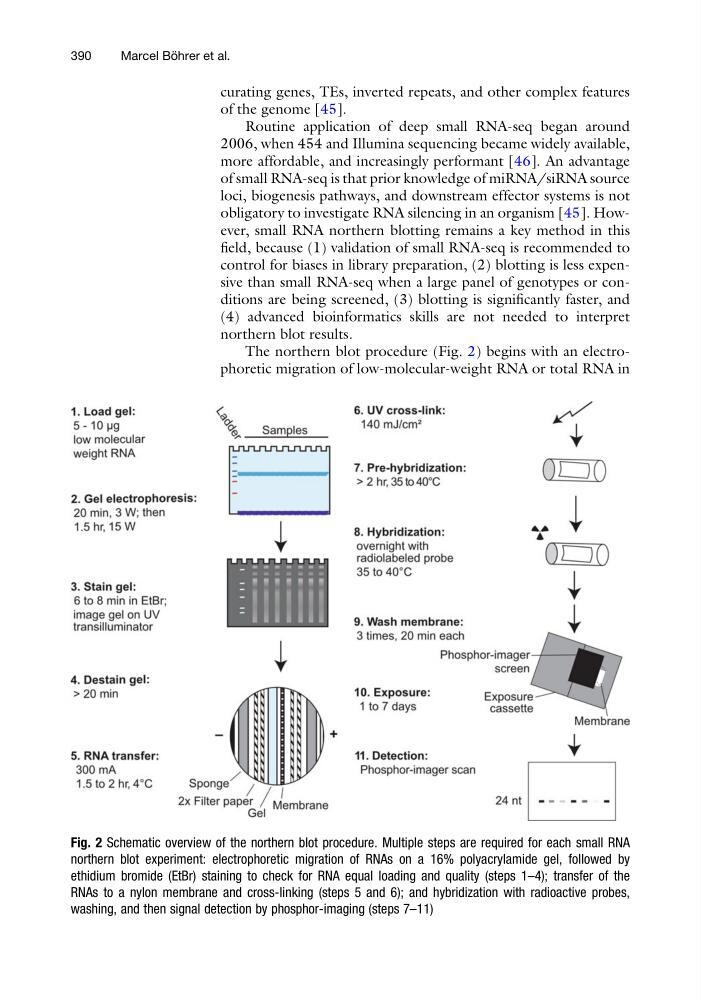
The northern blot procedure (Fig. 2) begins with an electrophoretic migration of low-molecular-weight RNA or total RNA in
Fig. 2 Schematic overview of the northern blot procedure. Multiple steps are required for each small RNA
northern blot experiment: electrophoretic migration of RNAs on a 16% polyacrylamide gel, followed by
ethidium bromide (EtBr) staining to check for RNA equal loading and quality (steps 1–4); transfer of the
RNAs to a nylon membrane and cross-linking (steps 5 and 6); and hybridization with radioactive probes,
washing, and then signal detection by phosphor-imaging (steps 7–11)
390
Marcel Bo ¨ hrer et al.
of the genome [45].
Routine application of deep small RNA-seq began around
2006, when 454 and Illumina sequencing became widely available,
more affordable, and increasingly performant [46]. An advantage
of small RNA-seq is that prior knowledge of miRNA/siRNA source
loci, biogenesis pathways, and downstream effector systems is not
obligatory to investigate RNA silencing in an organism [45]. However, small RNA northern blotting remains a key method in this
field, because (1) validation of small RNA-seq is recommended to
control for biases in library preparation, (2) blotting is less expensive than small RNA-seq when a large panel of genotypes or conditions are being screened, (3) blotting is significantly faster, and
(4) advanced bioinformatics skills are not needed to interpret
northern blot results.
The northern blot procedure (Fig. 2) begins with an electrophoretic migration of low-molecular-weight RNA or total RNA in
Fig. 2 Schematic overview of the northern blot procedure. Multiple steps are required for each small RNA
northern blot experiment: electrophoretic migration of RNAs on a 16% polyacrylamide gel, followed by
ethidium bromide (EtBr) staining to check for RNA equal loading and quality (steps 1–4); transfer of the
RNAs to a nylon membrane and cross-linking (steps 5 and 6); and hybridization with radioactive probes,
washing, and then signal detection by phosphor-imaging (steps 7–11)
390
Marcel Bo ¨ hrer et al.