

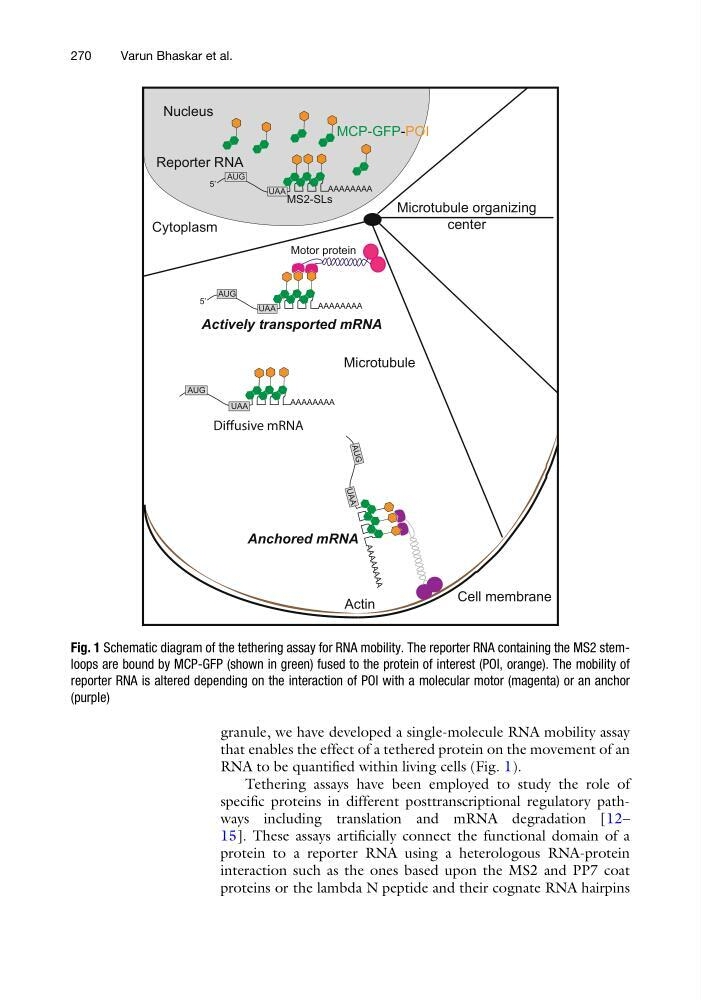
granule, we have developed a single-molecule RNA mobility assay
that enables the effect of a tethered protein on the movement of an
RNA to be quantified within living cells (Fig. 1).
Tethering assays have been employed to study the role of
specific proteins in different posttranscriptional regulatory pathways including translation and mRNA degradation [12–
15]. These assays artificially connect the functional domain of a
protein to a reporter RNA using a heterologous RNA-protein
interaction such as the ones based upon the MS2 and PP7 coat
proteins or the lambda N peptide and their cognate RNA hairpins
AAAAAAAA
5’
UAA
AUG
AAAAAAAA
5’
AUG
UAA
Nucleus
Cytoplasm
Cell membrane
Microtubule organizing
center
Actin
MS2-SLs
Reporter RNA
MCP-GFP-POI
Motor protein
A
A
A
A
A
A
A
A
U
A
A A
U
G
AAAAAAAA
UAA
AUG
Microtubule
Anchored mRNA
Actively transported mRNA
Fig. 1 Schematic diagram of the tethering assay for RNA mobility. The reporter RNA containing the MS2 stemloops are bound by MCP-GFP (shown in green) fused to the protein of interest (POI, orange). The mobility of
reporter RNA is altered depending on the interaction of POI with a molecular motor (magenta) or an anchor
(purple)
270
Varun Bhaskar et al.
that enables the effect of a tethered protein on the movement of an
RNA to be quantified within living cells (Fig. 1).
Tethering assays have been employed to study the role of
specific proteins in different posttranscriptional regulatory pathways including translation and mRNA degradation [12–
15]. These assays artificially connect the functional domain of a
protein to a reporter RNA using a heterologous RNA-protein
interaction such as the ones based upon the MS2 and PP7 coat
proteins or the lambda N peptide and their cognate RNA hairpins
AAAAAAAA
5’
UAA
AUG
AAAAAAAA
5’
AUG
UAA
Nucleus
Cytoplasm
Cell membrane
Microtubule organizing
center
Actin
MS2-SLs
Reporter RNA
MCP-GFP-POI
Motor protein
A
A
A
A
A
A
A
A
U
A
A A
U
G
AAAAAAAA
UAA
AUG
Microtubule
Anchored mRNA
Actively transported mRNA
Fig. 1 Schematic diagram of the tethering assay for RNA mobility. The reporter RNA containing the MS2 stemloops are bound by MCP-GFP (shown in green) fused to the protein of interest (POI, orange). The mobility of
reporter RNA is altered depending on the interaction of POI with a molecular motor (magenta) or an anchor
(purple)
270
Varun Bhaskar et al.