

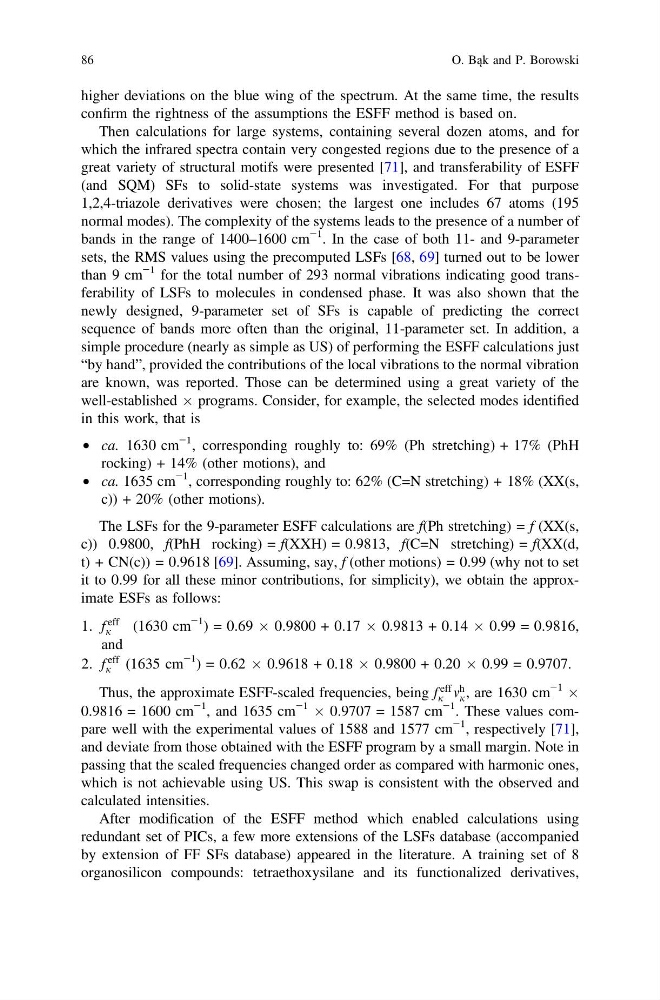
higher deviations on the blue wing of the spectrum. At the same time, the results
confirm the rightness of the assumptions the ESFF method is based on.
Then calculations for large systems, containing several dozen atoms, and for
which the infrared spectra contain very congested regions due to the presence of a
great variety of structural motifs were presented [71], and transferability of ESFF
(and SQM) SFs to solid-state systems was investigated. For that purpose
1,2,4-triazole derivatives were chosen; the largest one includes 67 atoms (195
normal modes). The complexity of the systems leads to the presence of a number of
bands in the range of 1400–1600 cm
−1 . In the case of both 11- and 9-parameter
sets, the RMS values using the precomputed LSFs [68, 69] turned out to be lower
than 9 cm
−1 for the total number of 293 normal vibrations indicating good transferability of LSFs to molecules in condensed phase. It was also shown that the
newly designed, 9-parameter set of SFs is capable of predicting the correct
sequence of bands more often than the original, 11-parameter set. In addition, a
simple procedure (nearly as simple as US) of performing the ESFF calculations just
“by hand”, provided the contributions of the local vibrations to the normal vibration
are known, was reported. Those can be determined using a great variety of the
well-established  programs. Consider, for example, the selected modes identified
in this work, that is
• ca. 1630 cm
−1 , corresponding roughly to: 69% (Ph stretching) + 17% (PhH
rocking) + 14% (other motions), and
• ca. 1635 cm
−1 , corresponding roughly to: 62% (C=N stretching) + 18% (XX(s,
c)) + 20% (other motions).
The LSFs for the 9-parameter ESFF calculations are f(Ph stretching) = f (XX(s,
c)) 0.9800, f(PhH rocking) = f(XXH) = 0.9813, f(C=N stretching) = f(XX(d,
t) + CN(c)) = 0.9618 [69]. Assuming, say, f (other motions) = 0.99 (why not to set
it to 0.99 for all these minor contributions, for simplicity), we obtain the approximate ESFs as follows:
1. f
eff
j
(1630 cm
−1 ) = 0.69 Â 0.9800 + 0.17 Â 0.9813 + 0.14 Â 0.99 = 0.9816,
and
2. f
eff
j (1635 cm
−1 ) = 0.62 Â 0.9618 + 0.18 Â 0.9800 + 0.20 Â 0.99 = 0.9707.
Thus, the approximate ESFF-scaled frequencies, being f
eff
j m
h
j , are 1630 cm
−1
Â
0.9816 = 1600 cm
−1 , and 1635 cm
−1
 0.9707 = 1587 cm
−1
. These values compare well with the experimental values of 1588 and 1577 cm
−1 , respectively [71],
and deviate from those obtained with the ESFF program by a small margin. Note in
passing that the scaled frequencies changed order as compared with harmonic ones,
which is not achievable using US. This swap is consistent with the observed and
calculated intensities.
After modification of the ESFF method which enabled calculations using
redundant set of PICs, a few more extensions of the LSFs database (accompanied
by extension of FF SFs database) appeared in the literature. A training set of 8
organosilicon compounds: tetraethoxysilane and its functionalized derivatives,
86
O. Bąk and P. Borowski
confirm the rightness of the assumptions the ESFF method is based on.
Then calculations for large systems, containing several dozen atoms, and for
which the infrared spectra contain very congested regions due to the presence of a
great variety of structural motifs were presented [71], and transferability of ESFF
(and SQM) SFs to solid-state systems was investigated. For that purpose
1,2,4-triazole derivatives were chosen; the largest one includes 67 atoms (195
normal modes). The complexity of the systems leads to the presence of a number of
bands in the range of 1400–1600 cm
−1 . In the case of both 11- and 9-parameter
sets, the RMS values using the precomputed LSFs [68, 69] turned out to be lower
than 9 cm
−1 for the total number of 293 normal vibrations indicating good transferability of LSFs to molecules in condensed phase. It was also shown that the
newly designed, 9-parameter set of SFs is capable of predicting the correct
sequence of bands more often than the original, 11-parameter set. In addition, a
simple procedure (nearly as simple as US) of performing the ESFF calculations just
“by hand”, provided the contributions of the local vibrations to the normal vibration
are known, was reported. Those can be determined using a great variety of the
well-established  programs. Consider, for example, the selected modes identified
in this work, that is
• ca. 1630 cm
−1 , corresponding roughly to: 69% (Ph stretching) + 17% (PhH
rocking) + 14% (other motions), and
• ca. 1635 cm
−1 , corresponding roughly to: 62% (C=N stretching) + 18% (XX(s,
c)) + 20% (other motions).
The LSFs for the 9-parameter ESFF calculations are f(Ph stretching) = f (XX(s,
c)) 0.9800, f(PhH rocking) = f(XXH) = 0.9813, f(C=N stretching) = f(XX(d,
t) + CN(c)) = 0.9618 [69]. Assuming, say, f (other motions) = 0.99 (why not to set
it to 0.99 for all these minor contributions, for simplicity), we obtain the approximate ESFs as follows:
1. f
eff
j
(1630 cm
−1 ) = 0.69 Â 0.9800 + 0.17 Â 0.9813 + 0.14 Â 0.99 = 0.9816,
and
2. f
eff
j (1635 cm
−1 ) = 0.62 Â 0.9618 + 0.18 Â 0.9800 + 0.20 Â 0.99 = 0.9707.
Thus, the approximate ESFF-scaled frequencies, being f
eff
j m
h
j , are 1630 cm
−1
Â
0.9816 = 1600 cm
−1 , and 1635 cm
−1
 0.9707 = 1587 cm
−1
. These values compare well with the experimental values of 1588 and 1577 cm
−1 , respectively [71],
and deviate from those obtained with the ESFF program by a small margin. Note in
passing that the scaled frequencies changed order as compared with harmonic ones,
which is not achievable using US. This swap is consistent with the observed and
calculated intensities.
After modification of the ESFF method which enabled calculations using
redundant set of PICs, a few more extensions of the LSFs database (accompanied
by extension of FF SFs database) appeared in the literature. A training set of 8
organosilicon compounds: tetraethoxysilane and its functionalized derivatives,
86
O. Bąk and P. Borowski