

recommended SFs for subsequent use with FFs obtained with BLYP and B3LYP
density functional with 6-31G* basis set were carried out. The authors used 20
small organic molecules containing C, H, N, and O atoms and selected a number of
securely assigned bands. First, they noticed that good overall performance of the
BLYP functional with regard to predicting fundamentals without scaling is due to
the fortuitous cancelation of errors due to overestimation of bond length which
results in a decrease of FCs. Second, they calculated single FF SF, which for BLYP
functional was equal to nearly unity (for the reasons described above) and for
B3LYP—0.928 (which corresponds to the value of
ffiffiffiffiffiffiffiffiffiffiffi
0:928
p
¼ 0:963 for frequencies). Third, they proved good transferability of SFs by using them in prediction of
vibrational spectra of 11 additional molecules of a test set. Fourth, they optimized
11 SFs for the selected types of NICs with the RMS value of 19.1 and 12.8 cm
−1
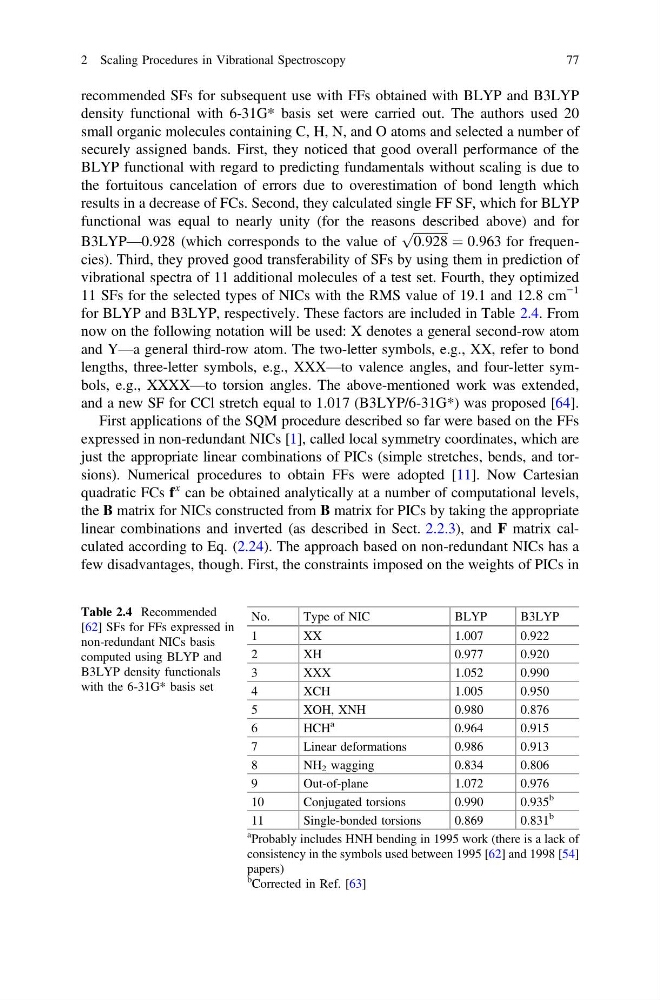
for BLYP and B3LYP, respectively. These factors are included in Table 2.4. From
now on the following notation will be used: X denotes a general second-row atom
and Y—a general third-row atom. The two-letter symbols, e.g., XX, refer to bond
lengths, three-letter symbols, e.g., XXX—to valence angles, and four-letter symbols, e.g., XXXX—to torsion angles. The above-mentioned work was extended,
and a new SF for CCl stretch equal to 1.017 (B3LYP/6-31G*) was proposed [64].
First applications of the SQM procedure described so far were based on the FFs
expressed in non-redundant NICs [1], called local symmetry coordinates, which are
just the appropriate linear combinations of PICs (simple stretches, bends, and torsions). Numerical procedures to obtain FFs were adopted [11]. Now Cartesian
quadratic FCs f
x can be obtained analytically at a number of computational levels,
the B matrix for NICs constructed from B matrix for PICs by taking the appropriate
linear combinations and inverted (as described in Sect. 2.2.3), and F matrix calculated according to Eq. (2.24). The approach based on non-redundant NICs has a
few disadvantages, though. First, the constraints imposed on the weights of PICs in
Table 2.4 Recommended
[62] SFs for FFs expressed in
non-redundant NICs basis
computed using BLYP and
B3LYP density functionals
with the 6-31G* basis set
No.
Type of NIC
BLYP
B3LYP
1
XX
1.007
0.922
2
XH
0.977
0.920
3
XXX
1.052
0.990
4
XCH
1.005
0.950
5
XOH, XNH
0.980
0.876
6
HCH
a
0.964
0.915
7
Linear deformations
0.986
0.913
8
N H 2 wagging
0.834
0.806
9
Out-of-plane
1.072
0.976
10
Conjugated torsions
0.990
0.935
b
11
Single-bonded torsions
0.869
0.831
b
a Probably includes HNH bending in 1995 work (there is a lack of
consistency in the symbols used between 1995 [62] and 1998 [54]
papers)
b
Corrected in Ref. [63]
2 Scaling Procedures in Vibrational Spectroscopy
77
density functional with 6-31G* basis set were carried out. The authors used 20
small organic molecules containing C, H, N, and O atoms and selected a number of
securely assigned bands. First, they noticed that good overall performance of the
BLYP functional with regard to predicting fundamentals without scaling is due to
the fortuitous cancelation of errors due to overestimation of bond length which
results in a decrease of FCs. Second, they calculated single FF SF, which for BLYP
functional was equal to nearly unity (for the reasons described above) and for
B3LYP—0.928 (which corresponds to the value of
ffiffiffiffiffiffiffiffiffiffiffi
0:928
p
¼ 0:963 for frequencies). Third, they proved good transferability of SFs by using them in prediction of
vibrational spectra of 11 additional molecules of a test set. Fourth, they optimized
11 SFs for the selected types of NICs with the RMS value of 19.1 and 12.8 cm
−1
for BLYP and B3LYP, respectively. These factors are included in Table 2.4. From
now on the following notation will be used: X denotes a general second-row atom
and Y—a general third-row atom. The two-letter symbols, e.g., XX, refer to bond
lengths, three-letter symbols, e.g., XXX—to valence angles, and four-letter symbols, e.g., XXXX—to torsion angles. The above-mentioned work was extended,
and a new SF for CCl stretch equal to 1.017 (B3LYP/6-31G*) was proposed [64].
First applications of the SQM procedure described so far were based on the FFs
expressed in non-redundant NICs [1], called local symmetry coordinates, which are
just the appropriate linear combinations of PICs (simple stretches, bends, and torsions). Numerical procedures to obtain FFs were adopted [11]. Now Cartesian
quadratic FCs f
x can be obtained analytically at a number of computational levels,
the B matrix for NICs constructed from B matrix for PICs by taking the appropriate
linear combinations and inverted (as described in Sect. 2.2.3), and F matrix calculated according to Eq. (2.24). The approach based on non-redundant NICs has a
few disadvantages, though. First, the constraints imposed on the weights of PICs in
Table 2.4 Recommended
[62] SFs for FFs expressed in
non-redundant NICs basis
computed using BLYP and
B3LYP density functionals
with the 6-31G* basis set
No.
Type of NIC
BLYP
B3LYP
1
XX
1.007
0.922
2
XH
0.977
0.920
3
XXX
1.052
0.990
4
XCH
1.005
0.950
5
XOH, XNH
0.980
0.876
6
HCH
a
0.964
0.915
7
Linear deformations
0.986
0.913
8
N H 2 wagging
0.834
0.806
9
Out-of-plane
1.072
0.976
10
Conjugated torsions
0.990
0.935
b
11
Single-bonded torsions
0.869
0.831
b
a Probably includes HNH bending in 1995 work (there is a lack of
consistency in the symbols used between 1995 [62] and 1998 [54]
papers)
b
Corrected in Ref. [63]
2 Scaling Procedures in Vibrational Spectroscopy
77