

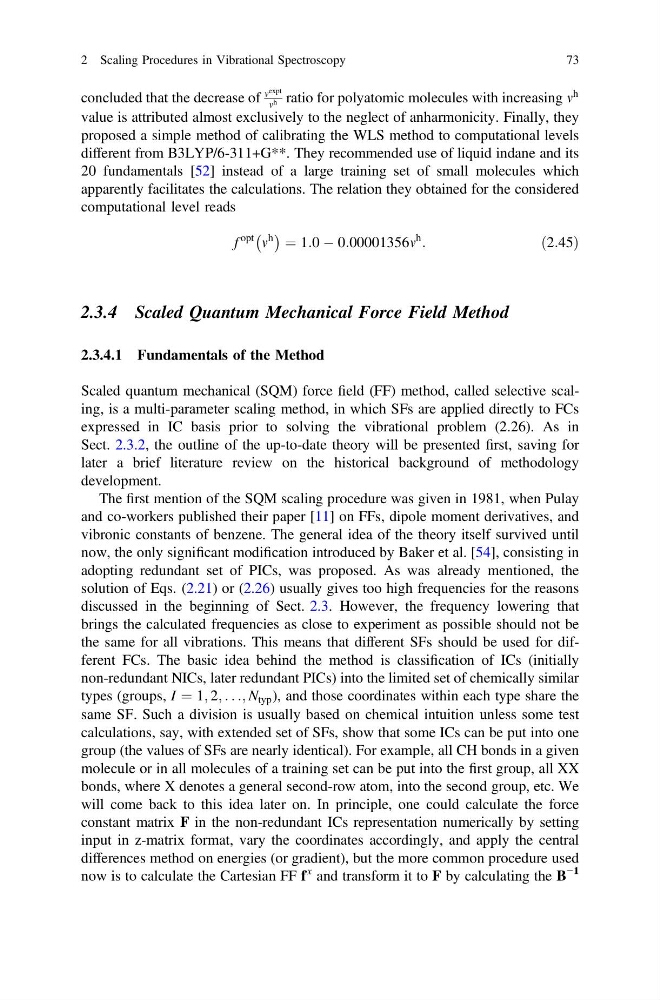
concluded that the decrease of
m
expt
m h ratio for polyatomic molecules with increasing m
h
value is attributed almost exclusively to the neglect of anharmonicity. Finally, they
proposed a simple method of calibrating the WLS method to computational levels
different from B3LYP/6-311+G**. They recommended use of liquid indane and its
20 fundamentals [52] instead of a large training set of small molecules which
apparently facilitates the calculations. The relation they obtained for the considered
computational level reads
f
opt m
h
À Á ¼ 1:0 À 0:00001356m
h
:
ð2:45Þ
2.3.4 Scaled Quantum Mechanical Force Field Method
2.3.4.1 Fundamentals of the Method
Scaled quantum mechanical (SQM) force field (FF) method, called selective scaling, is a multi-parameter scaling method, in which SFs are applied directly to FCs
expressed in IC basis prior to solving the vibrational problem (2.26). As in
Sect. 2.3.2, the outline of the up-to-date theory will be presented first, saving for
later a brief literature review on the historical background of methodology
development.
The first mention of the SQM scaling procedure was given in 1981, when Pulay
and co-workers published their paper [11] on FFs, dipole moment derivatives, and
vibronic constants of benzene. The general idea of the theory itself survived until
now, the only significant modification introduced by Baker et al. [54], consisting in
adopting redundant set of PICs, was proposed. As was already mentioned, the
solution of Eqs. (2.21) or (2.26) usually gives too high frequencies for the reasons
discussed in the beginning of Sect. 2.3. However, the frequency lowering that
brings the calculated frequencies as close to experiment as possible should not be
the same for all vibrations. This means that different SFs should be used for different FCs. The basic idea behind the method is classification of ICs (initially
non-redundant NICs, later redundant PICs) into the limited set of chemically similar
types (groups, I ¼ 1; 2; . . .; N typ ), and those coordinates within each type share the
same SF. Such a division is usually based on chemical intuition unless some test
calculations, say, with extended set of SFs, show that some ICs can be put into one
group (the values of SFs are nearly identical). For example, all CH bonds in a given
molecule or in all molecules of a training set can be put into the first group, all XX
bonds, where X denotes a general second-row atom, into the second group, etc. We
will come back to this idea later on. In principle, one could calculate the force
constant matrix F in the non-redundant ICs representation numerically by setting
input in z-matrix format, vary the coordinates accordingly, and apply the central
differences method on energies (or gradient), but the more common procedure used
now is to calculate the Cartesian FF f
x and transform it to F by calculating the B
−1
2 Scaling Procedures in Vibrational Spectroscopy
73
m
expt
m h ratio for polyatomic molecules with increasing m
h
value is attributed almost exclusively to the neglect of anharmonicity. Finally, they
proposed a simple method of calibrating the WLS method to computational levels
different from B3LYP/6-311+G**. They recommended use of liquid indane and its
20 fundamentals [52] instead of a large training set of small molecules which
apparently facilitates the calculations. The relation they obtained for the considered
computational level reads
f
opt m
h
À Á ¼ 1:0 À 0:00001356m
h
:
ð2:45Þ
2.3.4 Scaled Quantum Mechanical Force Field Method
2.3.4.1 Fundamentals of the Method
Scaled quantum mechanical (SQM) force field (FF) method, called selective scaling, is a multi-parameter scaling method, in which SFs are applied directly to FCs
expressed in IC basis prior to solving the vibrational problem (2.26). As in
Sect. 2.3.2, the outline of the up-to-date theory will be presented first, saving for
later a brief literature review on the historical background of methodology
development.
The first mention of the SQM scaling procedure was given in 1981, when Pulay
and co-workers published their paper [11] on FFs, dipole moment derivatives, and
vibronic constants of benzene. The general idea of the theory itself survived until
now, the only significant modification introduced by Baker et al. [54], consisting in
adopting redundant set of PICs, was proposed. As was already mentioned, the
solution of Eqs. (2.21) or (2.26) usually gives too high frequencies for the reasons
discussed in the beginning of Sect. 2.3. However, the frequency lowering that
brings the calculated frequencies as close to experiment as possible should not be
the same for all vibrations. This means that different SFs should be used for different FCs. The basic idea behind the method is classification of ICs (initially
non-redundant NICs, later redundant PICs) into the limited set of chemically similar
types (groups, I ¼ 1; 2; . . .; N typ ), and those coordinates within each type share the
same SF. Such a division is usually based on chemical intuition unless some test
calculations, say, with extended set of SFs, show that some ICs can be put into one
group (the values of SFs are nearly identical). For example, all CH bonds in a given
molecule or in all molecules of a training set can be put into the first group, all XX
bonds, where X denotes a general second-row atom, into the second group, etc. We
will come back to this idea later on. In principle, one could calculate the force
constant matrix F in the non-redundant ICs representation numerically by setting
input in z-matrix format, vary the coordinates accordingly, and apply the central
differences method on energies (or gradient), but the more common procedure used
now is to calculate the Cartesian FF f
x and transform it to F by calculating the B
−1
2 Scaling Procedures in Vibrational Spectroscopy
73