

quadratic FF. Taking into account the high accuracy of the methods we may easily
predict their dominance in the nearest future, at least with respect to the systems of
the appreciable size. It should be noted at this stage that—as the pioneers of the
scaling procedures claim (see, e.g., [11])—none of them has a strict theoretical
basis. These procedures are empirical, and therefore, their validity is judged based
on the agreement of the calculations and experiment.
2.3.1 General Strategy
In all scaling procedures, regardless of their nature (frequency or FF scaling, singleor multi-parameter scaling), the main strategy is the same: One uses scaling factors
(SFs) which depend on the computational level (defined as method/basis set) and
which—when determined for a well-defined set of N mol molecules (called “a
training set” or “a calibration set”)—are assumed to be transferable to other
molecules. The choice of a training set depends on the problem being investigated.
One could consider, e.g., a set of small organic molecules vibrational spectra of
which are known and use the optimized factors to perform the relevant scaling for
other organic molecules, spectra of which are to be interpreted. Another problem is
associated with the choice of experimental frequencies. The proper assignment of
bands on IR and/or Raman spectra to vibrational (harmonic) modes of all molecules
of a training set is needed prior to optimization of SFs. In addition, bands of
imprecise experimental position as well as bands exhibiting excessively larger
deviations from theoretical frequencies as compared with the remaining ones should
be omitted.
Given the properly chosen set of experimental vibrational frequencies for a given
training set of molecules m
expt
p , p ¼ 1; 2; . . .; N vib , the so-called optimization (refinement) of SFs f ¼ f 1 ; f 2 ; . . .; f N scl
ð
Þhas to be performed. Note that in case of
single-parameter scaling procedures N scl ¼ 1. In general, the scaled frequencies are
functions of SFs, i.e., m
scl
p ¼ m
scl
p f
ð Þ. In order to find the optimal SFs f
opt , one has to
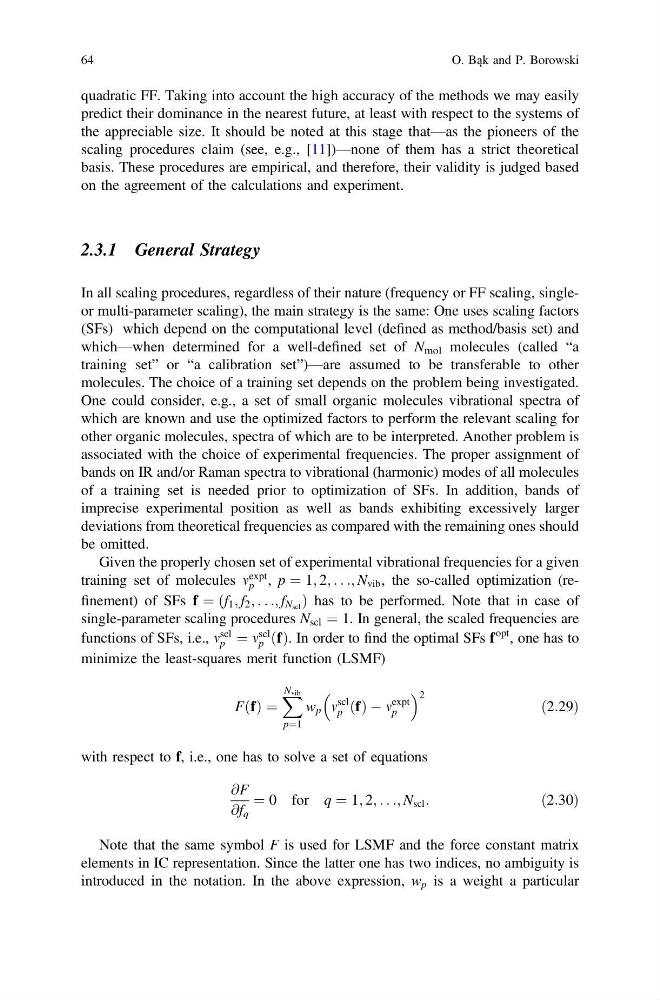
minimize the least-squares merit function (LSMF)
F f
ð Þ ¼
X N vib
p¼1
w p m
scl
p f
ð Þ À m
expt
p
2
ð2:29Þ
with respect to f, i.e., one has to solve a set of equations
@F
@f q
¼ 0 for q ¼ 1; 2; . . .; N scl :
ð2:30Þ
Note that the same symbol F is used for LSMF and the force constant matrix
elements in IC representation. Since the latter one has two indices, no ambiguity is
introduced in the notation. In the above expression, w p is a weight a particular
64
O. Bąk and P. Borowski
predict their dominance in the nearest future, at least with respect to the systems of
the appreciable size. It should be noted at this stage that—as the pioneers of the
scaling procedures claim (see, e.g., [11])—none of them has a strict theoretical
basis. These procedures are empirical, and therefore, their validity is judged based
on the agreement of the calculations and experiment.
2.3.1 General Strategy
In all scaling procedures, regardless of their nature (frequency or FF scaling, singleor multi-parameter scaling), the main strategy is the same: One uses scaling factors
(SFs) which depend on the computational level (defined as method/basis set) and
which—when determined for a well-defined set of N mol molecules (called “a
training set” or “a calibration set”)—are assumed to be transferable to other
molecules. The choice of a training set depends on the problem being investigated.
One could consider, e.g., a set of small organic molecules vibrational spectra of
which are known and use the optimized factors to perform the relevant scaling for
other organic molecules, spectra of which are to be interpreted. Another problem is
associated with the choice of experimental frequencies. The proper assignment of
bands on IR and/or Raman spectra to vibrational (harmonic) modes of all molecules
of a training set is needed prior to optimization of SFs. In addition, bands of
imprecise experimental position as well as bands exhibiting excessively larger
deviations from theoretical frequencies as compared with the remaining ones should
be omitted.
Given the properly chosen set of experimental vibrational frequencies for a given
training set of molecules m
expt
p , p ¼ 1; 2; . . .; N vib , the so-called optimization (refinement) of SFs f ¼ f 1 ; f 2 ; . . .; f N scl
ð
Þhas to be performed. Note that in case of
single-parameter scaling procedures N scl ¼ 1. In general, the scaled frequencies are
functions of SFs, i.e., m
scl
p ¼ m
scl
p f
ð Þ. In order to find the optimal SFs f
opt , one has to
minimize the least-squares merit function (LSMF)
F f
ð Þ ¼
X N vib
p¼1
w p m
scl
p f
ð Þ À m
expt
p
2
ð2:29Þ
with respect to f, i.e., one has to solve a set of equations
@F
@f q
¼ 0 for q ¼ 1; 2; . . .; N scl :
ð2:30Þ
Note that the same symbol F is used for LSMF and the force constant matrix
elements in IC representation. Since the latter one has two indices, no ambiguity is
introduced in the notation. In the above expression, w p is a weight a particular
64
O. Bąk and P. Borowski