

N vib
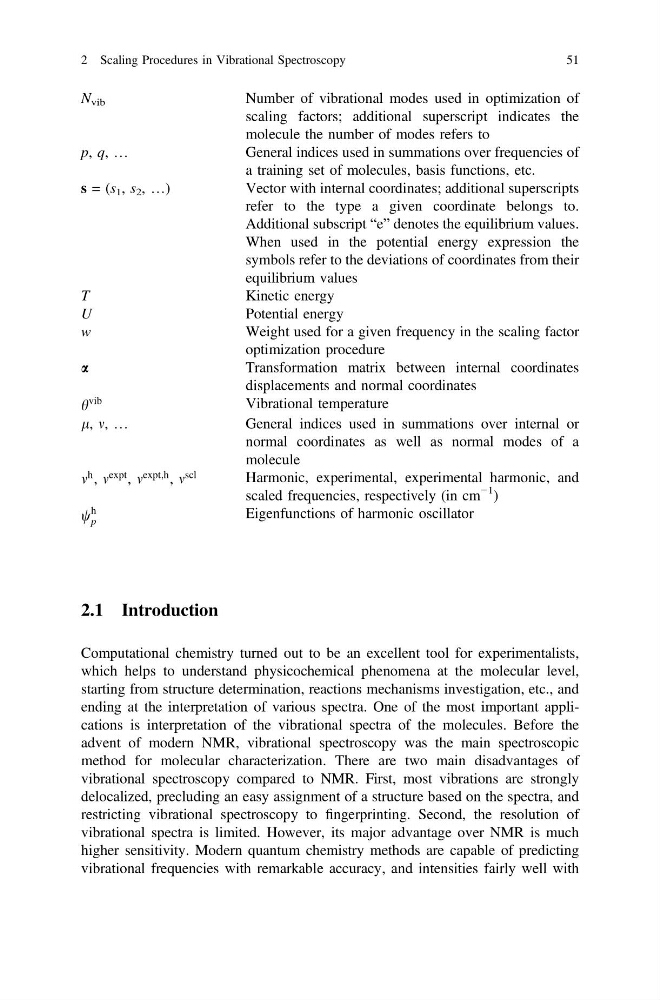
Number of vibrational modes used in optimization of
scaling factors; additional superscript indicates the
molecule the number of modes refers to
p, q, …
General indices used in summations over frequencies of
a training set of molecules, basis functions, etc.
s = (s 1 , s 2 , …)
Vector with internal coordinates; additional superscripts
refer to the type a given coordinate belongs to.
Additional subscript “e” denotes the equilibrium values.
When used in the potential energy expression the
symbols refer to the deviations of coordinates from their
equilibrium values
T
Kinetic energy
U
Potential energy
w
Weight used for a given frequency in the scaling factor
optimization procedure
a
Transformation matrix between internal coordinates
displacements and normal coordinates
h
vib
Vibrational temperature
l, m, …
General indices used in summations over internal or
normal coordinates as well as normal modes of a
molecule
m
h , m
expt , m
expt;h , m
scl
Harmonic, experimental, experimental harmonic, and
scaled frequencies, respectively (in cm
−1 )
w
h
p
Eigenfunctions of harmonic oscillator
2.1 Introduction
Computational chemistry turned out to be an excellent tool for experimentalists,
which helps to understand physicochemical phenomena at the molecular level,
starting from structure determination, reactions mechanisms investigation, etc., and
ending at the interpretation of various spectra. One of the most important applications is interpretation of the vibrational spectra of the molecules. Before the
advent of modern NMR, vibrational spectroscopy was the main spectroscopic
method for molecular characterization. There are two main disadvantages of
vibrational spectroscopy compared to NMR. First, most vibrations are strongly
delocalized, precluding an easy assignment of a structure based on the spectra, and
restricting vibrational spectroscopy to fingerprinting. Second, the resolution of
vibrational spectra is limited. However, its major advantage over NMR is much
higher sensitivity. Modern quantum chemistry methods are capable of predicting
vibrational frequencies with remarkable accuracy, and intensities fairly well with
2 Scaling Procedures in Vibrational Spectroscopy
51
Number of vibrational modes used in optimization of
scaling factors; additional superscript indicates the
molecule the number of modes refers to
p, q, …
General indices used in summations over frequencies of
a training set of molecules, basis functions, etc.
s = (s 1 , s 2 , …)
Vector with internal coordinates; additional superscripts
refer to the type a given coordinate belongs to.
Additional subscript “e” denotes the equilibrium values.
When used in the potential energy expression the
symbols refer to the deviations of coordinates from their
equilibrium values
T
Kinetic energy
U
Potential energy
w
Weight used for a given frequency in the scaling factor
optimization procedure
a
Transformation matrix between internal coordinates
displacements and normal coordinates
h
vib
Vibrational temperature
l, m, …
General indices used in summations over internal or
normal coordinates as well as normal modes of a
molecule
m
h , m
expt , m
expt;h , m
scl
Harmonic, experimental, experimental harmonic, and
scaled frequencies, respectively (in cm
−1 )
w
h
p
Eigenfunctions of harmonic oscillator
2.1 Introduction
Computational chemistry turned out to be an excellent tool for experimentalists,
which helps to understand physicochemical phenomena at the molecular level,
starting from structure determination, reactions mechanisms investigation, etc., and
ending at the interpretation of various spectra. One of the most important applications is interpretation of the vibrational spectra of the molecules. Before the
advent of modern NMR, vibrational spectroscopy was the main spectroscopic
method for molecular characterization. There are two main disadvantages of
vibrational spectroscopy compared to NMR. First, most vibrations are strongly
delocalized, precluding an easy assignment of a structure based on the spectra, and
restricting vibrational spectroscopy to fingerprinting. Second, the resolution of
vibrational spectra is limited. However, its major advantage over NMR is much
higher sensitivity. Modern quantum chemistry methods are capable of predicting
vibrational frequencies with remarkable accuracy, and intensities fairly well with
2 Scaling Procedures in Vibrational Spectroscopy
51