

In the world of art conservation, it is practiced to test the lightfastness of sacrificial materials or model samples (sometimes produced according to historical
recipes) as well as modern products used in conservation (paints, glues, papers,
cardboards, threads) based on the methods described in the relevant industrial
standards (ISO, etc.), using laboratory light aging chambers or direct sun exposure
methods [147]. In 1999, Paul Whitmore and co-authors published a paper in which
a new approach to photoaging studies was presented, opening exciting possibilities
to perform lightfastness measurements on originals [148].
16.3.1.1 Description of the Methodology
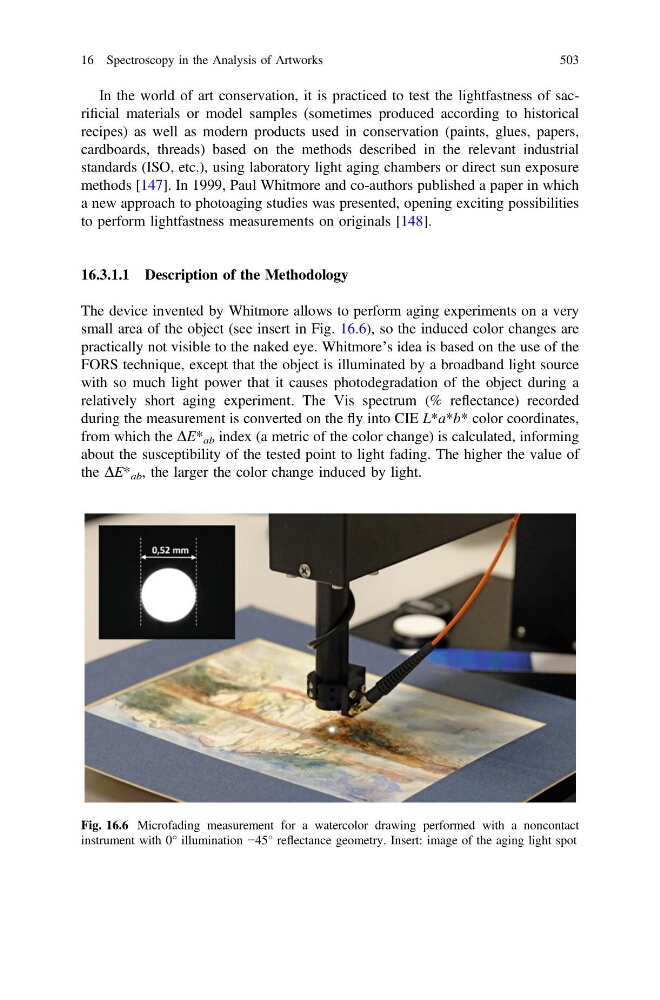
The device invented by Whitmore allows to perform aging experiments on a very
small area of the object (see insert in Fig. 16.6), so the induced color changes are
practically not visible to the naked eye. Whitmore’s idea is based on the use of the
FORS technique, except that the object is illuminated by a broadband light source
with so much light power that it causes photodegradation of the object during a
relatively short aging experiment. The Vis spectrum (% reflectance) recorded
during the measurement is converted on the fly into CIE L*a*b* color coordinates,
from which the DE* ab index (a metric of the color change) is calculated, informing
about the susceptibility of the tested point to light fading. The higher the value of
the DE* ab , the larger the color change induced by light.
Fig. 16.6 Microfading measurement for a watercolor drawing performed with a noncontact
instrument with 0° illumination −45° reflectance geometry. Insert: image of the aging light spot
16 Spectroscopy in the Analysis of Artworks
503
recipes) as well as modern products used in conservation (paints, glues, papers,
cardboards, threads) based on the methods described in the relevant industrial
standards (ISO, etc.), using laboratory light aging chambers or direct sun exposure
methods [147]. In 1999, Paul Whitmore and co-authors published a paper in which
a new approach to photoaging studies was presented, opening exciting possibilities
to perform lightfastness measurements on originals [148].
16.3.1.1 Description of the Methodology
The device invented by Whitmore allows to perform aging experiments on a very
small area of the object (see insert in Fig. 16.6), so the induced color changes are
practically not visible to the naked eye. Whitmore’s idea is based on the use of the
FORS technique, except that the object is illuminated by a broadband light source
with so much light power that it causes photodegradation of the object during a
relatively short aging experiment. The Vis spectrum (% reflectance) recorded
during the measurement is converted on the fly into CIE L*a*b* color coordinates,
from which the DE* ab index (a metric of the color change) is calculated, informing
about the susceptibility of the tested point to light fading. The higher the value of
the DE* ab , the larger the color change induced by light.
Fig. 16.6 Microfading measurement for a watercolor drawing performed with a noncontact
instrument with 0° illumination −45° reflectance geometry. Insert: image of the aging light spot
16 Spectroscopy in the Analysis of Artworks
503