

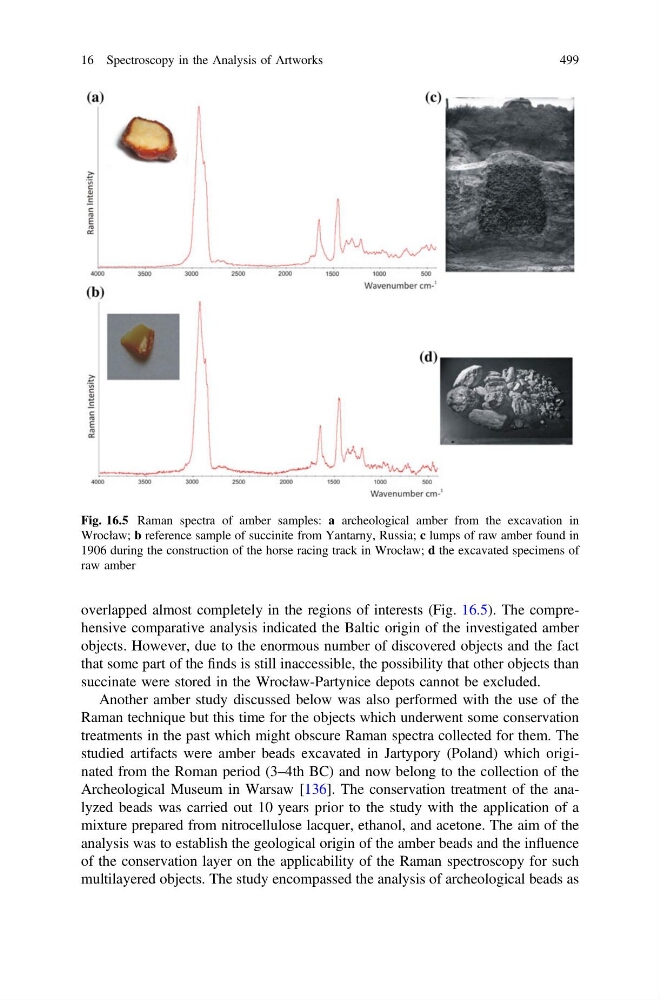
overlapped almost completely in the regions of interests (Fig. 16.5). The comprehensive comparative analysis indicated the Baltic origin of the investigated amber
objects. However, due to the enormous number of discovered objects and the fact
that some part of the finds is still inaccessible, the possibility that other objects than
succinate were stored in the Wrocław-Partynice depots cannot be excluded.
Another amber study discussed below was also performed with the use of the
Raman technique but this time for the objects which underwent some conservation
treatments in the past which might obscure Raman spectra collected for them. The
studied artifacts were amber beads excavated in Jartypory (Poland) which originated from the Roman period (3–4th BC) and now belong to the collection of the
Archeological Museum in Warsaw [136]. The conservation treatment of the analyzed beads was carried out 10 years prior to the study with the application of a
mixture prepared from nitrocellulose lacquer, ethanol, and acetone. The aim of the
analysis was to establish the geological origin of the amber beads and the influence
of the conservation layer on the applicability of the Raman spectroscopy for such
multilayered objects. The study encompassed the analysis of archeological beads as
Fig. 16.5 Raman spectra of amber samples: a archeological amber from the excavation in
Wrocław; b reference sample of succinite from Yantarny, Russia; c lumps of raw amber found in
1906 during the construction of the horse racing track in Wrocław; d the excavated specimens of
raw amber
16 Spectroscopy in the Analysis of Artworks
499
objects. However, due to the enormous number of discovered objects and the fact
that some part of the finds is still inaccessible, the possibility that other objects than
succinate were stored in the Wrocław-Partynice depots cannot be excluded.
Another amber study discussed below was also performed with the use of the
Raman technique but this time for the objects which underwent some conservation
treatments in the past which might obscure Raman spectra collected for them. The
studied artifacts were amber beads excavated in Jartypory (Poland) which originated from the Roman period (3–4th BC) and now belong to the collection of the
Archeological Museum in Warsaw [136]. The conservation treatment of the analyzed beads was carried out 10 years prior to the study with the application of a
mixture prepared from nitrocellulose lacquer, ethanol, and acetone. The aim of the
analysis was to establish the geological origin of the amber beads and the influence
of the conservation layer on the applicability of the Raman spectroscopy for such
multilayered objects. The study encompassed the analysis of archeological beads as
Fig. 16.5 Raman spectra of amber samples: a archeological amber from the excavation in
Wrocław; b reference sample of succinite from Yantarny, Russia; c lumps of raw amber found in
1906 during the construction of the horse racing track in Wrocław; d the excavated specimens of
raw amber
16 Spectroscopy in the Analysis of Artworks
499