

tetrahedron order also exists in more complex systems. Based on the results presented, inter alia, in the work of Sitarz et al. [20], it can be stated that this order is
analogous to that inside the respective crystalline form. IR spectra decomposition of
glasses with compositions corresponding to that of Na 2 [Si 2 O 5 ] (Fig. 15.10c) and
K 2 [Si 2 O 5 ] (Fig. 15.10d) reveals two bands in the first case at 671 and 587 cm
−1 ,
and 661 and 599 cm
−1 in the second case. These bands as in the case of m-SiO 2
(Fig. 15.10d) can be associated with ring vibrations. In the case of glass composed
of Li 2 [Si 2 O 5 ] (Fig. 15.10a), in the pseudo-lattice range, an entire series of bands are
visible, the presence of which can indicate the existence of deformed rings with
different elements due to the small size of lithium and its above-mentioned capability of inserting itself into tetrahedron positions [57].
Similar conclusions can be derived from analysis of IR spectra obtained from
aluminosilicate glasses. Crystalline structures of potassium tecto-aluminosilicate
(orthoclase K[AlSi 3 O 8 ], leucite K[AlSi 2 O 6 ], and calsilite K[AlSiO 4 ]) possess
aluminum atoms in tetrahedron positions. The existence of [AlO 4 ]
5− tetrahedrons is
associated with the presence of potassium ions K
+ in the structure (they compensate
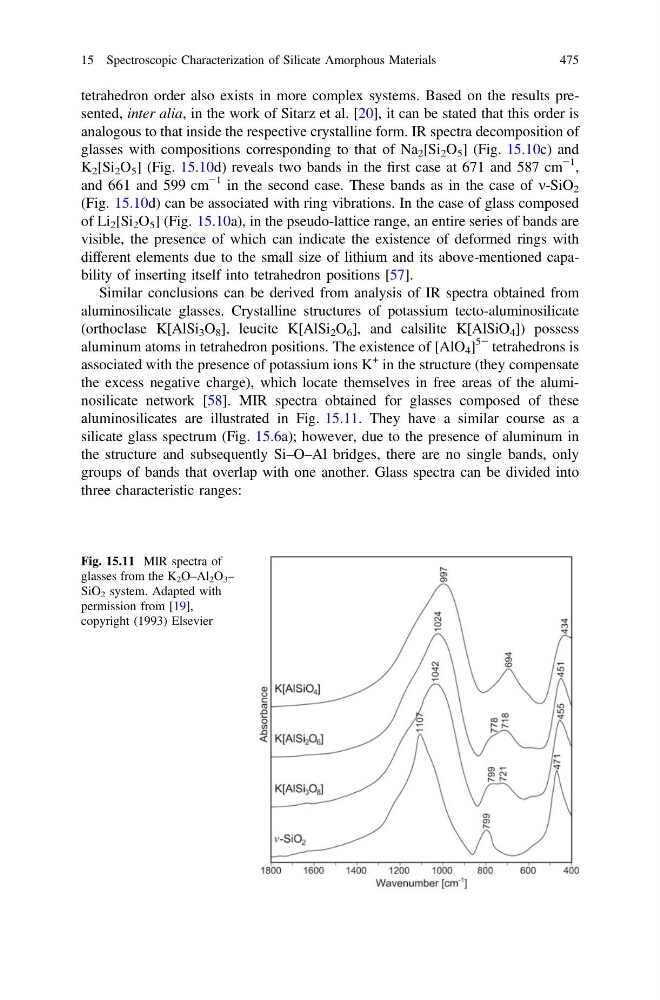
the excess negative charge), which locate themselves in free areas of the aluminosilicate network [58]. MIR spectra obtained for glasses composed of these
aluminosilicates are illustrated in Fig. 15.11. They have a similar course as a
silicate glass spectrum (Fig. 15.6a); however, due to the presence of aluminum in
the structure and subsequently Si–O–Al bridges, there are no single bands, only
groups of bands that overlap with one another. Glass spectra can be divided into
three characteristic ranges:
Fig. 15.11 MIR spectra of
glasses from the K 2 O–Al 2 O 3 –
SiO 2 system. Adapted with
permission from [19],
copyright (1993) Elsevier
15 Spectroscopic Characterization of Silicate Amorphous Materials
475
analogous to that inside the respective crystalline form. IR spectra decomposition of
glasses with compositions corresponding to that of Na 2 [Si 2 O 5 ] (Fig. 15.10c) and
K 2 [Si 2 O 5 ] (Fig. 15.10d) reveals two bands in the first case at 671 and 587 cm
−1 ,
and 661 and 599 cm
−1 in the second case. These bands as in the case of m-SiO 2
(Fig. 15.10d) can be associated with ring vibrations. In the case of glass composed
of Li 2 [Si 2 O 5 ] (Fig. 15.10a), in the pseudo-lattice range, an entire series of bands are
visible, the presence of which can indicate the existence of deformed rings with
different elements due to the small size of lithium and its above-mentioned capability of inserting itself into tetrahedron positions [57].
Similar conclusions can be derived from analysis of IR spectra obtained from
aluminosilicate glasses. Crystalline structures of potassium tecto-aluminosilicate
(orthoclase K[AlSi 3 O 8 ], leucite K[AlSi 2 O 6 ], and calsilite K[AlSiO 4 ]) possess
aluminum atoms in tetrahedron positions. The existence of [AlO 4 ]
5− tetrahedrons is
associated with the presence of potassium ions K
+ in the structure (they compensate
the excess negative charge), which locate themselves in free areas of the aluminosilicate network [58]. MIR spectra obtained for glasses composed of these
aluminosilicates are illustrated in Fig. 15.11. They have a similar course as a
silicate glass spectrum (Fig. 15.6a); however, due to the presence of aluminum in
the structure and subsequently Si–O–Al bridges, there are no single bands, only
groups of bands that overlap with one another. Glass spectra can be divided into
three characteristic ranges:
Fig. 15.11 MIR spectra of
glasses from the K 2 O–Al 2 O 3 –
SiO 2 system. Adapted with
permission from [19],
copyright (1993) Elsevier
15 Spectroscopic Characterization of Silicate Amorphous Materials
475