

explained by the large number of bands in the spectrum and is also reflected in the
crystalline form of this silicate.
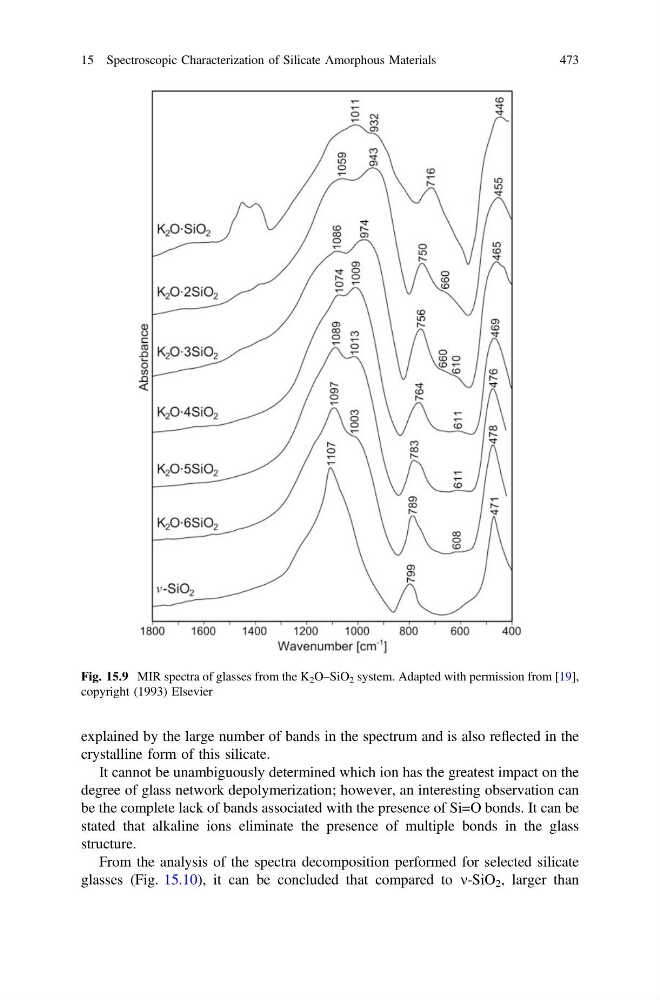
It cannot be unambiguously determined which ion has the greatest impact on the
degree of glass network depolymerization; however, an interesting observation can
be the complete lack of bands associated with the presence of Si=O bonds. It can be
stated that alkaline ions eliminate the presence of multiple bonds in the glass
structure.
From the analysis of the spectra decomposition performed for selected silicate
glasses (Fig. 15.10), it can be concluded that compared to m-SiO 2 , larger than
Fig. 15.9 MIR spectra of glasses from the K 2 O–SiO 2 system. Adapted with permission from [19],
copyright (1993) Elsevier
15 Spectroscopic Characterization of Silicate Amorphous Materials
473
crystalline form of this silicate.
It cannot be unambiguously determined which ion has the greatest impact on the
degree of glass network depolymerization; however, an interesting observation can
be the complete lack of bands associated with the presence of Si=O bonds. It can be
stated that alkaline ions eliminate the presence of multiple bonds in the glass
structure.
From the analysis of the spectra decomposition performed for selected silicate
glasses (Fig. 15.10), it can be concluded that compared to m-SiO 2 , larger than
Fig. 15.9 MIR spectra of glasses from the K 2 O–SiO 2 system. Adapted with permission from [19],
copyright (1993) Elsevier
15 Spectroscopic Characterization of Silicate Amorphous Materials
473