

An alternate theory on the internal silicate glass structure was presented by
Zachariasen in 1932 [5], who assumed the existence of a continuous, uninterrupted
construction formed by [SiO 4 ]
4− tetrahedrons, statistically disordered and connected with one another. This assumption is called the continuous random network
theory (Fig. 15.1b). Thus, a m-SiO 2 glass network, according to this concept,
consists of an uninterrupted frame of randomly connected [SiO 4 ] tetrahedrons, in
which every silicon ion is tetrahedrally surrounded by oxygen ions and every
oxygen ion is located between two silicon ions—thus, broken bonds are not present.
This theory has been experimentally supported by Warren [8–10], who determined
on the basis of radical atom density distribution the presence of proper tetrahedrons
arranged in a completely random manner and ordered regions in silicate glass not
exceeding 7–8 Å (with 5.7 Å tetrahedron dimensions). Therefore, the continuous
random network model limits the range of structural order to the first coordination
sphere, i.e., to one [SiO 4 ] tetrahedron in silicate glass.
According to Görlich [1], the differences between these theories in fact come
down to the sizes of ordered regions—15–20 Å in the case of crystallite theory and
a single tetrahedron in the case of the continuous random network theory.
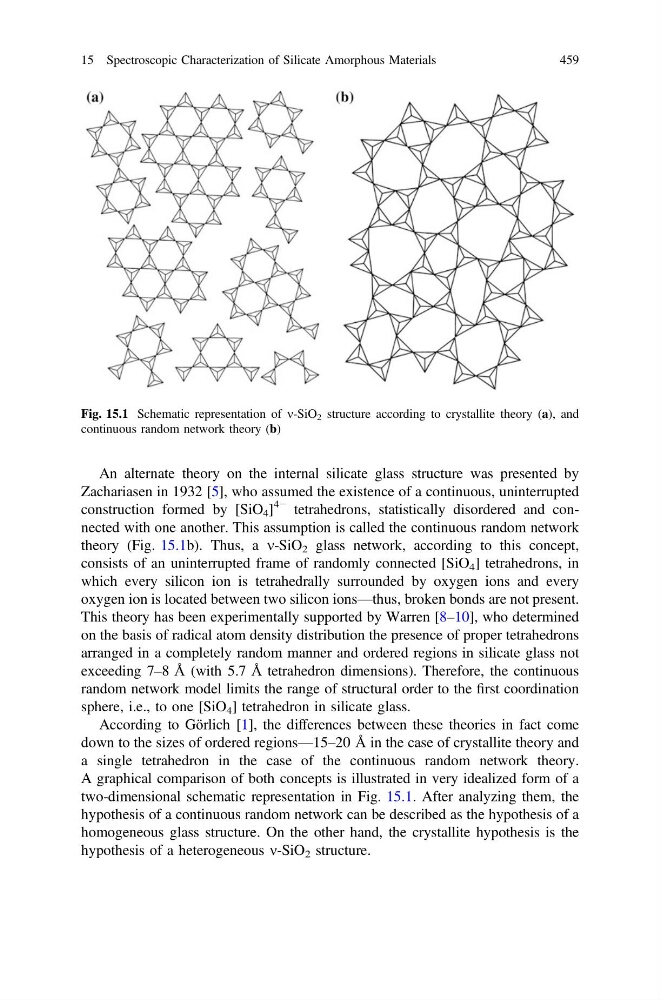
A graphical comparison of both concepts is illustrated in very idealized form of a
two-dimensional schematic representation in Fig. 15.1. After analyzing them, the
hypothesis of a continuous random network can be described as the hypothesis of a
homogeneous glass structure. On the other hand, the crystallite hypothesis is the
hypothesis of a heterogeneous m-SiO 2 structure.
Fig. 15.1 Schematic representation of m-SiO 2 structure according to crystallite theory (a), and
continuous random network theory (b)
15 Spectroscopic Characterization of Silicate Amorphous Materials
459
Zachariasen in 1932 [5], who assumed the existence of a continuous, uninterrupted
construction formed by [SiO 4 ]
4− tetrahedrons, statistically disordered and connected with one another. This assumption is called the continuous random network
theory (Fig. 15.1b). Thus, a m-SiO 2 glass network, according to this concept,
consists of an uninterrupted frame of randomly connected [SiO 4 ] tetrahedrons, in
which every silicon ion is tetrahedrally surrounded by oxygen ions and every
oxygen ion is located between two silicon ions—thus, broken bonds are not present.
This theory has been experimentally supported by Warren [8–10], who determined
on the basis of radical atom density distribution the presence of proper tetrahedrons
arranged in a completely random manner and ordered regions in silicate glass not
exceeding 7–8 Å (with 5.7 Å tetrahedron dimensions). Therefore, the continuous
random network model limits the range of structural order to the first coordination
sphere, i.e., to one [SiO 4 ] tetrahedron in silicate glass.
According to Görlich [1], the differences between these theories in fact come
down to the sizes of ordered regions—15–20 Å in the case of crystallite theory and
a single tetrahedron in the case of the continuous random network theory.
A graphical comparison of both concepts is illustrated in very idealized form of a
two-dimensional schematic representation in Fig. 15.1. After analyzing them, the
hypothesis of a continuous random network can be described as the hypothesis of a
homogeneous glass structure. On the other hand, the crystallite hypothesis is the
hypothesis of a heterogeneous m-SiO 2 structure.
Fig. 15.1 Schematic representation of m-SiO 2 structure according to crystallite theory (a), and
continuous random network theory (b)
15 Spectroscopic Characterization of Silicate Amorphous Materials
459