

PCB manufacturing and suited for short-distance optical data transmission even in
harsh environments replacing other optical polymers such as acrylates and
epoxy-based materials.
13.4 Conclusions
The absorption loss of PDMS in the spectral datacom and telecom regions of 600–
1600 nm was analysed and summarized to result from scattering loss and vibrational overtone and combination bands of the CH groups of the materials. In terms
of the observed positions of the fundamental, overtone and combination bands of
CH containing group vibrations in the mid-IR and NIR spectra, anharmonicity
constants including normal harmonic vibration frequencies have been determined
and an empirical equation for estimating the significant intrinsic absorption loss
wavelengths has been presented. The results agreed well with the experimental
data. Furthermore, we derived an empirical equation between integral band strength
and the intrinsic absorption loss based on the NIR spectral data of PDMS, which
can be exploited also for the limit estimation of the optical loss in deuterated or
halogenated siloxane-based polymers (0.005 dB/cm at 850 nm) applied in different
datacom devices.
Furthermore, the PDMS waveguides were fabricated with low optical insertion
loss at 850 nm and with high thermal stability (with temperatures > 250 °C after
heating). This indeed has proven that two-component thermally cured PDMS is a
very promising candidate for the production of highly reliable datacom devices.
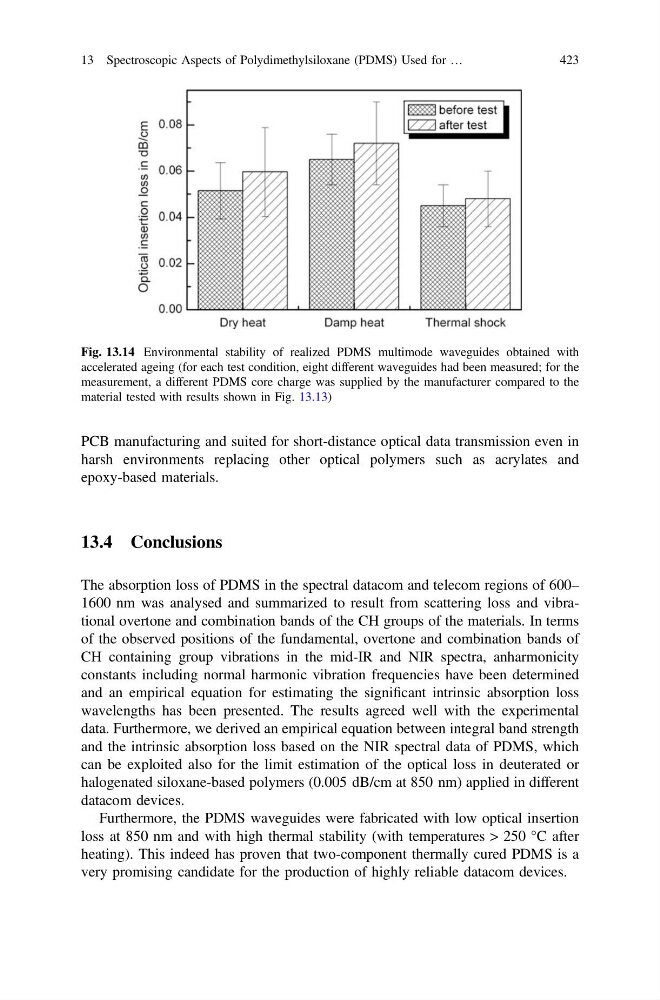
Fig. 13.14 Environmental stability of realized PDMS multimode waveguides obtained with
accelerated ageing (for each test condition, eight different waveguides had been measured; for the
measurement, a different PDMS core charge was supplied by the manufacturer compared to the
material tested with results shown in Fig. 13.13)
13 Spectroscopic Aspects of Polydimethylsiloxane (PDMS) Used for …
423
harsh environments replacing other optical polymers such as acrylates and
epoxy-based materials.
13.4 Conclusions
The absorption loss of PDMS in the spectral datacom and telecom regions of 600–
1600 nm was analysed and summarized to result from scattering loss and vibrational overtone and combination bands of the CH groups of the materials. In terms
of the observed positions of the fundamental, overtone and combination bands of
CH containing group vibrations in the mid-IR and NIR spectra, anharmonicity
constants including normal harmonic vibration frequencies have been determined
and an empirical equation for estimating the significant intrinsic absorption loss
wavelengths has been presented. The results agreed well with the experimental
data. Furthermore, we derived an empirical equation between integral band strength
and the intrinsic absorption loss based on the NIR spectral data of PDMS, which
can be exploited also for the limit estimation of the optical loss in deuterated or
halogenated siloxane-based polymers (0.005 dB/cm at 850 nm) applied in different
datacom devices.
Furthermore, the PDMS waveguides were fabricated with low optical insertion
loss at 850 nm and with high thermal stability (with temperatures > 250 °C after
heating). This indeed has proven that two-component thermally cured PDMS is a
very promising candidate for the production of highly reliable datacom devices.
Fig. 13.14 Environmental stability of realized PDMS multimode waveguides obtained with
accelerated ageing (for each test condition, eight different waveguides had been measured; for the
measurement, a different PDMS core charge was supplied by the manufacturer compared to the
material tested with results shown in Fig. 13.13)
13 Spectroscopic Aspects of Polydimethylsiloxane (PDMS) Used for …
423