

converted to benzyl chloride units (no signal at d = 4.8 ppm, presence of the signal
at d = 4.50 ppm, CH 2 Cl); the latter were subsequently transformed to
adenine-containing benzyl groups (line at d = 4.31 ppm instead of that at
d = 4.50 ppm). Similar conclusions were drawn based on FTIR and
13
C NMR
spectra. Additionally,
1 H NMR spectra revealed that hydrosilylation of vinyl benzyl
chloride with Q 8 M 8
H yielded both b and a adducts in the ratio of 1.64:1 (b:a). The
obtained adenine-containing spherosilicate was applied to prepare nanocomposites
with thymine-functionalized polybenzoxazine. Existence of multiple hydrogen
bonds between adenine and thymine moieties present in the systems was established by FTIR spectroscopy.
12.6 Conclusions
Review of the literature shows that spectroscopic methods play an important role in
the studies on modification of polysiloxanes, cubic oligomeric silsesquioxanes,
and spherosilicates by organic functional groups via hydrosilylation.
FTIR and
1 H NMR spectroscopies are very often applied to monitor the progress
of the hydrosilylation process by establishing changes in the spectral features
characteristic for the Si–H bonds during the reaction. Based on FTIR and
1 H NMR
spectra, conclusions on completeness of functionalization of the starting compounds
are also drawn. Conversion degrees of Si–H bonds within a certain time period,
determined by these spectroscopic methods, allow evaluating activity of a given
catalyst and comparing activities of various catalysts applied in the process. In the
case of heterogeneous catalysts, changes in their activity as well as their stability
after several reaction cycles (i.e., the “lifetime” of the catalyst) can be determined
by spectroscopic investigations.
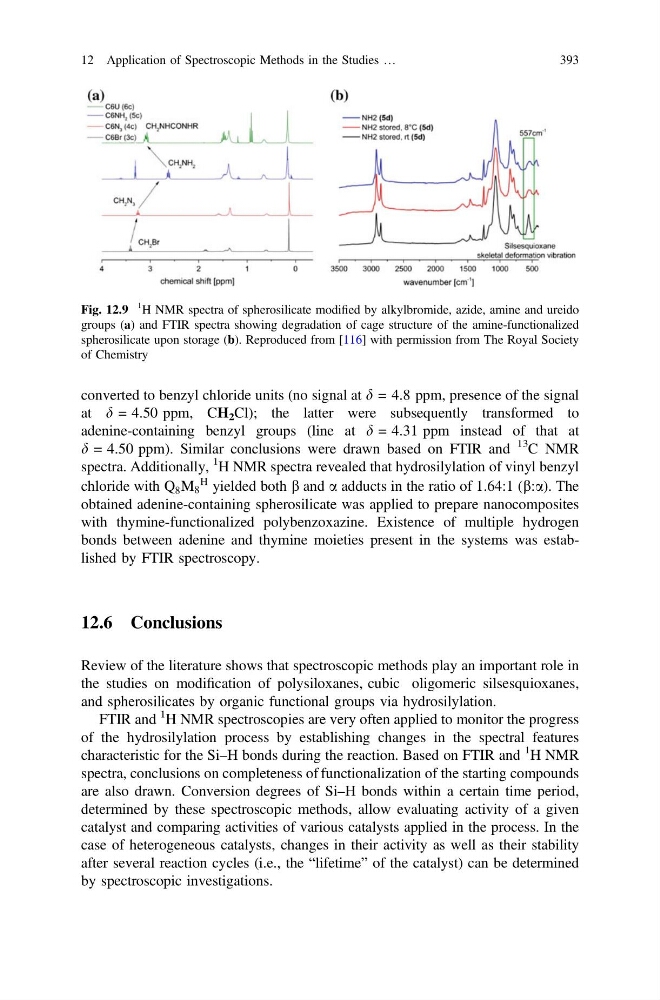
Fig. 12.9
1
H NMR spectra of spherosilicate modified by alkylbromide, azide, amine and ureido
groups (a) and FTIR spectra showing degradation of cage structure of the amine-functionalized
spherosilicate upon storage (b). Reproduced from [116] with permission from The Royal Society
of Chemistry
12 Application of Spectroscopic Methods in the Studies …
393
at d = 4.50 ppm, CH 2 Cl); the latter were subsequently transformed to
adenine-containing benzyl groups (line at d = 4.31 ppm instead of that at
d = 4.50 ppm). Similar conclusions were drawn based on FTIR and
13
C NMR
spectra. Additionally,
1 H NMR spectra revealed that hydrosilylation of vinyl benzyl
chloride with Q 8 M 8
H yielded both b and a adducts in the ratio of 1.64:1 (b:a). The
obtained adenine-containing spherosilicate was applied to prepare nanocomposites
with thymine-functionalized polybenzoxazine. Existence of multiple hydrogen
bonds between adenine and thymine moieties present in the systems was established by FTIR spectroscopy.
12.6 Conclusions
Review of the literature shows that spectroscopic methods play an important role in
the studies on modification of polysiloxanes, cubic oligomeric silsesquioxanes,
and spherosilicates by organic functional groups via hydrosilylation.
FTIR and
1 H NMR spectroscopies are very often applied to monitor the progress
of the hydrosilylation process by establishing changes in the spectral features
characteristic for the Si–H bonds during the reaction. Based on FTIR and
1 H NMR
spectra, conclusions on completeness of functionalization of the starting compounds
are also drawn. Conversion degrees of Si–H bonds within a certain time period,
determined by these spectroscopic methods, allow evaluating activity of a given
catalyst and comparing activities of various catalysts applied in the process. In the
case of heterogeneous catalysts, changes in their activity as well as their stability
after several reaction cycles (i.e., the “lifetime” of the catalyst) can be determined
by spectroscopic investigations.
Fig. 12.9
1
H NMR spectra of spherosilicate modified by alkylbromide, azide, amine and ureido
groups (a) and FTIR spectra showing degradation of cage structure of the amine-functionalized
spherosilicate upon storage (b). Reproduced from [116] with permission from The Royal Society
of Chemistry
12 Application of Spectroscopic Methods in the Studies …
393