

AS-POSS was subsequently hydrolyzed to afford cage molecules with incorporated
eight 4-hydroxyphenyl groups (OP-POSS, FTIR: hydrogen-bonded and free OH
bands at 3340 and 3540 cm
−1 and no C=O band). The prepared functionalized
POSS were blended with phenolic resins [93, 94], poly(4-acetoxystyrene) and poly
(4-vinylpyridine) [94], poly(ethylene oxide) [95], diblock styrene-4-vinylpyridine
copolymer [96–98], or diblock styrene-2-vinylpyridine, styrene-methyl methacrylate copolymers [98]. In the studies, conclusions on hydrogen bonds between
polymer matrices and functionalized spherosilicate molecules were drawn based on
positions of C=O and/or OH bands in the 1D FTIR spectra [93, 95–98]; in several
cases [93, 95], they were supported by the 2D FTIR correlation spectra analysis.
Cage molecules with introduced acetoxy groups (Table 12.3, S14) were also
obtained in the reaction of allyl acetate (AA) and T 8
H carried out in toluene, at 60 °
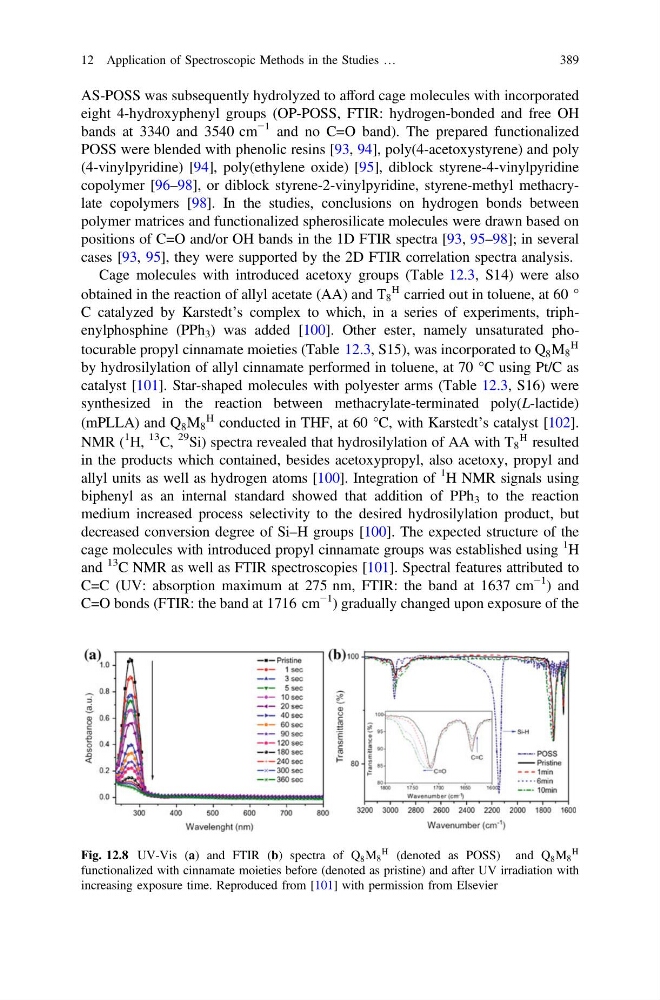
C catalyzed by Karstedt’s complex to which, in a series of experiments, triphenylphosphine (PPh 3 ) was added [100]. Other ester, namely unsaturated photocurable propyl cinnamate moieties (Table 12.3, S15), was incorporated to Q 8 M 8
H
by hydrosilylation of allyl cinnamate performed in toluene, at 70 °C using Pt/C as
catalyst [101]. Star-shaped molecules with polyester arms (Table 12.3, S16) were
synthesized in the reaction between methacrylate-terminated poly(L-lactide)
(mPLLA) and Q 8 M 8
H conducted in THF, at 60 °C, with Karstedt’s catalyst [102].
NMR (
1 H,
13 C,
29 Si) spectra revealed that hydrosilylation of AA with T 8
H resulted
in the products which contained, besides acetoxypropyl, also acetoxy, propyl and
allyl units as well as hydrogen atoms [100]. Integration of
1 H NMR signals using
biphenyl as an internal standard showed that addition of PPh 3 to the reaction
medium increased process selectivity to the desired hydrosilylation product, but
decreased conversion degree of Si–H groups [100]. The expected structure of the
cage molecules with introduced propyl cinnamate groups was established using
1
H
and
13 C NMR as well as FTIR spectroscopies [101]. Spectral features attributed to
C=C (UV: absorption maximum at 275 nm, FTIR: the band at 1637 cm
−1 ) and
C=O bonds (FTIR: the band at 1716 cm
−1 ) gradually changed upon exposure of the
Fig. 12.8 UV-Vis (a) and FTIR (b) spectra of Q 8 M 8
H (denoted as POSS) and Q 8 M 8
H
functionalized with cinnamate moieties before (denoted as pristine) and after UV irradiation with
increasing exposure time. Reproduced from [101] with permission from Elsevier
12 Application of Spectroscopic Methods in the Studies …
389
eight 4-hydroxyphenyl groups (OP-POSS, FTIR: hydrogen-bonded and free OH
bands at 3340 and 3540 cm
−1 and no C=O band). The prepared functionalized
POSS were blended with phenolic resins [93, 94], poly(4-acetoxystyrene) and poly
(4-vinylpyridine) [94], poly(ethylene oxide) [95], diblock styrene-4-vinylpyridine
copolymer [96–98], or diblock styrene-2-vinylpyridine, styrene-methyl methacrylate copolymers [98]. In the studies, conclusions on hydrogen bonds between
polymer matrices and functionalized spherosilicate molecules were drawn based on
positions of C=O and/or OH bands in the 1D FTIR spectra [93, 95–98]; in several
cases [93, 95], they were supported by the 2D FTIR correlation spectra analysis.
Cage molecules with introduced acetoxy groups (Table 12.3, S14) were also
obtained in the reaction of allyl acetate (AA) and T 8
H carried out in toluene, at 60 °
C catalyzed by Karstedt’s complex to which, in a series of experiments, triphenylphosphine (PPh 3 ) was added [100]. Other ester, namely unsaturated photocurable propyl cinnamate moieties (Table 12.3, S15), was incorporated to Q 8 M 8
H
by hydrosilylation of allyl cinnamate performed in toluene, at 70 °C using Pt/C as
catalyst [101]. Star-shaped molecules with polyester arms (Table 12.3, S16) were
synthesized in the reaction between methacrylate-terminated poly(L-lactide)
(mPLLA) and Q 8 M 8
H conducted in THF, at 60 °C, with Karstedt’s catalyst [102].
NMR (
1 H,
13 C,
29 Si) spectra revealed that hydrosilylation of AA with T 8
H resulted
in the products which contained, besides acetoxypropyl, also acetoxy, propyl and
allyl units as well as hydrogen atoms [100]. Integration of
1 H NMR signals using
biphenyl as an internal standard showed that addition of PPh 3 to the reaction
medium increased process selectivity to the desired hydrosilylation product, but
decreased conversion degree of Si–H groups [100]. The expected structure of the
cage molecules with introduced propyl cinnamate groups was established using
1
H
and
13 C NMR as well as FTIR spectroscopies [101]. Spectral features attributed to
C=C (UV: absorption maximum at 275 nm, FTIR: the band at 1637 cm
−1 ) and
C=O bonds (FTIR: the band at 1716 cm
−1 ) gradually changed upon exposure of the
Fig. 12.8 UV-Vis (a) and FTIR (b) spectra of Q 8 M 8
H (denoted as POSS) and Q 8 M 8
H
functionalized with cinnamate moieties before (denoted as pristine) and after UV irradiation with
increasing exposure time. Reproduced from [101] with permission from Elsevier
12 Application of Spectroscopic Methods in the Studies …
389