

was followed by the reaction (conducted at 60 °C) with vinyltrimethoxysilane in
order to introduce methoxy side groups that allowed polymer’s cross-linking in the
next step. Products of the reactions were studied by FTIR-ATR,
1 H (1D as well as
2D COSY technique) and
29
Si NMR spectroscopies. In the FTIR-ATR spectra,
there was no Si–H absorption band at 2156 cm
−1 and new bands at 3056 and
1600 cm
−1 , representing aromatic units of carbazole, occurred. The band at
2840 cm
−1 of C–H vibrations in methoxy groups manifested the incorporation of
trimethoxysilyl moieties into the polymer. Successful hydrosilylation of the two
vinyl compounds was also confirmed by
1 H NMR spectra in which the signals due
to protons of C=C bonds (d = 5.0–6.5 ppm) were absent and those attributed to
aromatic protons of carbazolyl units (d = 7.0–8.0 ppm) were visible. A 2D
1 H–
1 H
COSY dataset provided information on mutually coupled protons and thus made
the complete structural characterization of the synthesized compounds possible
[77].
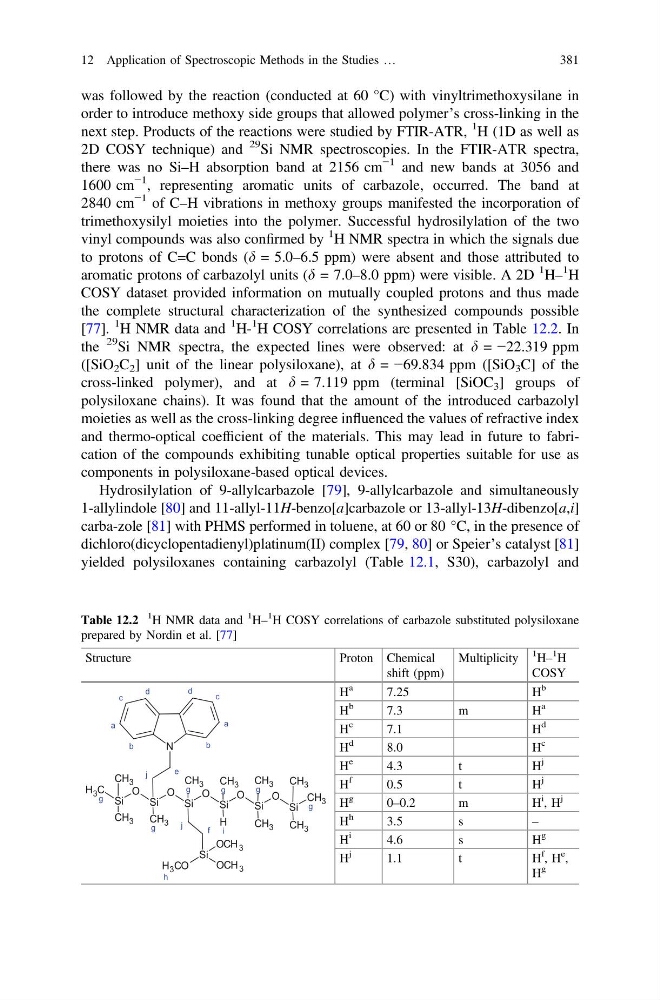
1 H NMR data and
1 H1 H COSY correlations are presented in Table 12.2. In
the
29 Si NMR spectra, the expected lines were observed: at d = −22.319 ppm
([SiO 2 C 2 ] unit of the linear polysiloxane), at d = −69.834 ppm ([SiO 3 C] of the
cross-linked polymer), and at d = 7.119 ppm (terminal [SiOC 3 ] groups of
polysiloxane chains). It was found that the amount of the introduced carbazolyl
moieties as well as the cross-linking degree influenced the values of refractive index
and thermo-optical coefficient of the materials. This may lead in future to fabrication of the compounds exhibiting tunable optical properties suitable for use as
components in polysiloxane-based optical devices.
Hydrosilylation of 9-allylcarbazole [79], 9-allylcarbazole and simultaneously
1-allylindole [80] and 11-allyl-11H-benzo[a]carbazole or 13-allyl-13H-dibenzo[a,i]
carba-zole [81] with PHMS performed in toluene, at 60 or 80 °C, in the presence of
dichloro(dicyclopentadienyl)platinum(II) complex [79, 80] or Speier’s catalyst [81]
yielded polysiloxanes containing carbazolyl (Table 12.1, S30), carbazolyl and
Table 12.2
1
H NMR data and
1
H–
1
H COSY correlations of carbazole substituted polysiloxane
prepared by Nordin et al. [77]
Structure
Proton Chemical
shift (ppm)
Multiplicity
1
H–
1
H
COSY
Si
O
Si
O
Si
O
Si
O
Si
O
Si
C
H 3 g
CH 3
g
CH 3
CH 3
CH 3
g
j
e
N
b
a
d
c
b
a
d
c
j
CH 3
g
f
Si
H 3 CO
h
OCH 3
OCH 3
H
i
CH 3
g
CH 3
CH 3
g
CH 3
CH 3
H
a
7.25
H
b
H
b
7.3
m
H
a
H
c
7.1
H
d
H
d
8.0
H
c
H
e
4.3
t
H
j
H
f
0.5
t
H
j
H
g
0–0.2
m
H
i
, H
j
H
h
3.5
s
–
H
i
4.6
s
H
g
H
j
1.1
t
H
f
, H
e ,
H
g
12 Application of Spectroscopic Methods in the Studies …
381
order to introduce methoxy side groups that allowed polymer’s cross-linking in the
next step. Products of the reactions were studied by FTIR-ATR,
1 H (1D as well as
2D COSY technique) and
29
Si NMR spectroscopies. In the FTIR-ATR spectra,
there was no Si–H absorption band at 2156 cm
−1 and new bands at 3056 and
1600 cm
−1 , representing aromatic units of carbazole, occurred. The band at
2840 cm
−1 of C–H vibrations in methoxy groups manifested the incorporation of
trimethoxysilyl moieties into the polymer. Successful hydrosilylation of the two
vinyl compounds was also confirmed by
1 H NMR spectra in which the signals due
to protons of C=C bonds (d = 5.0–6.5 ppm) were absent and those attributed to
aromatic protons of carbazolyl units (d = 7.0–8.0 ppm) were visible. A 2D
1 H–
1 H
COSY dataset provided information on mutually coupled protons and thus made
the complete structural characterization of the synthesized compounds possible
[77].
1 H NMR data and
1 H1 H COSY correlations are presented in Table 12.2. In
the
29 Si NMR spectra, the expected lines were observed: at d = −22.319 ppm
([SiO 2 C 2 ] unit of the linear polysiloxane), at d = −69.834 ppm ([SiO 3 C] of the
cross-linked polymer), and at d = 7.119 ppm (terminal [SiOC 3 ] groups of
polysiloxane chains). It was found that the amount of the introduced carbazolyl
moieties as well as the cross-linking degree influenced the values of refractive index
and thermo-optical coefficient of the materials. This may lead in future to fabrication of the compounds exhibiting tunable optical properties suitable for use as
components in polysiloxane-based optical devices.
Hydrosilylation of 9-allylcarbazole [79], 9-allylcarbazole and simultaneously
1-allylindole [80] and 11-allyl-11H-benzo[a]carbazole or 13-allyl-13H-dibenzo[a,i]
carba-zole [81] with PHMS performed in toluene, at 60 or 80 °C, in the presence of
dichloro(dicyclopentadienyl)platinum(II) complex [79, 80] or Speier’s catalyst [81]
yielded polysiloxanes containing carbazolyl (Table 12.1, S30), carbazolyl and
Table 12.2
1
H NMR data and
1
H–
1
H COSY correlations of carbazole substituted polysiloxane
prepared by Nordin et al. [77]
Structure
Proton Chemical
shift (ppm)
Multiplicity
1
H–
1
H
COSY
Si
O
Si
O
Si
O
Si
O
Si
O
Si
C
H 3 g
CH 3
g
CH 3
CH 3
CH 3
g
j
e
N
b
a
d
c
b
a
d
c
j
CH 3
g
f
Si
H 3 CO
h
OCH 3
OCH 3
H
i
CH 3
g
CH 3
CH 3
g
CH 3
CH 3
H
a
7.25
H
b
H
b
7.3
m
H
a
H
c
7.1
H
d
H
d
8.0
H
c
H
e
4.3
t
H
j
H
f
0.5
t
H
j
H
g
0–0.2
m
H
i
, H
j
H
h
3.5
s
–
H
i
4.6
s
H
g
H
j
1.1
t
H
f
, H
e ,
H
g
12 Application of Spectroscopic Methods in the Studies …
381