

polysiloxanes modified by oxygen-containing side groups, the ones with acrylic,
methacrylic ester or acid and polyether moieties seem to be the most important
because potentially they can be applied as biomaterials, surfactants, or polymer
electrolytes. In the literature there are, however, also examples of polysiloxanes
functionalized with other oxygen-containing pendant groups via hydrosilylation.
In several investigations, acrylic and methacrylic ester or acid moieties were
introduced to PHMS and its copolymers as the only side groups [23, 37–39]. Hao
et al. [23] hydrosilylated allyl methacrylate with PHMS-DMS copolymers, called
by the authors prepolymers, containing various amounts of [Si(CH 3 )H] units
(60 °C, toluene, Karstedt’s or Speier’s catalyst). Hydrosilylation products
(Table 12.1, polymer B-S6), in the paper referred to as macromonomers, were
polymerized in the presence of a photo-initiator under irradiation of blue light
which resulted in the formation of soft polysiloxane gels. The aim of the work was
to obtain injectable, curable in situ materials suitable for fabrication of artificial,
accommodating intraocular lenses that would mimic the performance of natural
lenses in eyes of a young person. Spectroscopic methods were applied in the studies
to determine the average molecular weight of prepolymers and macromonomers
(based on the end group analysis by
1 H NMR), to follow the progress of the
hydrosilylation process (in situ FTIR measurements), to establish the chemical
structure of the prepolymers and macromonomers (FTIR and
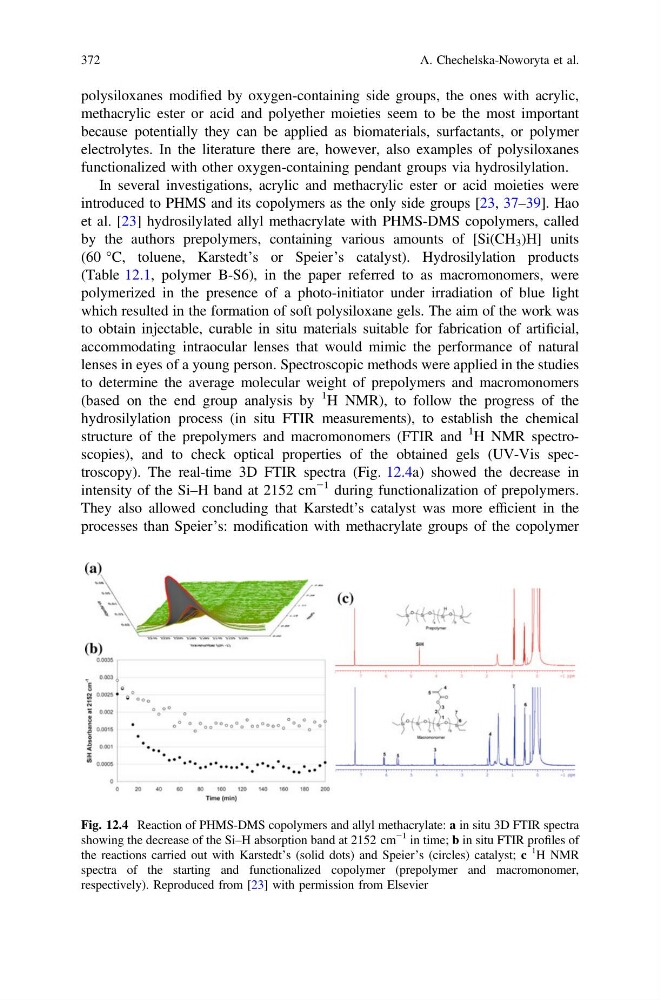
1 H NMR spectroscopies), and to check optical properties of the obtained gels (UV-Vis spectroscopy). The real-time 3D FTIR spectra (Fig. 12.4a) showed the decrease in
intensity of the Si–H band at 2152 cm
−1 during functionalization of prepolymers.
They also allowed concluding that Karstedt’s catalyst was more efficient in the
processes than Speier’s: modification with methacrylate groups of the copolymer
Fig. 12.4 Reaction of PHMS-DMS copolymers and allyl methacrylate: a in situ 3D FTIR spectra
showing the decrease of the Si–H absorption band at 2152 cm
−1 in time; b in situ FTIR profiles of
the reactions carried out with Karstedt’s (solid dots) and Speier’s (circles) catalyst; c
1
H NMR
spectra of the starting and functionalized copolymer (prepolymer and macromonomer,
respectively). Reproduced from [23] with permission from Elsevier
372
A. Chechelska-Noworyta et al.
methacrylic ester or acid and polyether moieties seem to be the most important
because potentially they can be applied as biomaterials, surfactants, or polymer
electrolytes. In the literature there are, however, also examples of polysiloxanes
functionalized with other oxygen-containing pendant groups via hydrosilylation.
In several investigations, acrylic and methacrylic ester or acid moieties were
introduced to PHMS and its copolymers as the only side groups [23, 37–39]. Hao
et al. [23] hydrosilylated allyl methacrylate with PHMS-DMS copolymers, called
by the authors prepolymers, containing various amounts of [Si(CH 3 )H] units
(60 °C, toluene, Karstedt’s or Speier’s catalyst). Hydrosilylation products
(Table 12.1, polymer B-S6), in the paper referred to as macromonomers, were
polymerized in the presence of a photo-initiator under irradiation of blue light
which resulted in the formation of soft polysiloxane gels. The aim of the work was
to obtain injectable, curable in situ materials suitable for fabrication of artificial,
accommodating intraocular lenses that would mimic the performance of natural
lenses in eyes of a young person. Spectroscopic methods were applied in the studies
to determine the average molecular weight of prepolymers and macromonomers
(based on the end group analysis by
1 H NMR), to follow the progress of the
hydrosilylation process (in situ FTIR measurements), to establish the chemical
structure of the prepolymers and macromonomers (FTIR and
1 H NMR spectroscopies), and to check optical properties of the obtained gels (UV-Vis spectroscopy). The real-time 3D FTIR spectra (Fig. 12.4a) showed the decrease in
intensity of the Si–H band at 2152 cm
−1 during functionalization of prepolymers.
They also allowed concluding that Karstedt’s catalyst was more efficient in the
processes than Speier’s: modification with methacrylate groups of the copolymer
Fig. 12.4 Reaction of PHMS-DMS copolymers and allyl methacrylate: a in situ 3D FTIR spectra
showing the decrease of the Si–H absorption band at 2152 cm
−1 in time; b in situ FTIR profiles of
the reactions carried out with Karstedt’s (solid dots) and Speier’s (circles) catalyst; c
1
H NMR
spectra of the starting and functionalized copolymer (prepolymer and macromonomer,
respectively). Reproduced from [23] with permission from Elsevier
372
A. Chechelska-Noworyta et al.