

They include migration of the carbon–carbon double bond in the alkene derivative
or dehydrogenation of Si–H groups [17].
Hydrosilylation of carbon–carbon multiple bonds finds a wide range of applications. This process carried out in the presence of Karstedt’s catalyst is used to
cross-link PDMS with vinyl or Si–H terminal groups to form PDMS gels or
elastomers for which there is a big market [19]. Hydrosilylation of carbon–carbon
triple bonds leads to valuable, unsaturated products which can be further modified
[17]. This reaction is also a convenient way to synthesize polymers and to introduce
organic functional groups into organosilicon compounds [11, 17, 18].
12.3 Spectroscopic Methods Applied in the Studies
of Polysiloxanes, Oligomeric Silsesquioxanes,
and Spherosilicates Modified by Hydrosilylation
The main spectroscopic methods applied in the studies of polysiloxanes, cubic
oligomeric silsesquioxanes, and spherosilicates modified by hydrosilylation are
Fourier Transform Infrared (FTIR) and Nuclear Magnetic Resonance (NMR).
FTIR spectroscopy in mid-infrared range of 400–4000 cm
−1 , as a technique
sensitive to bonds between atoms, is primarily utilized for qualitative analysis, i.e.,
to identify chemical structure of the hydrosilylation products. The advantage of this
method in the studies of hydrosilylation is that the band corresponding to stretching
vibrations of Si–H groups, located between 2100 and 2200 cm
−1 [22], is distinct
and does not interfere with any other bands in the spectra of organosilicon compounds. Lowering in its intensity or its disappearance from the spectrum proves that
the reaction has occurred. The Si–H band is also sometimes used to follow
hydrosilylation quantitatively. Such analysis can be conducted in situ, i.e., during
the reaction [23, 24] or ex situ, i.e., using the spectra of the samples withdrawn from
the reaction medium after certain time periods [12, 13, 25]. In the former case, the
analysis is based on direct measurements of Si–H band integral intensities in the
spectra. In the latter, Si–H band calibration is performed using an external standard
[25], or the ratios of the integral intensities of the Si–H band and the band that stays
constant during the process (an internal standard, usually the band originating from
the asymmetric stretching vibrations of C–H bond in Si–CH 3 groups at ca.
1250 cm
−1 [22]) are calculated and compared as the reaction progresses [12, 13].
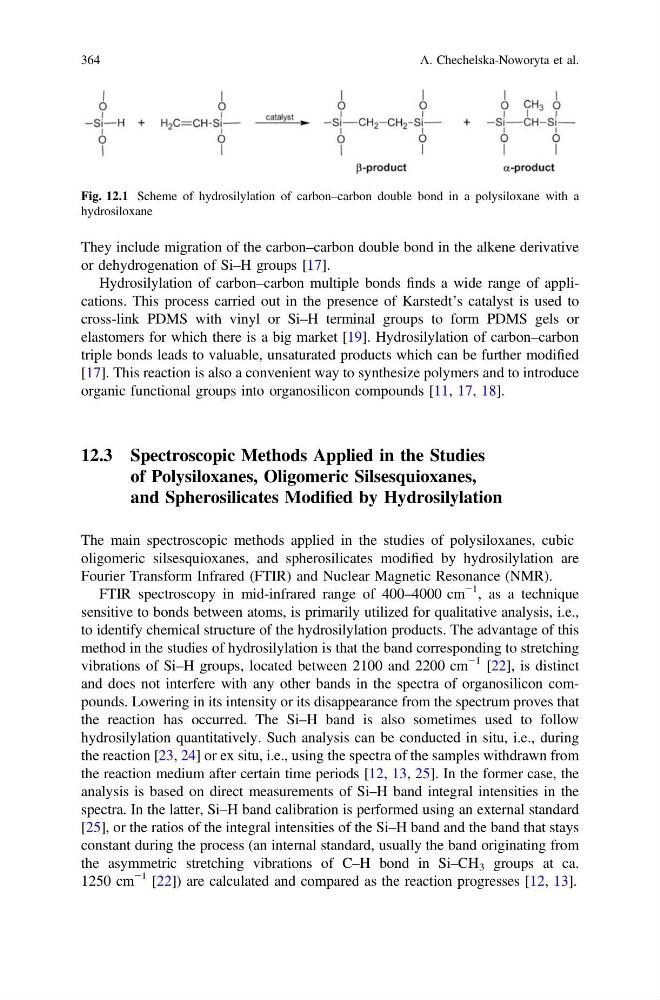
Fig. 12.1 Scheme of hydrosilylation of carbon–carbon double bond in a polysiloxane with a
hydrosiloxane
364
A. Chechelska-Noworyta et al.
or dehydrogenation of Si–H groups [17].
Hydrosilylation of carbon–carbon multiple bonds finds a wide range of applications. This process carried out in the presence of Karstedt’s catalyst is used to
cross-link PDMS with vinyl or Si–H terminal groups to form PDMS gels or
elastomers for which there is a big market [19]. Hydrosilylation of carbon–carbon
triple bonds leads to valuable, unsaturated products which can be further modified
[17]. This reaction is also a convenient way to synthesize polymers and to introduce
organic functional groups into organosilicon compounds [11, 17, 18].
12.3 Spectroscopic Methods Applied in the Studies
of Polysiloxanes, Oligomeric Silsesquioxanes,
and Spherosilicates Modified by Hydrosilylation
The main spectroscopic methods applied in the studies of polysiloxanes, cubic
oligomeric silsesquioxanes, and spherosilicates modified by hydrosilylation are
Fourier Transform Infrared (FTIR) and Nuclear Magnetic Resonance (NMR).
FTIR spectroscopy in mid-infrared range of 400–4000 cm
−1 , as a technique
sensitive to bonds between atoms, is primarily utilized for qualitative analysis, i.e.,
to identify chemical structure of the hydrosilylation products. The advantage of this
method in the studies of hydrosilylation is that the band corresponding to stretching
vibrations of Si–H groups, located between 2100 and 2200 cm
−1 [22], is distinct
and does not interfere with any other bands in the spectra of organosilicon compounds. Lowering in its intensity or its disappearance from the spectrum proves that
the reaction has occurred. The Si–H band is also sometimes used to follow
hydrosilylation quantitatively. Such analysis can be conducted in situ, i.e., during
the reaction [23, 24] or ex situ, i.e., using the spectra of the samples withdrawn from
the reaction medium after certain time periods [12, 13, 25]. In the former case, the
analysis is based on direct measurements of Si–H band integral intensities in the
spectra. In the latter, Si–H band calibration is performed using an external standard
[25], or the ratios of the integral intensities of the Si–H band and the band that stays
constant during the process (an internal standard, usually the band originating from
the asymmetric stretching vibrations of C–H bond in Si–CH 3 groups at ca.
1250 cm
−1 [22]) are calculated and compared as the reaction progresses [12, 13].
Fig. 12.1 Scheme of hydrosilylation of carbon–carbon double bond in a polysiloxane with a
hydrosiloxane
364
A. Chechelska-Noworyta et al.