

Raman and in situ DR-UV-Vis experiments show that the surface of the cobalt
catalyst deposited at the metallic support oxidised during catalytic combustion on nnonane. Analysis of 2D correlation µRaman spectra reveals that the band at
520 cm
−1 , attributed to the cobalt spinel oxide, broadens with increased temperature. Additionally, analysis of the asynchronous DRIFT spectra reveals bands that
were not easily observable in standard and synchronous spectra.
A series of investigations devoted to 2D COS FTIR spectroscopy
transmission-absorption mode is reported in the references [88–90]. The in situ
FTIR studies were performed to characterise xylene isomerisation over hierarchical
zeolites. The complexity of the spectra for individual products of isomerisation and
by-products makes overall analysis and further insights into mechanistic studies
challenging. Analysis of 2D correlation spectra has also confirmed that the high
selectivity towards the p-xylene was also influenced by the microporous character
of the selected zeolites.
11.2.3 in Situ Raman Spectroscopy
Raman spectroscopy is based on an outstanding effect that occurs upon light
scattering in contact with matter. It happens that a part of the scattered light
undergoes inelastic effects as opposed to Rayleigh phenomena, which are dominant.
Depending on the distribution of bosons, representing the vibrating molecules in
ground and excited vibrational states, two effects occur. Notwithstanding the further
mechanism, the low-temperature effect called Stokes effect, leads to a change in the
occupancy of the states towards the excited vibrational state, as the majority of the
molecules are originally located on the ground state (as described by the Bose–
Einstein distribution function). The anti-Stokes effect is opposite, shifting the
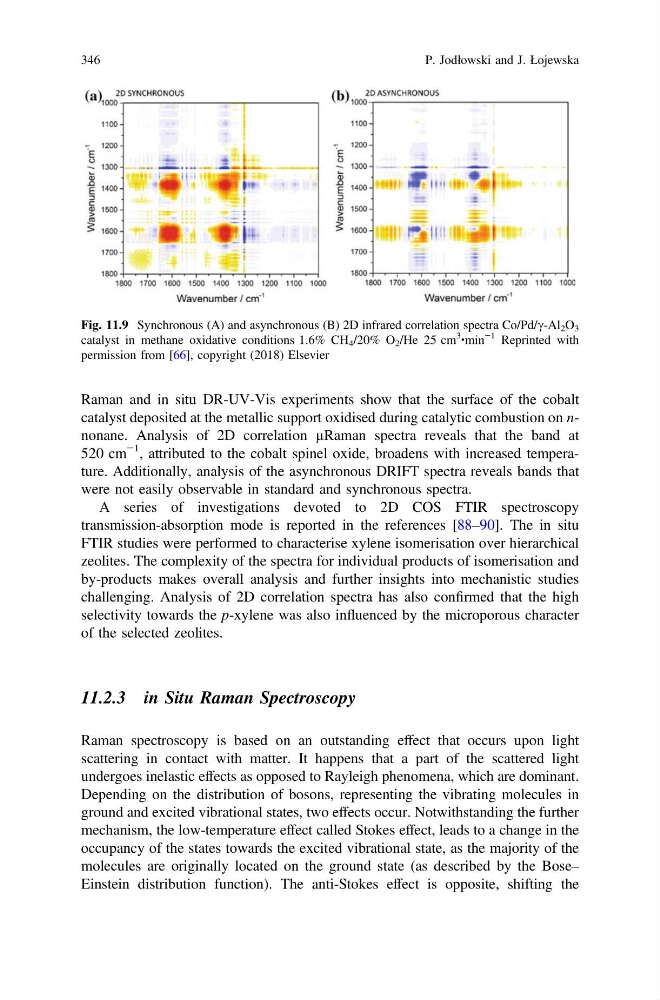
Fig. 11.9 Synchronous (A) and asynchronous (B) 2D infrared correlation spectra Co/Pd/c-Al 2 O 3
catalyst in methane oxidative conditions 1.6% CH 4 /20% O 2 /He 25 cm
3
∙min
−1 Reprinted with
permission from [66], copyright (2018) Elsevier
346
P. Jodłowski and J. Łojewska
catalyst deposited at the metallic support oxidised during catalytic combustion on nnonane. Analysis of 2D correlation µRaman spectra reveals that the band at
520 cm
−1 , attributed to the cobalt spinel oxide, broadens with increased temperature. Additionally, analysis of the asynchronous DRIFT spectra reveals bands that
were not easily observable in standard and synchronous spectra.
A series of investigations devoted to 2D COS FTIR spectroscopy
transmission-absorption mode is reported in the references [88–90]. The in situ
FTIR studies were performed to characterise xylene isomerisation over hierarchical
zeolites. The complexity of the spectra for individual products of isomerisation and
by-products makes overall analysis and further insights into mechanistic studies
challenging. Analysis of 2D correlation spectra has also confirmed that the high
selectivity towards the p-xylene was also influenced by the microporous character
of the selected zeolites.
11.2.3 in Situ Raman Spectroscopy
Raman spectroscopy is based on an outstanding effect that occurs upon light
scattering in contact with matter. It happens that a part of the scattered light
undergoes inelastic effects as opposed to Rayleigh phenomena, which are dominant.
Depending on the distribution of bosons, representing the vibrating molecules in
ground and excited vibrational states, two effects occur. Notwithstanding the further
mechanism, the low-temperature effect called Stokes effect, leads to a change in the
occupancy of the states towards the excited vibrational state, as the majority of the
molecules are originally located on the ground state (as described by the Bose–
Einstein distribution function). The anti-Stokes effect is opposite, shifting the
Fig. 11.9 Synchronous (A) and asynchronous (B) 2D infrared correlation spectra Co/Pd/c-Al 2 O 3
catalyst in methane oxidative conditions 1.6% CH 4 /20% O 2 /He 25 cm
3
∙min
−1 Reprinted with
permission from [66], copyright (2018) Elsevier
346
P. Jodłowski and J. Łojewska