

marginalised [63]. Since the first heated DRIFT cell was presented by Hamadeh
et al. [64] the several in situ DRIFT cells have been proposed [4, 7]. The currently
commercially available high temperature in situ cells are able to achieve temperatures up to 910 °C under vacuum, which increases the applicability of DRIFT
analysis for catalyst characterisation.
In the literature, numerous reports describe the application of in situ and operando DRIFT spectroscopy to characterise catalyst structure–activity relationships
[7, 65–70]. The operando studies are not limited only to measuring the gas phase
by the detection of effluent gases using gas spectrometers or mass spectrometers,
but more detailed catalyst characterisation studies using combined DRIFT/XAS
[71, 72] and DRIFT/XANES/MS [73] can be also found.
The possible application of in situ DRFIT spectroscopy for the determination of
surface intermediates during the catalytic combustion of methane was presented in
work by Jodłowski et al., shown here as an example [66]. DRIFT analysis of the
catalyst’s surface indicated the different active site occupation under oxygen-rich
and oxygen-less conditions. It showed methoxy groups of characteristic bands at
2999 and 2907 cm
−1 , attributed to –OCH 3 , and formate HCOO
− species, respectively. TPSR experiments also show (cf. Figure 11.7) that methane is able to react
with the catalyst surface under oxygen-less conditions, indicating the Mars–
van-Kreveln mechanism which is involved in its oxidation. This resulted in more
intense bands in the 1650–1200 cm
−1 range for oxygen-free conditions, which were
attributed to carbonates and formates. The combination of static and pulse together
with oxygen-rich and oxygen-free conditions brought about the recognition of
stable surface intermediates, which allowed the methane catalytic combustion
mechanism over supported oxide catalyst to be derived (Fig. 11.8).
The operando mode of DRIFT experiments seems to be a powerful tool for
determining the relations with the structure of active centres and the observed
catalytic activity. The detection of the effluent gases is carried out with connected
gas analysers, from which Gas chromatographs (GC) or quadrupole mass spectrometers (QMSs) are the most commonly used. GC or QMS allows precise
determination and quantitative analysis of the effluent gas composition. In a study
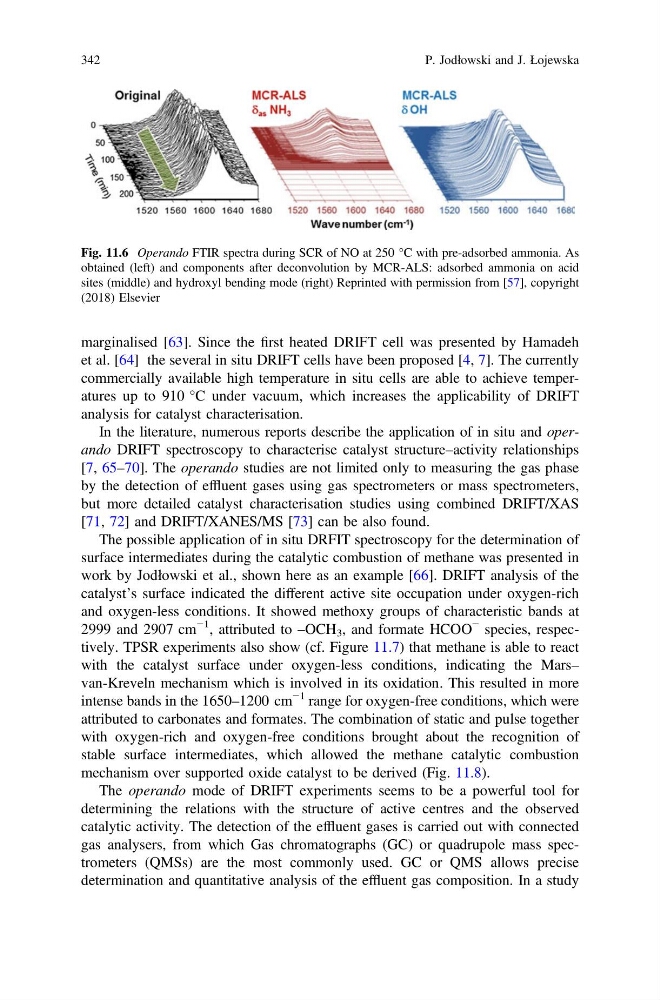
Fig. 11.6 Operando FTIR spectra during SCR of NO at 250 °C with pre-adsorbed ammonia. As
obtained (left) and components after deconvolution by MCR-ALS: adsorbed ammonia on acid
sites (middle) and hydroxyl bending mode (right) Reprinted with permission from [57], copyright
(2018) Elsevier
342
P. Jodłowski and J. Łojewska
et al. [64] the several in situ DRIFT cells have been proposed [4, 7]. The currently
commercially available high temperature in situ cells are able to achieve temperatures up to 910 °C under vacuum, which increases the applicability of DRIFT
analysis for catalyst characterisation.
In the literature, numerous reports describe the application of in situ and operando DRIFT spectroscopy to characterise catalyst structure–activity relationships
[7, 65–70]. The operando studies are not limited only to measuring the gas phase
by the detection of effluent gases using gas spectrometers or mass spectrometers,
but more detailed catalyst characterisation studies using combined DRIFT/XAS
[71, 72] and DRIFT/XANES/MS [73] can be also found.
The possible application of in situ DRFIT spectroscopy for the determination of
surface intermediates during the catalytic combustion of methane was presented in
work by Jodłowski et al., shown here as an example [66]. DRIFT analysis of the
catalyst’s surface indicated the different active site occupation under oxygen-rich
and oxygen-less conditions. It showed methoxy groups of characteristic bands at
2999 and 2907 cm
−1 , attributed to –OCH 3 , and formate HCOO
− species, respectively. TPSR experiments also show (cf. Figure 11.7) that methane is able to react
with the catalyst surface under oxygen-less conditions, indicating the Mars–
van-Kreveln mechanism which is involved in its oxidation. This resulted in more
intense bands in the 1650–1200 cm
−1 range for oxygen-free conditions, which were
attributed to carbonates and formates. The combination of static and pulse together
with oxygen-rich and oxygen-free conditions brought about the recognition of
stable surface intermediates, which allowed the methane catalytic combustion
mechanism over supported oxide catalyst to be derived (Fig. 11.8).
The operando mode of DRIFT experiments seems to be a powerful tool for
determining the relations with the structure of active centres and the observed
catalytic activity. The detection of the effluent gases is carried out with connected
gas analysers, from which Gas chromatographs (GC) or quadrupole mass spectrometers (QMSs) are the most commonly used. GC or QMS allows precise
determination and quantitative analysis of the effluent gas composition. In a study
Fig. 11.6 Operando FTIR spectra during SCR of NO at 250 °C with pre-adsorbed ammonia. As
obtained (left) and components after deconvolution by MCR-ALS: adsorbed ammonia on acid
sites (middle) and hydroxyl bending mode (right) Reprinted with permission from [57], copyright
(2018) Elsevier
342
P. Jodłowski and J. Łojewska