

Despite the real progress that has been noted in in situ and operando experimental
approaches, there are still several problems associated with them, including reaction
temperature/pressure influence, catalyst form, catalyst activity and selectivity determination, and in situ cell construction [6]. In fact, it is the appropriate construction of
an in situ cell that defines the quality of the acquired spectra. The construction of
reaction cells is most often optimised for a specific spectroscopic method and available analytical device. The in situ cell can be “home-made” or chosen from commercially available solutions. Detailed examples of in situ cells for selected
spectroscopies can be found in the following exemplary references: IR [6, 7], Raman
[4, 6], UV-Vis [4, 6], XAS/XES [4, 8], and SAXS, AP XPS [9].
11.2 Methods for Real-Time Catalyst Investigation
11.2.1 Determination of Active Centres Using Probe
Molecules
The acidic properties of a catalyst’s surface play an important role in catalytic
processes. Many important technological processes, including catalytic cracking
[10], isomerization [11] and transesterification [12] rely on solid acid catalysts that
allow the use of fixed or fluidised-bed catalytic reactors [13]. The correct understanding of the nature, quantity and strength of the acid/base properties of the
catalysts used for technological processes has been the main topic of a vast array of
scientific papers over the decades [3, 14–18]. The term “active centre” was originally proposed by Taylor, who suggested that only a small percentage of a catalyst’s surface is able to adsorb and promote the catalytic reaction.
Nowadays, active sites are classified into several categories, the boundary of
which is redox and acidic/basic sites. The first category distinguishes the sites
varying in oxidation states of the metal and the sites composed of the charge
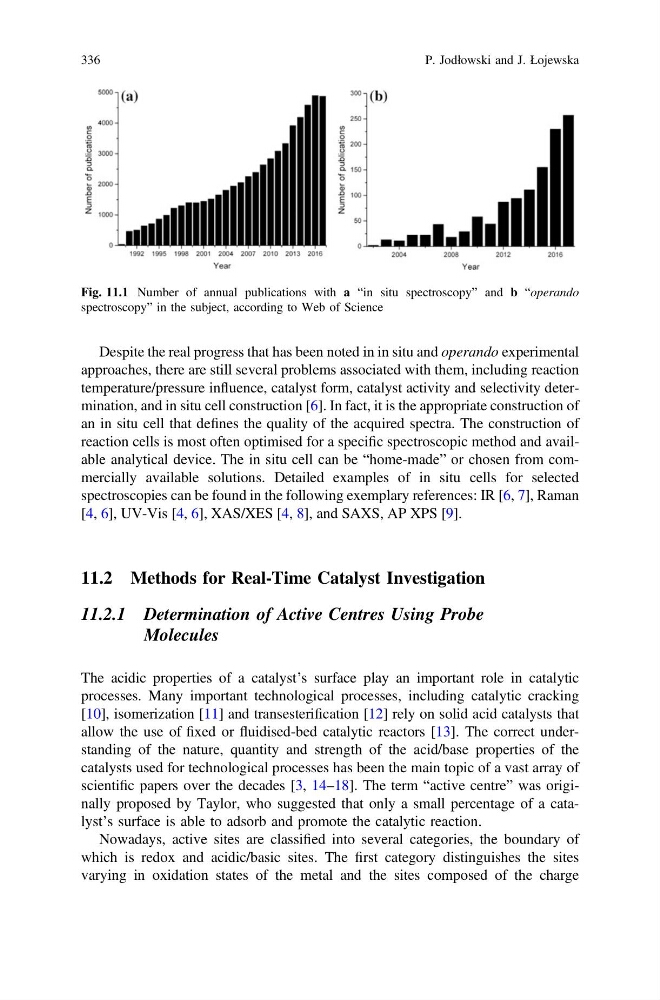
Fig. 11.1 Number of annual publications with a “in situ spectroscopy” and b “operando
spectroscopy” in the subject, according to Web of Science
336
P. Jodłowski and J. Łojewska
approaches, there are still several problems associated with them, including reaction
temperature/pressure influence, catalyst form, catalyst activity and selectivity determination, and in situ cell construction [6]. In fact, it is the appropriate construction of
an in situ cell that defines the quality of the acquired spectra. The construction of
reaction cells is most often optimised for a specific spectroscopic method and available analytical device. The in situ cell can be “home-made” or chosen from commercially available solutions. Detailed examples of in situ cells for selected
spectroscopies can be found in the following exemplary references: IR [6, 7], Raman
[4, 6], UV-Vis [4, 6], XAS/XES [4, 8], and SAXS, AP XPS [9].
11.2 Methods for Real-Time Catalyst Investigation
11.2.1 Determination of Active Centres Using Probe
Molecules
The acidic properties of a catalyst’s surface play an important role in catalytic
processes. Many important technological processes, including catalytic cracking
[10], isomerization [11] and transesterification [12] rely on solid acid catalysts that
allow the use of fixed or fluidised-bed catalytic reactors [13]. The correct understanding of the nature, quantity and strength of the acid/base properties of the
catalysts used for technological processes has been the main topic of a vast array of
scientific papers over the decades [3, 14–18]. The term “active centre” was originally proposed by Taylor, who suggested that only a small percentage of a catalyst’s surface is able to adsorb and promote the catalytic reaction.
Nowadays, active sites are classified into several categories, the boundary of
which is redox and acidic/basic sites. The first category distinguishes the sites
varying in oxidation states of the metal and the sites composed of the charge
Fig. 11.1 Number of annual publications with a “in situ spectroscopy” and b “operando
spectroscopy” in the subject, according to Web of Science
336
P. Jodłowski and J. Łojewska