

11.1 Introduction
Understanding the structure of catalyst surfaces and the surface intermediates
appearing during catalytic reactions is one of the key steps in determining the
reaction mechanism. Modern catalyst design for any technological process consolidates three scales: microscale, mesoscale and macroscale. The simultaneous
development of the technology allows scientists to look deeper into catalyst
structure and the elementary activity on the catalyst surface. The golden age of the
development of surface techniques started in the 1950 s [1], when new techniques
that allowed the detection limit to be decreased to the molecular level were
developed. The possibility of preparing ultrafine electronic materials allowed the
development of techniques for which ultra-high vacuum conditions are necessary.
Nowadays, the wide variety of techniques for catalyst characterisation allows a
choice of complimentary techniques for obtaining information about the measured
system. Over the years, the palette of available techniques has been increasing
gradually. The techniques used for catalyst characterisation described in this chapter
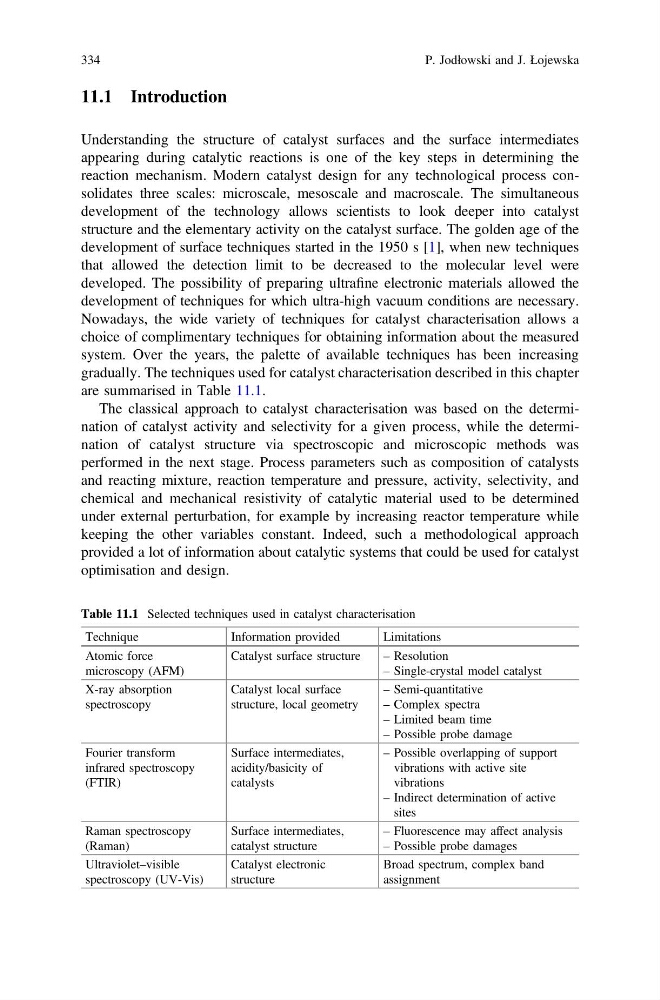
are summarised in Table 11.1.
The classical approach to catalyst characterisation was based on the determination of catalyst activity and selectivity for a given process, while the determination of catalyst structure via spectroscopic and microscopic methods was
performed in the next stage. Process parameters such as composition of catalysts
and reacting mixture, reaction temperature and pressure, activity, selectivity, and
chemical and mechanical resistivity of catalytic material used to be determined
under external perturbation, for example by increasing reactor temperature while
keeping the other variables constant. Indeed, such a methodological approach
provided a lot of information about catalytic systems that could be used for catalyst
optimisation and design.
Table 11.1 Selected techniques used in catalyst characterisation
Technique
Information provided
Limitations
Atomic force
microscopy (AFM)
Catalyst surface structure
– Resolution
– Single-crystal model catalyst
X-ray absorption
spectroscopy
Catalyst local surface
structure, local geometry
– Semi-quantitative
– Complex spectra
– Limited beam time
– Possible probe damage
Fourier transform
infrared spectroscopy
(FTIR)
Surface intermediates,
acidity/basicity of
catalysts
– Possible overlapping of support
vibrations with active site
vibrations
– Indirect determination of active
sites
Raman spectroscopy
(Raman)
Surface intermediates,
catalyst structure
– Fluorescence may affect analysis
– Possible probe damages
Ultraviolet–visible
spectroscopy (UV-Vis)
Catalyst electronic
structure
Broad spectrum, complex band
assignment
334
P. Jodłowski and J. Łojewska
Understanding the structure of catalyst surfaces and the surface intermediates
appearing during catalytic reactions is one of the key steps in determining the
reaction mechanism. Modern catalyst design for any technological process consolidates three scales: microscale, mesoscale and macroscale. The simultaneous
development of the technology allows scientists to look deeper into catalyst
structure and the elementary activity on the catalyst surface. The golden age of the
development of surface techniques started in the 1950 s [1], when new techniques
that allowed the detection limit to be decreased to the molecular level were
developed. The possibility of preparing ultrafine electronic materials allowed the
development of techniques for which ultra-high vacuum conditions are necessary.
Nowadays, the wide variety of techniques for catalyst characterisation allows a
choice of complimentary techniques for obtaining information about the measured
system. Over the years, the palette of available techniques has been increasing
gradually. The techniques used for catalyst characterisation described in this chapter
are summarised in Table 11.1.
The classical approach to catalyst characterisation was based on the determination of catalyst activity and selectivity for a given process, while the determination of catalyst structure via spectroscopic and microscopic methods was
performed in the next stage. Process parameters such as composition of catalysts
and reacting mixture, reaction temperature and pressure, activity, selectivity, and
chemical and mechanical resistivity of catalytic material used to be determined
under external perturbation, for example by increasing reactor temperature while
keeping the other variables constant. Indeed, such a methodological approach
provided a lot of information about catalytic systems that could be used for catalyst
optimisation and design.
Table 11.1 Selected techniques used in catalyst characterisation
Technique
Information provided
Limitations
Atomic force
microscopy (AFM)
Catalyst surface structure
– Resolution
– Single-crystal model catalyst
X-ray absorption
spectroscopy
Catalyst local surface
structure, local geometry
– Semi-quantitative
– Complex spectra
– Limited beam time
– Possible probe damage
Fourier transform
infrared spectroscopy
(FTIR)
Surface intermediates,
acidity/basicity of
catalysts
– Possible overlapping of support
vibrations with active site
vibrations
– Indirect determination of active
sites
Raman spectroscopy
(Raman)
Surface intermediates,
catalyst structure
– Fluorescence may affect analysis
– Possible probe damages
Ultraviolet–visible
spectroscopy (UV-Vis)
Catalyst electronic
structure
Broad spectrum, complex band
assignment
334
P. Jodłowski and J. Łojewska