

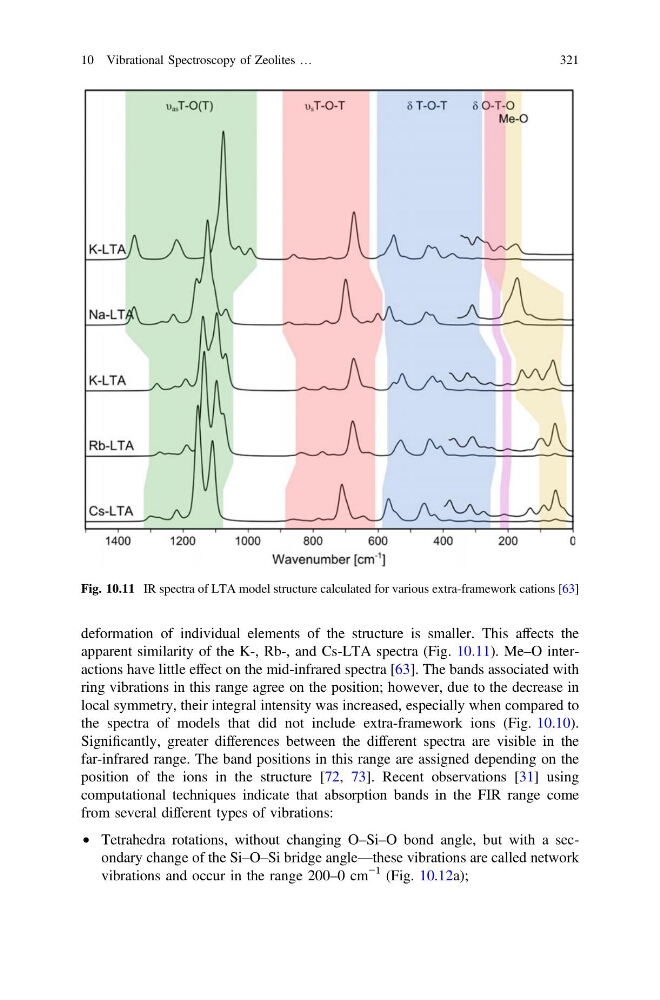
deformation of individual elements of the structure is smaller. This affects the
apparent similarity of the K-, Rb-, and Cs-LTA spectra (Fig. 10.11). Me–O interactions have little effect on the mid-infrared spectra [63]. The bands associated with
ring vibrations in this range agree on the position; however, due to the decrease in
local symmetry, their integral intensity was increased, especially when compared to
the spectra of models that did not include extra-framework ions (Fig. 10.10).
Significantly, greater differences between the different spectra are visible in the
far-infrared range. The band positions in this range are assigned depending on the
position of the ions in the structure [72, 73]. Recent observations [31] using
computational techniques indicate that absorption bands in the FIR range come
from several different types of vibrations:
• Tetrahedra rotations, without changing O–Si–O bond angle, but with a secondary change of the Si–O–Si bridge angle—these vibrations are called network
vibrations and occur in the range 200–0 cm
−1 (Fig. 10.12a);
Fig. 10.11 IR spectra of LTA model structure calculated for various extra-framework cations [63]
10 Vibrational Spectroscopy of Zeolites …
321
apparent similarity of the K-, Rb-, and Cs-LTA spectra (Fig. 10.11). Me–O interactions have little effect on the mid-infrared spectra [63]. The bands associated with
ring vibrations in this range agree on the position; however, due to the decrease in
local symmetry, their integral intensity was increased, especially when compared to
the spectra of models that did not include extra-framework ions (Fig. 10.10).
Significantly, greater differences between the different spectra are visible in the
far-infrared range. The band positions in this range are assigned depending on the
position of the ions in the structure [72, 73]. Recent observations [31] using
computational techniques indicate that absorption bands in the FIR range come
from several different types of vibrations:
• Tetrahedra rotations, without changing O–Si–O bond angle, but with a secondary change of the Si–O–Si bridge angle—these vibrations are called network
vibrations and occur in the range 200–0 cm
−1 (Fig. 10.12a);
Fig. 10.11 IR spectra of LTA model structure calculated for various extra-framework cations [63]
10 Vibrational Spectroscopy of Zeolites …
321