

results with the measured experimental spectra of zeolites [36, 37, 43, 49].
Characteristic bands, for example zeolites with different structural groups, are
summarized in Table 10.1. Particularly important from the point of view of
structural analysis is the pseudolattice region of spectrum (800–500 cm
−1
), in
which characteristic vibrations of SBUs occur. Based on the sequence of positions
and the ratio of the intensities of integral bands present in this range, it is possible to
identify a given type of structure (provided that the tested material is a single
phase).
It is worth noting that in addition to RO and PO vibrations of single and double
4- and 6-membered rings, shown in Fig. 10.4, a “pseudoring” RO-type
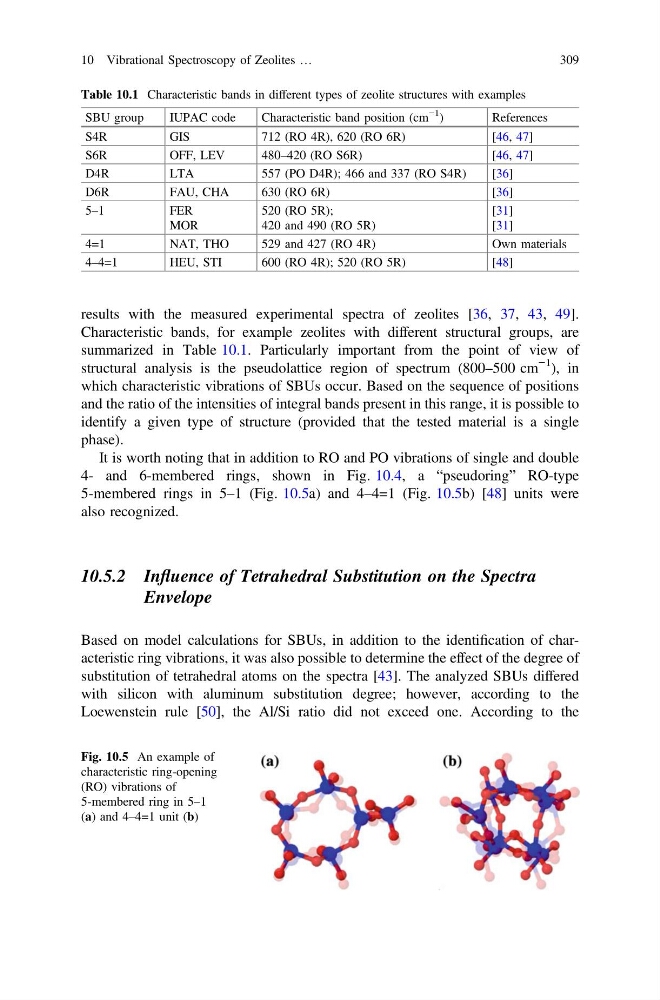
5-membered rings in 5–1 (Fig. 10.5a) and 4–4=1 (Fig. 10.5b) [48] units were
also recognized.
10.5.2 Influence of Tetrahedral Substitution on the Spectra
Envelope
Based on model calculations for SBUs, in addition to the identification of characteristic ring vibrations, it was also possible to determine the effect of the degree of
substitution of tetrahedral atoms on the spectra [43]. The analyzed SBUs differed
with silicon with aluminum substitution degree; however, according to the
Loewenstein rule [50], the Al/Si ratio did not exceed one. According to the
Table 10.1 Characteristic bands in different types of zeolite structures with examples
SBU group
IUPAC code
Characteristic band position (cm
−1
)
References
S4R
GIS
712 (RO 4R), 620 (RO 6R)
[46, 47]
S6R
OFF, LEV
480–420 (RO S6R)
[46, 47]
D4R
LTA
557 (PO D4R); 466 and 337 (RO S4R)
[36]
D6R
FAU, CHA
630 (RO 6R)
[36]
5–1
FER
MOR
520 (RO 5R);
420 and 490 (RO 5R)
[31]
[31]
4=1
NAT, THO
529 and 427 (RO 4R)
Own materials
4–4=1
HEU, STI
600 (RO 4R); 520 (RO 5R)
[48]
Fig. 10.5 An example of
characteristic ring-opening
(RO) vibrations of
5-membered ring in 5–1
(a) and 4–4=1 unit (b)
10 Vibrational Spectroscopy of Zeolites …
309
Characteristic bands, for example zeolites with different structural groups, are
summarized in Table 10.1. Particularly important from the point of view of
structural analysis is the pseudolattice region of spectrum (800–500 cm
−1
), in
which characteristic vibrations of SBUs occur. Based on the sequence of positions
and the ratio of the intensities of integral bands present in this range, it is possible to
identify a given type of structure (provided that the tested material is a single
phase).
It is worth noting that in addition to RO and PO vibrations of single and double
4- and 6-membered rings, shown in Fig. 10.4, a “pseudoring” RO-type
5-membered rings in 5–1 (Fig. 10.5a) and 4–4=1 (Fig. 10.5b) [48] units were
also recognized.
10.5.2 Influence of Tetrahedral Substitution on the Spectra
Envelope
Based on model calculations for SBUs, in addition to the identification of characteristic ring vibrations, it was also possible to determine the effect of the degree of
substitution of tetrahedral atoms on the spectra [43]. The analyzed SBUs differed
with silicon with aluminum substitution degree; however, according to the
Loewenstein rule [50], the Al/Si ratio did not exceed one. According to the
Table 10.1 Characteristic bands in different types of zeolite structures with examples
SBU group
IUPAC code
Characteristic band position (cm
−1
)
References
S4R
GIS
712 (RO 4R), 620 (RO 6R)
[46, 47]
S6R
OFF, LEV
480–420 (RO S6R)
[46, 47]
D4R
LTA
557 (PO D4R); 466 and 337 (RO S4R)
[36]
D6R
FAU, CHA
630 (RO 6R)
[36]
5–1
FER
MOR
520 (RO 5R);
420 and 490 (RO 5R)
[31]
[31]
4=1
NAT, THO
529 and 427 (RO 4R)
Own materials
4–4=1
HEU, STI
600 (RO 4R); 520 (RO 5R)
[48]
Fig. 10.5 An example of
characteristic ring-opening
(RO) vibrations of
5-membered ring in 5–1
(a) and 4–4=1 unit (b)
10 Vibrational Spectroscopy of Zeolites …
309