

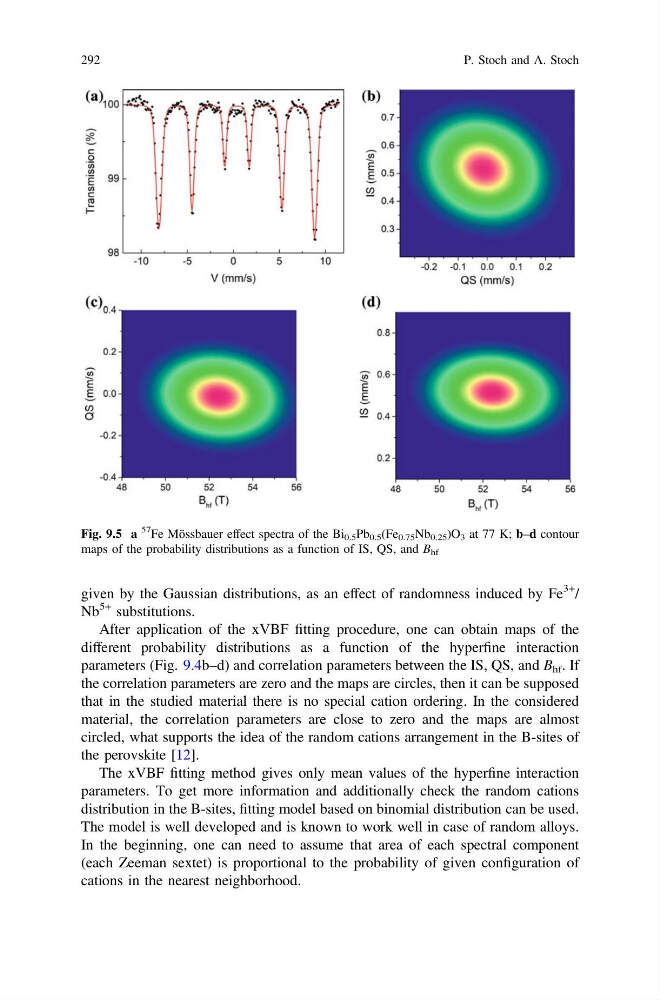
given by the Gaussian distributions, as an effect of randomness induced by Fe
3+ /
Nb
5+ substitutions.
After application of the xVBF fitting procedure, one can obtain maps of the
different probability distributions as a function of the hyperfine interaction
parameters (Fig. 9.4b–d) and correlation parameters between the IS, QS, and B hf . If
the correlation parameters are zero and the maps are circles, then it can be supposed
that in the studied material there is no special cation ordering. In the considered
material, the correlation parameters are close to zero and the maps are almost
circled, what supports the idea of the random cations arrangement in the B-sites of
the perovskite [12].
The xVBF fitting method gives only mean values of the hyperfine interaction
parameters. To get more information and additionally check the random cations
distribution in the B-sites, fitting model based on binomial distribution can be used.
The model is well developed and is known to work well in case of random alloys.
In the beginning, one can need to assume that area of each spectral component
(each Zeeman sextet) is proportional to the probability of given configuration of
cations in the nearest neighborhood.
Fig. 9.5 a
57
Fe Mössbauer effect spectra of the Bi 0.5 Pb 0.5 (Fe 0.75 Nb 0.25 )O 3 at 77 K; b–d contour
maps of the probability distributions as a function of IS, QS, and B hf
292
P. Stoch and A. Stoch
3+ /
Nb
5+ substitutions.
After application of the xVBF fitting procedure, one can obtain maps of the
different probability distributions as a function of the hyperfine interaction
parameters (Fig. 9.4b–d) and correlation parameters between the IS, QS, and B hf . If
the correlation parameters are zero and the maps are circles, then it can be supposed
that in the studied material there is no special cation ordering. In the considered
material, the correlation parameters are close to zero and the maps are almost
circled, what supports the idea of the random cations arrangement in the B-sites of
the perovskite [12].
The xVBF fitting method gives only mean values of the hyperfine interaction
parameters. To get more information and additionally check the random cations
distribution in the B-sites, fitting model based on binomial distribution can be used.
The model is well developed and is known to work well in case of random alloys.
In the beginning, one can need to assume that area of each spectral component
(each Zeeman sextet) is proportional to the probability of given configuration of
cations in the nearest neighborhood.
Fig. 9.5 a
57
Fe Mössbauer effect spectra of the Bi 0.5 Pb 0.5 (Fe 0.75 Nb 0.25 )O 3 at 77 K; b–d contour
maps of the probability distributions as a function of IS, QS, and B hf
292
P. Stoch and A. Stoch