

The values of V zz and ƞ (Eq. 9.6) parameters are the output of the calculation
software. Thus, one can easily calculate the effective field gradient V zz 1 þ
1
3 g
2
À
Á 1=2
which versus the experimental quadrupole splitting creates a straight line. In this
way, value of the unknown nuclear quadrupole moment Q can be estimated. The
Q value varied from +0.082 barn to +0.016 barn depending on the calculation
method. For the similar as above set of compounds, the FLAPW methods predict
the Q = +0.17(1) barn [17].
It should be notated that errors for both of the above parameters are larger than
simple linear regression errors and they are about 10% due to various approximations used and uncertainty of the experimental results [16].
In magnetic materials, the magnetic hyperfine field can be also calculated.
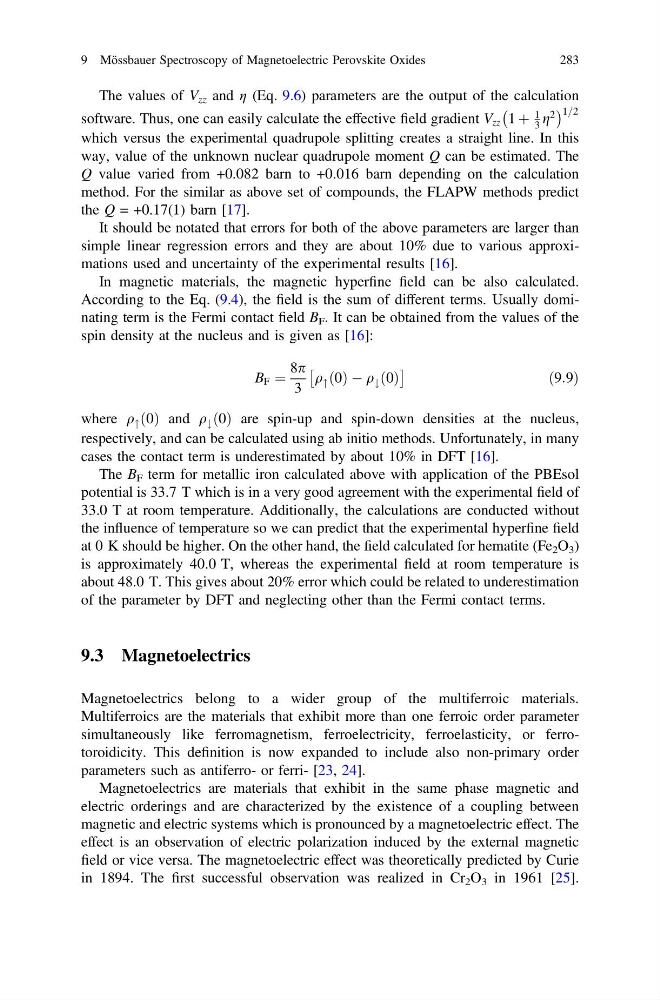
According to the Eq. (9.4), the field is the sum of different terms. Usually dominating term is the Fermi contact field B F . It can be obtained from the values of the
spin density at the nucleus and is given as [16]:
B F ¼
8p
3
q " 0
ð Þ À q # 0
ð Þ
Â
Ã
ð9:9Þ
where q " 0
ð Þ and q # 0
ð Þ are spin-up and spin-down densities at the nucleus,
respectively, and can be calculated using ab initio methods. Unfortunately, in many
cases the contact term is underestimated by about 10% in DFT [16].
The B F term for metallic iron calculated above with application of the PBEsol
potential is 33.7 T which is in a very good agreement with the experimental field of
33.0 T at room temperature. Additionally, the calculations are conducted without
the influence of temperature so we can predict that the experimental hyperfine field
at 0 K should be higher. On the other hand, the field calculated for hematite (Fe 2 O 3 )
is approximately 40.0 T, whereas the experimental field at room temperature is
about 48.0 T. This gives about 20% error which could be related to underestimation
of the parameter by DFT and neglecting other than the Fermi contact terms.
9.3 Magnetoelectrics
Magnetoelectrics belong to a wider group of the multiferroic materials.
Multiferroics are the materials that exhibit more than one ferroic order parameter
simultaneously like ferromagnetism, ferroelectricity, ferroelasticity, or ferrotoroidicity. This definition is now expanded to include also non-primary order
parameters such as antiferro- or ferri- [23, 24].
Magnetoelectrics are materials that exhibit in the same phase magnetic and
electric orderings and are characterized by the existence of a coupling between
magnetic and electric systems which is pronounced by a magnetoelectric effect. The
effect is an observation of electric polarization induced by the external magnetic
field or vice versa. The magnetoelectric effect was theoretically predicted by Curie
in 1894. The first successful observation was realized in Cr 2 O 3 in 1961 [25].
9 Mössbauer Spectroscopy of Magnetoelectric Perovskite Oxides
283
software. Thus, one can easily calculate the effective field gradient V zz 1 þ
1
3 g
2
À
Á 1=2
which versus the experimental quadrupole splitting creates a straight line. In this
way, value of the unknown nuclear quadrupole moment Q can be estimated. The
Q value varied from +0.082 barn to +0.016 barn depending on the calculation
method. For the similar as above set of compounds, the FLAPW methods predict
the Q = +0.17(1) barn [17].
It should be notated that errors for both of the above parameters are larger than
simple linear regression errors and they are about 10% due to various approximations used and uncertainty of the experimental results [16].
In magnetic materials, the magnetic hyperfine field can be also calculated.
According to the Eq. (9.4), the field is the sum of different terms. Usually dominating term is the Fermi contact field B F . It can be obtained from the values of the
spin density at the nucleus and is given as [16]:
B F ¼
8p
3
q " 0
ð Þ À q # 0
ð Þ
Â
Ã
ð9:9Þ
where q " 0
ð Þ and q # 0
ð Þ are spin-up and spin-down densities at the nucleus,
respectively, and can be calculated using ab initio methods. Unfortunately, in many
cases the contact term is underestimated by about 10% in DFT [16].
The B F term for metallic iron calculated above with application of the PBEsol
potential is 33.7 T which is in a very good agreement with the experimental field of
33.0 T at room temperature. Additionally, the calculations are conducted without
the influence of temperature so we can predict that the experimental hyperfine field
at 0 K should be higher. On the other hand, the field calculated for hematite (Fe 2 O 3 )
is approximately 40.0 T, whereas the experimental field at room temperature is
about 48.0 T. This gives about 20% error which could be related to underestimation
of the parameter by DFT and neglecting other than the Fermi contact terms.
9.3 Magnetoelectrics
Magnetoelectrics belong to a wider group of the multiferroic materials.
Multiferroics are the materials that exhibit more than one ferroic order parameter
simultaneously like ferromagnetism, ferroelectricity, ferroelasticity, or ferrotoroidicity. This definition is now expanded to include also non-primary order
parameters such as antiferro- or ferri- [23, 24].
Magnetoelectrics are materials that exhibit in the same phase magnetic and
electric orderings and are characterized by the existence of a coupling between
magnetic and electric systems which is pronounced by a magnetoelectric effect. The
effect is an observation of electric polarization induced by the external magnetic
field or vice versa. The magnetoelectric effect was theoretically predicted by Curie
in 1894. The first successful observation was realized in Cr 2 O 3 in 1961 [25].
9 Mössbauer Spectroscopy of Magnetoelectric Perovskite Oxides
283