

9.2.1 Hyperfine Interactions
The Mössbauer effect gives the possibility to resolve the hyperfine interactions
which are the interactions between a nuclear (moment) property and an appropriate
electronic or atomic property. The information of the interactions gives information
regarding electron- and spin-density distributions.
The total interaction Hamiltonian for the atom contains terms relating to interactions between the nucleus and the electrons. The Hamiltonian can be written as:
^
H ¼ ^
H 0 þ E 0 þ M 1 þ E 2 þ Á Á Á
ð9:1Þ
where Ĥ 0 represents all terms in the Hamiltonian for atom except the hyperfine
interactions; E 0 is an electric monopole (Coulombic) interaction between the
nucleus and the electrons; M 1 is a magnetic dipole hyperfine interaction; E 2 is
electric quadrupole interaction. Higher terms are negligible [2].
There are three main hyperfine interactions [5]:
• electronic monopole interaction—isomer shift;
• magnetic dipole interaction—nuclear Zeeman effect;
• electric quadrupole interaction—quadrupole splitting.
9.2.1.1 Isomer Shift
The isomer shift (IS) also known as the chemical shift is an effect of differences in
electron densities at the nuclei site between an absorber and source. The differences
are the result of differences in the crystalochemical surrounding of the test nuclei.
The isomer shift value gives the information concerning the character of atomic
bonds, valence, and coordination of the studied atom. It is observed as a shift of the
Mössbauer absorption line relative to zero velocity of the relative motion.
The IS is the electronic monopole interaction and is the electrostatic interaction
of atom nuclei with electrons. It depends on the size of nucleus and the electron
density at the nuclei site. The larger the size of the atomic nucleus, the greater the
contribution of the interaction to the nuclear energy level position.
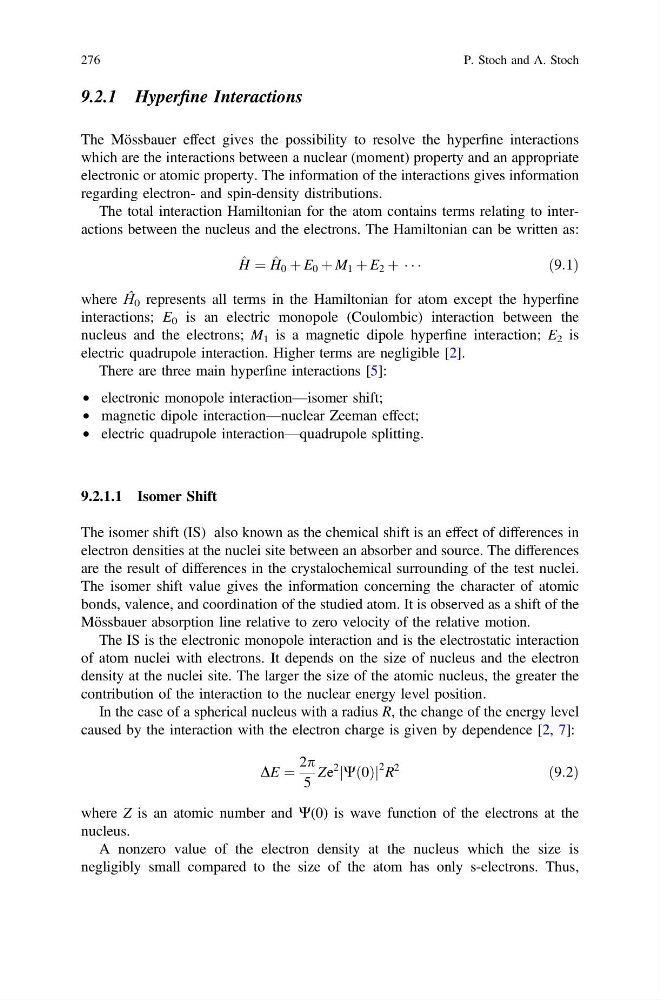
In the case of a spherical nucleus with a radius R, the change of the energy level
caused by the interaction with the electron charge is given by dependence [2, 7]:
DE ¼
2p
5
Ze
2
W 0
ð Þ
j
j
2 R
2
ð9:2Þ
where Z is an atomic number and W(0) is wave function of the electrons at the
nucleus.
A nonzero value of the electron density at the nucleus which the size is
negligibly small compared to the size of the atom has only s-electrons. Thus,
276
P. Stoch and A. Stoch
The Mössbauer effect gives the possibility to resolve the hyperfine interactions
which are the interactions between a nuclear (moment) property and an appropriate
electronic or atomic property. The information of the interactions gives information
regarding electron- and spin-density distributions.
The total interaction Hamiltonian for the atom contains terms relating to interactions between the nucleus and the electrons. The Hamiltonian can be written as:
^
H ¼ ^
H 0 þ E 0 þ M 1 þ E 2 þ Á Á Á
ð9:1Þ
where Ĥ 0 represents all terms in the Hamiltonian for atom except the hyperfine
interactions; E 0 is an electric monopole (Coulombic) interaction between the
nucleus and the electrons; M 1 is a magnetic dipole hyperfine interaction; E 2 is
electric quadrupole interaction. Higher terms are negligible [2].
There are three main hyperfine interactions [5]:
• electronic monopole interaction—isomer shift;
• magnetic dipole interaction—nuclear Zeeman effect;
• electric quadrupole interaction—quadrupole splitting.
9.2.1.1 Isomer Shift
The isomer shift (IS) also known as the chemical shift is an effect of differences in
electron densities at the nuclei site between an absorber and source. The differences
are the result of differences in the crystalochemical surrounding of the test nuclei.
The isomer shift value gives the information concerning the character of atomic
bonds, valence, and coordination of the studied atom. It is observed as a shift of the
Mössbauer absorption line relative to zero velocity of the relative motion.
The IS is the electronic monopole interaction and is the electrostatic interaction
of atom nuclei with electrons. It depends on the size of nucleus and the electron
density at the nuclei site. The larger the size of the atomic nucleus, the greater the
contribution of the interaction to the nuclear energy level position.
In the case of a spherical nucleus with a radius R, the change of the energy level
caused by the interaction with the electron charge is given by dependence [2, 7]:
DE ¼
2p
5
Ze
2
W 0
ð Þ
j
j
2 R
2
ð9:2Þ
where Z is an atomic number and W(0) is wave function of the electrons at the
nucleus.
A nonzero value of the electron density at the nucleus which the size is
negligibly small compared to the size of the atom has only s-electrons. Thus,
276
P. Stoch and A. Stoch