

investigation of larger systems in longer timescales. Still, new original and innovative alternatives appear in the form of dedicated machines, like Anton 2 for MD
simulations or ARUZ for MC methods. From the experimental point of view, the
high-resolution time (pump-and-probe) and space (such as nanoIR)-resolved
methods seem to be the most promising to open new doors towards a better
understanding of complex phenomena in polymer–water systems responsible for
their stimuli responsivity.
Acknowledgements The authors acknowledge the financial support within the projects granted
by National Science Centre, Poland: No. 2013/09/B/ST4/03010 (MK), No. 2014/14/A/ST5/00204
(KH, MK), No. DEC-2013/08/S/ST4/00556 (MP) and UMO-2015/17/B/ST4/04035 (MP). Special
thanks to Prof. Jacek Ulanski and Prof. Piotr Polanowski from the Department of Molecular
Physics for long and fruitful discussions. Also, the authors would like to acknowledge Prof. Piotr
Ulanski and Prof. Slawomir Kadlubowski from the Institute of Applied Radiation Chemistry at
Lodz University of Technology for everyday support and cooperation.
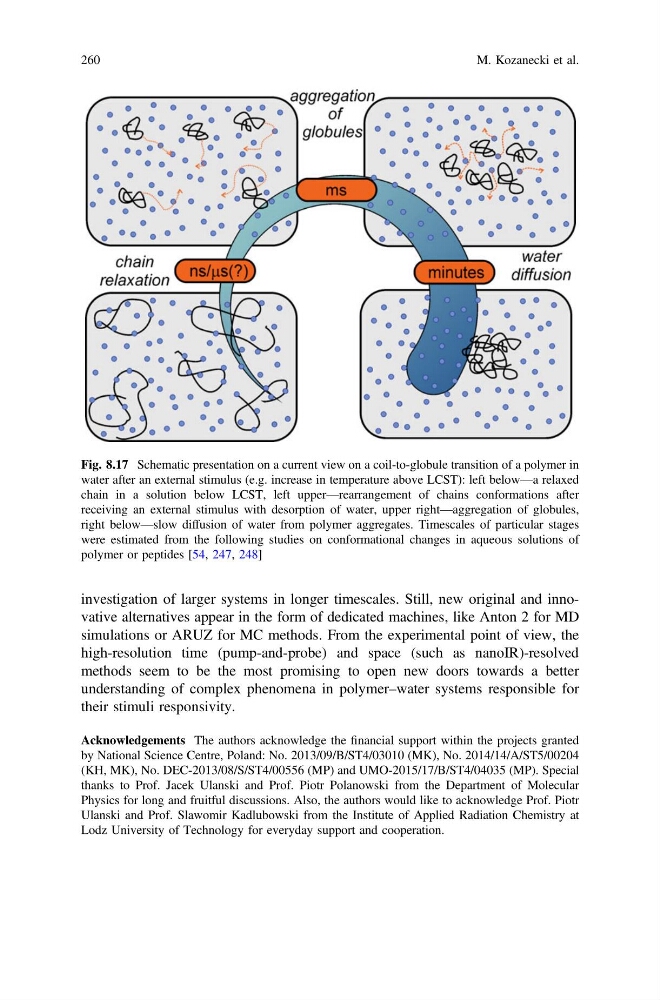
Fig. 8.17 Schematic presentation on a current view on a coil-to-globule transition of a polymer in
water after an external stimulus (e.g. increase in temperature above LCST): left below—a relaxed
chain in a solution below LCST, left upper—rearrangement of chains conformations after
receiving an external stimulus with desorption of water, upper right—aggregation of globules,
right below—slow diffusion of water from polymer aggregates. Timescales of particular stages
were estimated from the following studies on conformational changes in aqueous solutions of
polymer or peptides [54, 247, 248]
260
M. Kozanecki et al.
simulations or ARUZ for MC methods. From the experimental point of view, the
high-resolution time (pump-and-probe) and space (such as nanoIR)-resolved
methods seem to be the most promising to open new doors towards a better
understanding of complex phenomena in polymer–water systems responsible for
their stimuli responsivity.
Acknowledgements The authors acknowledge the financial support within the projects granted
by National Science Centre, Poland: No. 2013/09/B/ST4/03010 (MK), No. 2014/14/A/ST5/00204
(KH, MK), No. DEC-2013/08/S/ST4/00556 (MP) and UMO-2015/17/B/ST4/04035 (MP). Special
thanks to Prof. Jacek Ulanski and Prof. Piotr Polanowski from the Department of Molecular
Physics for long and fruitful discussions. Also, the authors would like to acknowledge Prof. Piotr
Ulanski and Prof. Slawomir Kadlubowski from the Institute of Applied Radiation Chemistry at
Lodz University of Technology for everyday support and cooperation.
Fig. 8.17 Schematic presentation on a current view on a coil-to-globule transition of a polymer in
water after an external stimulus (e.g. increase in temperature above LCST): left below—a relaxed
chain in a solution below LCST, left upper—rearrangement of chains conformations after
receiving an external stimulus with desorption of water, upper right—aggregation of globules,
right below—slow diffusion of water from polymer aggregates. Timescales of particular stages
were estimated from the following studies on conformational changes in aqueous solutions of
polymer or peptides [54, 247, 248]
260
M. Kozanecki et al.