

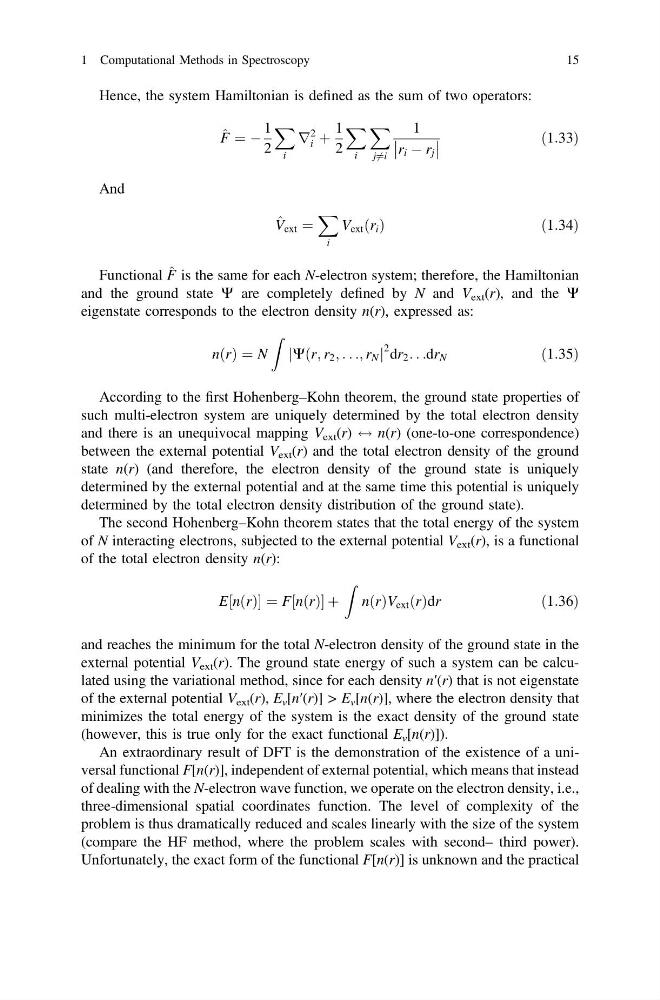
Hence, the system Hamiltonian is defined as the sum of two operators:
^
F ¼ À
1
2
X
i
r
2
i þ
1
2
X
i
X
j6 ¼i
1
r i À r j
ð1:33Þ
And
^
V ext ¼
X
i
V ext ðr i Þ
ð 1:34Þ
Functional ^
F is the same for each N-electron system; therefore, the Hamiltonian
and the ground state W are completely defined by N and V ext (r), and the W
eigenstate corresponds to the electron density n(r), expressed as:
nðrÞ ¼ N
Z
Wðr; r 2 ; . . .; r N
j
j
2 dr 2 . . .dr N
ð1:35Þ
According to the first Hohenberg–Kohn theorem, the ground state properties of
such multi-electron system are uniquely determined by the total electron density
and there is an unequivocal mapping V ext (r) $ n(r) (one-to-one correspondence)
between the external potential V ext (r) and the total electron density of the ground
state n(r) (and therefore, the electron density of the ground state is uniquely
determined by the external potential and at the same time this potential is uniquely
determined by the total electron density distribution of the ground state).
The second Hohenberg–Kohn theorem states that the total energy of the system
of N interacting electrons, subjected to the external potential V ext (r), is a functional
of the total electron density n(r):
E½nðrÞ ¼ F½nðrÞ þ
Z
nðrÞV ext ðrÞdr
ð1:36Þ
and reaches the minimum for the total N-electron density of the ground state in the
external potential V ext (r). The ground state energy of such a system can be calculated using the variational method, since for each density n′(r) that is not eigenstate
of the external potential V ext (r), E v [n′(r)] > E v [n(r)], where the electron density that
minimizes the total energy of the system is the exact density of the ground state
(however, this is true only for the exact functional E v [n(r)]).
An extraordinary result of DFT is the demonstration of the existence of a universal functional F[n(r)], independent of external potential, which means that instead
of dealing with the N-electron wave function, we operate on the electron density, i.e.,
three-dimensional spatial coordinates function. The level of complexity of the
problem is thus dramatically reduced and scales linearly with the size of the system
(compare the HF method, where the problem scales with second– third power).
Unfortunately, the exact form of the functional F[n(r)] is unknown and the practical
1 Computational Methods in Spectroscopy
15
^
F ¼ À
1
2
X
i
r
2
i þ
1
2
X
i
X
j6 ¼i
1
r i À r j
ð1:33Þ
And
^
V ext ¼
X
i
V ext ðr i Þ
ð 1:34Þ
Functional ^
F is the same for each N-electron system; therefore, the Hamiltonian
and the ground state W are completely defined by N and V ext (r), and the W
eigenstate corresponds to the electron density n(r), expressed as:
nðrÞ ¼ N
Z
Wðr; r 2 ; . . .; r N
j
j
2 dr 2 . . .dr N
ð1:35Þ
According to the first Hohenberg–Kohn theorem, the ground state properties of
such multi-electron system are uniquely determined by the total electron density
and there is an unequivocal mapping V ext (r) $ n(r) (one-to-one correspondence)
between the external potential V ext (r) and the total electron density of the ground
state n(r) (and therefore, the electron density of the ground state is uniquely
determined by the external potential and at the same time this potential is uniquely
determined by the total electron density distribution of the ground state).
The second Hohenberg–Kohn theorem states that the total energy of the system
of N interacting electrons, subjected to the external potential V ext (r), is a functional
of the total electron density n(r):
E½nðrÞ ¼ F½nðrÞ þ
Z
nðrÞV ext ðrÞdr
ð1:36Þ
and reaches the minimum for the total N-electron density of the ground state in the
external potential V ext (r). The ground state energy of such a system can be calculated using the variational method, since for each density n′(r) that is not eigenstate
of the external potential V ext (r), E v [n′(r)] > E v [n(r)], where the electron density that
minimizes the total energy of the system is the exact density of the ground state
(however, this is true only for the exact functional E v [n(r)]).
An extraordinary result of DFT is the demonstration of the existence of a universal functional F[n(r)], independent of external potential, which means that instead
of dealing with the N-electron wave function, we operate on the electron density, i.e.,
three-dimensional spatial coordinates function. The level of complexity of the
problem is thus dramatically reduced and scales linearly with the size of the system
(compare the HF method, where the problem scales with second– third power).
Unfortunately, the exact form of the functional F[n(r)] is unknown and the practical
1 Computational Methods in Spectroscopy
15