

polymer systems with various morphologies and a controlled nanostructure
[242, 243].
The chemical methods allow to control the structure at the nano- or, at most,
micrometer level. Thus, the development of polymer processing is also necessary to
find new, innovative, ways of designing stimuli-responsive devices on the higher
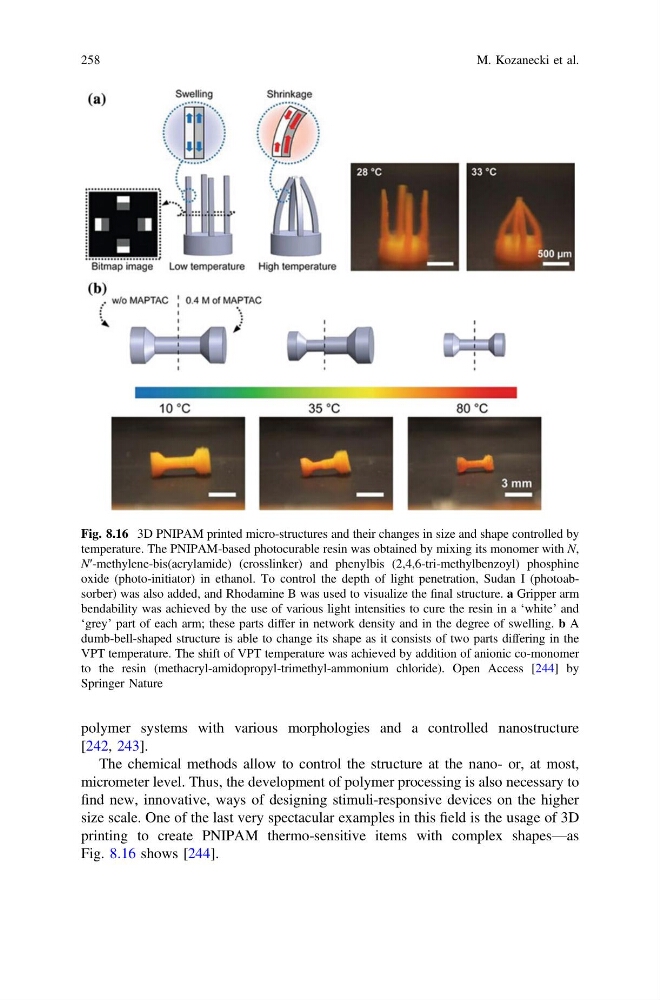
size scale. One of the last very spectacular examples in this field is the usage of 3D
printing to create PNIPAM thermo-sensitive items with complex shapes—as
Fig. 8.16 shows [244].
Fig. 8.16 3D PNIPAM printed micro-structures and their changes in size and shape controlled by
temperature. The PNIPAM-based photocurable resin was obtained by mixing its monomer with N,
N′-methylene-bis(acrylamide) (crosslinker) and phenylbis (2,4,6-tri-methylbenzoyl) phosphine
oxide (photo-initiator) in ethanol. To control the depth of light penetration, Sudan I (photoabsorber) was also added, and Rhodamine B was used to visualize the final structure. a Gripper arm
bendability was achieved by the use of various light intensities to cure the resin in a ‘white’ and
‘grey’ part of each arm; these parts differ in network density and in the degree of swelling. b A
dumb-bell-shaped structure is able to change its shape as it consists of two parts differing in the
VPT temperature. The shift of VPT temperature was achieved by addition of anionic co-monomer
to the resin (methacryl-amidopropyl-trimethyl-ammonium chloride). Open Access [244] by
Springer Nature
258
M. Kozanecki et al.
[242, 243].
The chemical methods allow to control the structure at the nano- or, at most,
micrometer level. Thus, the development of polymer processing is also necessary to
find new, innovative, ways of designing stimuli-responsive devices on the higher
size scale. One of the last very spectacular examples in this field is the usage of 3D
printing to create PNIPAM thermo-sensitive items with complex shapes—as
Fig. 8.16 shows [244].
Fig. 8.16 3D PNIPAM printed micro-structures and their changes in size and shape controlled by
temperature. The PNIPAM-based photocurable resin was obtained by mixing its monomer with N,
N′-methylene-bis(acrylamide) (crosslinker) and phenylbis (2,4,6-tri-methylbenzoyl) phosphine
oxide (photo-initiator) in ethanol. To control the depth of light penetration, Sudan I (photoabsorber) was also added, and Rhodamine B was used to visualize the final structure. a Gripper arm
bendability was achieved by the use of various light intensities to cure the resin in a ‘white’ and
‘grey’ part of each arm; these parts differ in network density and in the degree of swelling. b A
dumb-bell-shaped structure is able to change its shape as it consists of two parts differing in the
VPT temperature. The shift of VPT temperature was achieved by addition of anionic co-monomer
to the resin (methacryl-amidopropyl-trimethyl-ammonium chloride). Open Access [244] by
Springer Nature
258
M. Kozanecki et al.