

with the experimental data [155, 159, 160]. It was also proved that dehydration of
PNIPAM chains induced by the increasing temperature and leading to the
coil-to-globule transition is mainly an entropy-driven process [215].
Although results concerning water interactions with strongly polar or ionised
groups are rather well understood, the hydrophobic interactions are still discussed in
the literature. Dalgakiran and Tatlipinar [212] showed that water solubility of
PMEO 2 MA below LCST was provided by hydrophobic hydration around the side
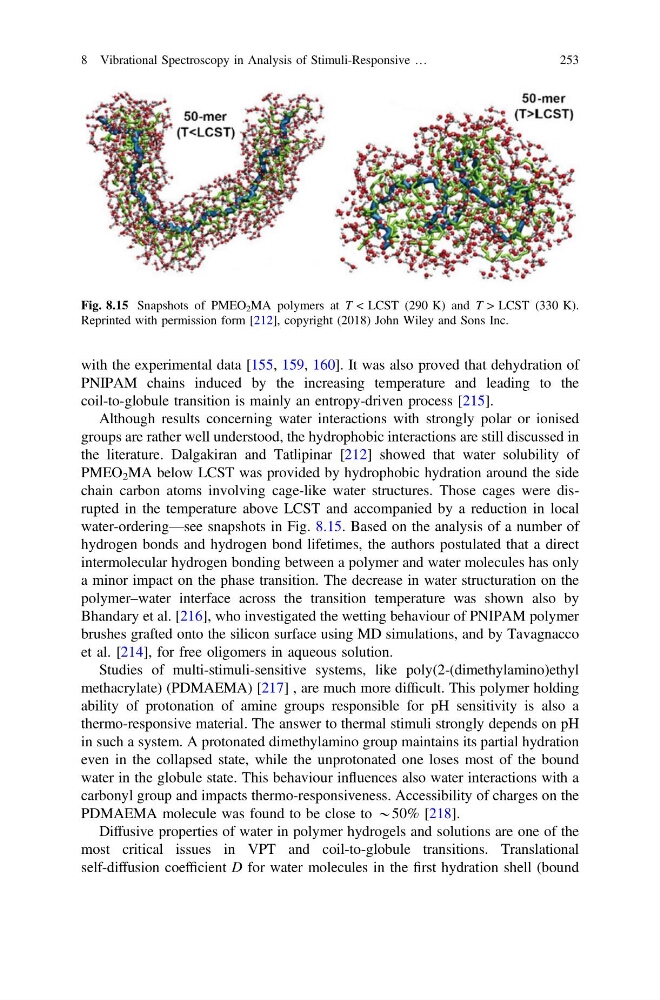
chain carbon atoms involving cage-like water structures. Those cages were disrupted in the temperature above LCST and accompanied by a reduction in local
water-ordering—see snapshots in Fig. 8.15. Based on the analysis of a number of
hydrogen bonds and hydrogen bond lifetimes, the authors postulated that a direct
intermolecular hydrogen bonding between a polymer and water molecules has only
a minor impact on the phase transition. The decrease in water structuration on the
polymer–water interface across the transition temperature was shown also by
Bhandary et al. [216], who investigated the wetting behaviour of PNIPAM polymer
brushes grafted onto the silicon surface using MD simulations, and by Tavagnacco
et al. [214], for free oligomers in aqueous solution.
Studies of multi-stimuli-sensitive systems, like poly(2-(dimethylamino)ethyl
methacrylate) (PDMAEMA) [217] , are much more difficult. This polymer holding
ability of protonation of amine groups responsible for pH sensitivity is also a
thermo-responsive material. The answer to thermal stimuli strongly depends on pH
in such a system. A protonated dimethylamino group maintains its partial hydration
even in the collapsed state, while the unprotonated one loses most of the bound
water in the globule state. This behaviour influences also water interactions with a
carbonyl group and impacts thermo-responsiveness. Accessibility of charges on the
PDMAEMA molecule was found to be close to *50% [218].
Diffusive properties of water in polymer hydrogels and solutions are one of the
most critical issues in VPT and coil-to-globule transitions. Translational
self-diffusion coefficient D for water molecules in the first hydration shell (bound
Fig. 8.15 Snapshots of PMEO 2 MA polymers at T < LCST (290 K) and T > LCST (330 K).
Reprinted with permission form [212], copyright (2018) John Wiley and Sons Inc.
8 Vibrational Spectroscopy in Analysis of Stimuli-Responsive …
253
PNIPAM chains induced by the increasing temperature and leading to the
coil-to-globule transition is mainly an entropy-driven process [215].
Although results concerning water interactions with strongly polar or ionised
groups are rather well understood, the hydrophobic interactions are still discussed in
the literature. Dalgakiran and Tatlipinar [212] showed that water solubility of
PMEO 2 MA below LCST was provided by hydrophobic hydration around the side
chain carbon atoms involving cage-like water structures. Those cages were disrupted in the temperature above LCST and accompanied by a reduction in local
water-ordering—see snapshots in Fig. 8.15. Based on the analysis of a number of
hydrogen bonds and hydrogen bond lifetimes, the authors postulated that a direct
intermolecular hydrogen bonding between a polymer and water molecules has only
a minor impact on the phase transition. The decrease in water structuration on the
polymer–water interface across the transition temperature was shown also by
Bhandary et al. [216], who investigated the wetting behaviour of PNIPAM polymer
brushes grafted onto the silicon surface using MD simulations, and by Tavagnacco
et al. [214], for free oligomers in aqueous solution.
Studies of multi-stimuli-sensitive systems, like poly(2-(dimethylamino)ethyl
methacrylate) (PDMAEMA) [217] , are much more difficult. This polymer holding
ability of protonation of amine groups responsible for pH sensitivity is also a
thermo-responsive material. The answer to thermal stimuli strongly depends on pH
in such a system. A protonated dimethylamino group maintains its partial hydration
even in the collapsed state, while the unprotonated one loses most of the bound
water in the globule state. This behaviour influences also water interactions with a
carbonyl group and impacts thermo-responsiveness. Accessibility of charges on the
PDMAEMA molecule was found to be close to *50% [218].
Diffusive properties of water in polymer hydrogels and solutions are one of the
most critical issues in VPT and coil-to-globule transitions. Translational
self-diffusion coefficient D for water molecules in the first hydration shell (bound
Fig. 8.15 Snapshots of PMEO 2 MA polymers at T < LCST (290 K) and T > LCST (330 K).
Reprinted with permission form [212], copyright (2018) John Wiley and Sons Inc.
8 Vibrational Spectroscopy in Analysis of Stimuli-Responsive …
253