

found to be only slightly smaller in comparison to pure water, while bulk water
does not differ from pure water [210]. The above-mentioned results were obtained
for linear polymers using united atom approximation.
Beside the non-uniform distribution of water molecules along the PVME chain,
it was also found that a significant amount (10%) of ether oxygen atoms does not
interact with water via a hydrogen bond, even if the concentration of the solution is
very low (3.3 wt%) and the temperature is below LCST (300 K) [211]. This
number increased with the increasing polymer content, however, the increase rate
changes if the concentration reaches *27 wt%. This point was recognized as
relating to demixing transition found experimentally by colorimetric method at 30
wt% [211]. Partial hydration of hydrophilic centres of different polymer chains
(PMEO 2 MA) in water was postulated not only basing on simulations [212], but also
on vibrational spectroscopy studies (see section Thermo-responsive systems
—“non-ionisable” polymers and [161]). It was explained in the light of steric effects
[146, 161, 210], which was well supported by comparative MD studies on various
model hydrogels, namely PVME, PNIPAM and poly(vinyl alcohol) (PVA), which
showed that the number of water–polymer hydrogen bonds is the largest for PVA
and the smallest for PVME [210]. This relates to accessibility of a polymer hydrophilic centre for water–oxygen in the PVME structure is partially hidden by both
a polymer chain and a methyl group, while in PVA the chain is the only steric
hindrance for water molecules. Additionally, some of hydrophilic (oxygen) centres
form hydrogen bonds with two water molecules despite the presence of
non-hydrated hydrophilic groups, as it was shown for PMEO 2 MA [213]. MD
simulations performed for PVME confirmed such a possibility. As it was mentioned
previously, the total bound water for many polymers and gels oscillated in the range
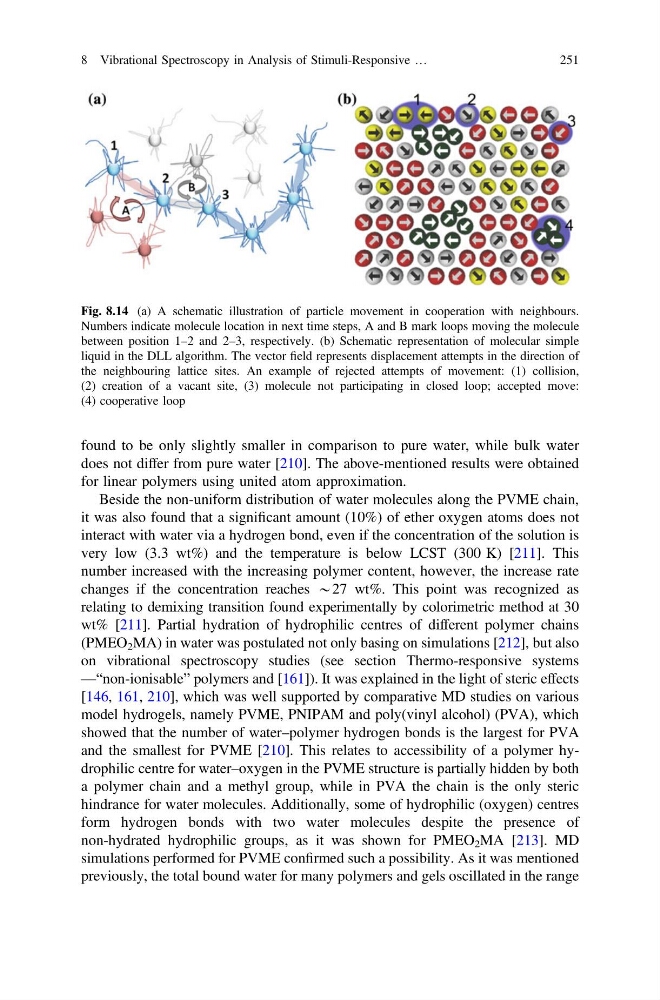
Fig. 8.14 (a) A schematic illustration of particle movement in cooperation with neighbours.
Numbers indicate molecule location in next time steps, A and B mark loops moving the molecule
between position 1–2 and 2–3, respectively. (b) Schematic representation of molecular simple
liquid in the DLL algorithm. The vector field represents displacement attempts in the direction of
the neighbouring lattice sites. An example of rejected attempts of movement: (1) collision,
(2) creation of a vacant site, (3) molecule not participating in closed loop; accepted move:
(4) cooperative loop
8 Vibrational Spectroscopy in Analysis of Stimuli-Responsive …
251
does not differ from pure water [210]. The above-mentioned results were obtained
for linear polymers using united atom approximation.
Beside the non-uniform distribution of water molecules along the PVME chain,
it was also found that a significant amount (10%) of ether oxygen atoms does not
interact with water via a hydrogen bond, even if the concentration of the solution is
very low (3.3 wt%) and the temperature is below LCST (300 K) [211]. This
number increased with the increasing polymer content, however, the increase rate
changes if the concentration reaches *27 wt%. This point was recognized as
relating to demixing transition found experimentally by colorimetric method at 30
wt% [211]. Partial hydration of hydrophilic centres of different polymer chains
(PMEO 2 MA) in water was postulated not only basing on simulations [212], but also
on vibrational spectroscopy studies (see section Thermo-responsive systems
—“non-ionisable” polymers and [161]). It was explained in the light of steric effects
[146, 161, 210], which was well supported by comparative MD studies on various
model hydrogels, namely PVME, PNIPAM and poly(vinyl alcohol) (PVA), which
showed that the number of water–polymer hydrogen bonds is the largest for PVA
and the smallest for PVME [210]. This relates to accessibility of a polymer hydrophilic centre for water–oxygen in the PVME structure is partially hidden by both
a polymer chain and a methyl group, while in PVA the chain is the only steric
hindrance for water molecules. Additionally, some of hydrophilic (oxygen) centres
form hydrogen bonds with two water molecules despite the presence of
non-hydrated hydrophilic groups, as it was shown for PMEO 2 MA [213]. MD
simulations performed for PVME confirmed such a possibility. As it was mentioned
previously, the total bound water for many polymers and gels oscillated in the range
Fig. 8.14 (a) A schematic illustration of particle movement in cooperation with neighbours.
Numbers indicate molecule location in next time steps, A and B mark loops moving the molecule
between position 1–2 and 2–3, respectively. (b) Schematic representation of molecular simple
liquid in the DLL algorithm. The vector field represents displacement attempts in the direction of
the neighbouring lattice sites. An example of rejected attempts of movement: (1) collision,
(2) creation of a vacant site, (3) molecule not participating in closed loop; accepted move:
(4) cooperative loop
8 Vibrational Spectroscopy in Analysis of Stimuli-Responsive …
251