

of thermo-responsive polymer systems. The pH-responsive systems benefit from an
ultrafast proton transfer of water through the Grotthuss mechanism, where only a
charge, not mass is transported between water molecules [53, 54]. In fact, on
account of the above-described properties of water, rehydration of a polymer is
usually a much slower process than dehydration, as the transport of heat, proton or
mass in neat polymers is significantly slower than in aqueous solutions or gels [55].
In the next part of this section, we will first characterize in detail a vibrational
spectrum of liquid water and then describe specific ‘states’ of water present in
polymer solutions and gels, and finally, we will shortly review ultrafast vibrational
spectroscopy methods applied to aqueous systems.
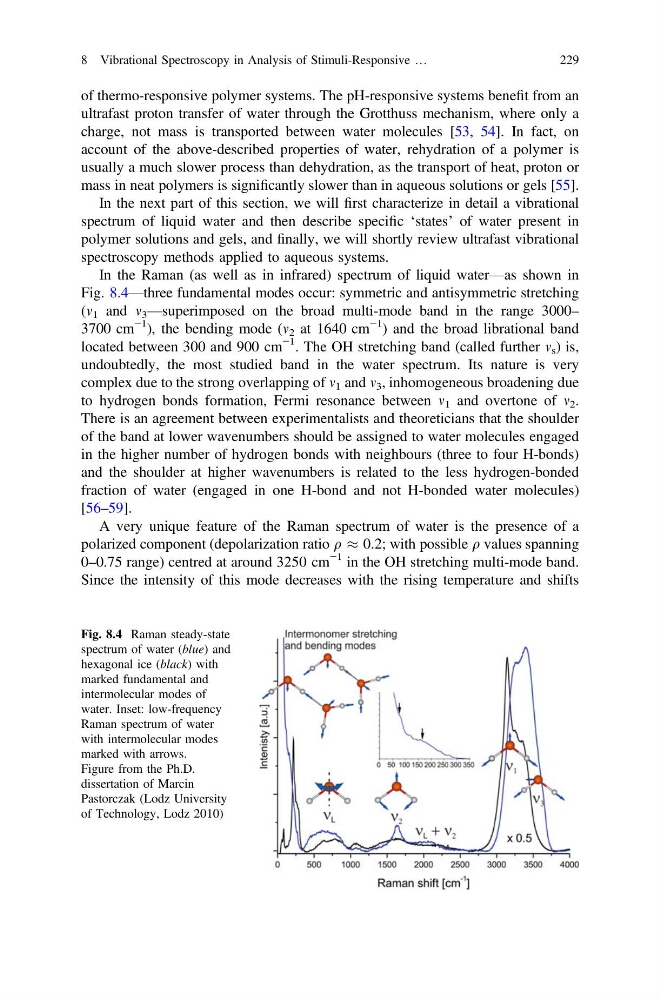
In the Raman (as well as in infrared) spectrum of liquid water—as shown in
Fig. 8.4—three fundamental modes occur: symmetric and antisymmetric stretching
(m 1 and m 3 —superimposed on the broad multi-mode band in the range 3000–
3700 cm
−1 ), the bending mode (m 2 at 1640 cm
−1 ) and the broad librational band
located between 300 and 900 cm
−1 . The OH stretching band (called further m s ) is,
undoubtedly, the most studied band in the water spectrum. Its nature is very
complex due to the strong overlapping of m 1 and m 3 , inhomogeneous broadening due
to hydrogen bonds formation, Fermi resonance between m 1 and overtone of m 2 .
There is an agreement between experimentalists and theoreticians that the shoulder
of the band at lower wavenumbers should be assigned to water molecules engaged
in the higher number of hydrogen bonds with neighbours (three to four H-bonds)
and the shoulder at higher wavenumbers is related to the less hydrogen-bonded
fraction of water (engaged in one H-bond and not H-bonded water molecules)
[56–59].
A very unique feature of the Raman spectrum of water is the presence of a
polarized component (depolarization ratio q % 0.2; with possible q values spanning
0–0.75 range) centred at around 3250 cm
−1 in the OH stretching multi-mode band.
Since the intensity of this mode decreases with the rising temperature and shifts
Fig. 8.4 Raman steady-state
spectrum of water (blue) and
hexagonal ice (black) with
marked fundamental and
intermolecular modes of
water. Inset: low-frequency
Raman spectrum of water
with intermolecular modes
marked with arrows.
Figure from the Ph.D.
dissertation of Marcin
Pastorczak (Lodz University
of Technology, Lodz 2010)
8 Vibrational Spectroscopy in Analysis of Stimuli-Responsive …
229
ultrafast proton transfer of water through the Grotthuss mechanism, where only a
charge, not mass is transported between water molecules [53, 54]. In fact, on
account of the above-described properties of water, rehydration of a polymer is
usually a much slower process than dehydration, as the transport of heat, proton or
mass in neat polymers is significantly slower than in aqueous solutions or gels [55].
In the next part of this section, we will first characterize in detail a vibrational
spectrum of liquid water and then describe specific ‘states’ of water present in
polymer solutions and gels, and finally, we will shortly review ultrafast vibrational
spectroscopy methods applied to aqueous systems.
In the Raman (as well as in infrared) spectrum of liquid water—as shown in
Fig. 8.4—three fundamental modes occur: symmetric and antisymmetric stretching
(m 1 and m 3 —superimposed on the broad multi-mode band in the range 3000–
3700 cm
−1 ), the bending mode (m 2 at 1640 cm
−1 ) and the broad librational band
located between 300 and 900 cm
−1 . The OH stretching band (called further m s ) is,
undoubtedly, the most studied band in the water spectrum. Its nature is very
complex due to the strong overlapping of m 1 and m 3 , inhomogeneous broadening due
to hydrogen bonds formation, Fermi resonance between m 1 and overtone of m 2 .
There is an agreement between experimentalists and theoreticians that the shoulder
of the band at lower wavenumbers should be assigned to water molecules engaged
in the higher number of hydrogen bonds with neighbours (three to four H-bonds)
and the shoulder at higher wavenumbers is related to the less hydrogen-bonded
fraction of water (engaged in one H-bond and not H-bonded water molecules)
[56–59].
A very unique feature of the Raman spectrum of water is the presence of a
polarized component (depolarization ratio q % 0.2; with possible q values spanning
0–0.75 range) centred at around 3250 cm
−1 in the OH stretching multi-mode band.
Since the intensity of this mode decreases with the rising temperature and shifts
Fig. 8.4 Raman steady-state
spectrum of water (blue) and
hexagonal ice (black) with
marked fundamental and
intermolecular modes of
water. Inset: low-frequency
Raman spectrum of water
with intermolecular modes
marked with arrows.
Figure from the Ph.D.
dissertation of Marcin
Pastorczak (Lodz University
of Technology, Lodz 2010)
8 Vibrational Spectroscopy in Analysis of Stimuli-Responsive …
229