

7.5 Conclusion
Modern vibrational spectroscopies play a central role in the investigation of the
structure and reactivity of chemical systems, from isolated molecules to complex
condensed phase structures. When used together with complementary techniques,
such as XRD, DSC, PLTM, and contemporary theoretical approaches, they allow
for elucidation of subtle structural details of the systems under investigation and
successfully extract fundamental information on the chemical transformations they
undergo, either induced by light or thermally.
This chapter intended to demonstrate some of the capabilities of vibrational
spectroscopy as major research tool to investigate the structure and reactivity of two
relevant closely-related families of nitrogen-containing heterocyclic molecules:
hydantoins and mercaptoimidazoles. Infrared spectroscopy, used in connection with
the matrix isolation technique and a set of complementary computational approaches, allowed to characterize in details the structures of the isolated molecules of the
compounds selected for investigation and their photochemistry. Infrared and Raman
spectroscopies, supplemented by thermodynamics, microscopy and diffraction
techniques, were used to investigate neat condensed phases of the compounds and
the observed transitions between these phases.
The tautomerism in the studied mercaptoimidazoles was addressed in various
perspectives, from the determination of the preferred tautomeric species present in
the different phases investigated, till the photochemically induced (inter)conversion
between the thione and thiol tautomers of these compounds. The crystal structure of
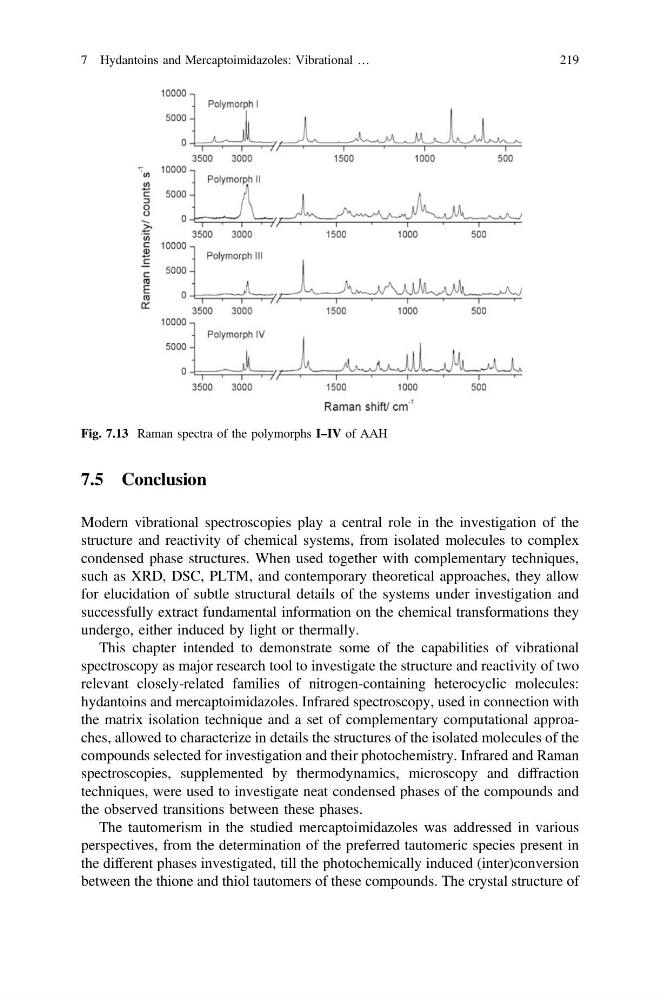
Fig. 7.13 Raman spectra of the polymorphs I–IV of AAH
7 Hydantoins and Mercaptoimidazoles: Vibrational …
219
Modern vibrational spectroscopies play a central role in the investigation of the
structure and reactivity of chemical systems, from isolated molecules to complex
condensed phase structures. When used together with complementary techniques,
such as XRD, DSC, PLTM, and contemporary theoretical approaches, they allow
for elucidation of subtle structural details of the systems under investigation and
successfully extract fundamental information on the chemical transformations they
undergo, either induced by light or thermally.
This chapter intended to demonstrate some of the capabilities of vibrational
spectroscopy as major research tool to investigate the structure and reactivity of two
relevant closely-related families of nitrogen-containing heterocyclic molecules:
hydantoins and mercaptoimidazoles. Infrared spectroscopy, used in connection with
the matrix isolation technique and a set of complementary computational approaches, allowed to characterize in details the structures of the isolated molecules of the
compounds selected for investigation and their photochemistry. Infrared and Raman
spectroscopies, supplemented by thermodynamics, microscopy and diffraction
techniques, were used to investigate neat condensed phases of the compounds and
the observed transitions between these phases.
The tautomerism in the studied mercaptoimidazoles was addressed in various
perspectives, from the determination of the preferred tautomeric species present in
the different phases investigated, till the photochemically induced (inter)conversion
between the thione and thiol tautomers of these compounds. The crystal structure of
Fig. 7.13 Raman spectra of the polymorphs I–IV of AAH
7 Hydantoins and Mercaptoimidazoles: Vibrational …
219