

307 nm, i.e., 390 kJ mol
−1 , whereas for the thiol ! thione isomerization E
[(radical + H) − thiol] = 325 kJ mol
−1 and the used excitation wavelength was
246 nm, i.e., 486 kJ mol
−1 .
The fact that for MTI, the photoinduced conversion of the thiol tautomer into the
thione form could not be observed is also in agreement with the involvement of the
thiyl radical in the photochemical process and the PIDA mechanism. Indeed, while for
TBI and MTBI, the intermediate radicals were shown to have a significant spin
density associated with the unpaired electron in both N and S atoms, in the case of
MTI, the calculated spin density associated with the unpaired electron in the corresponding thiyl radical is practically localized only in the sulfur atom, thus making
more difficult, for this molecule, recombination of the H atom at the N position. An
additional factor might also contribute to the inefficiency of the thiol ! thione tautomerization in MTI: The required excitation wavelength to induce the hydrogen
atom release in MTI is shorter, so that larger energies must be applied to the molecule;
this leads to photodecomposition to take place, as testified by observation of bands
ascribable to photofragmentation products, in particular N-vinylidenemethanamine
[which shall be formed together with isothiocyanic acid (SCNH) or thiocyanic acid
(NCSH)] [12].
7.3.2 Hydantoins
The matrix-isolated hydantoins were subjected to UV irradiations in a similar way
to what has been described in the previous section for the mercaptoimidazoles. For
these compounds, no tautomerization reactions were observed. On the other hand,
the compounds were found to undergo fragmentation, following a common pattern
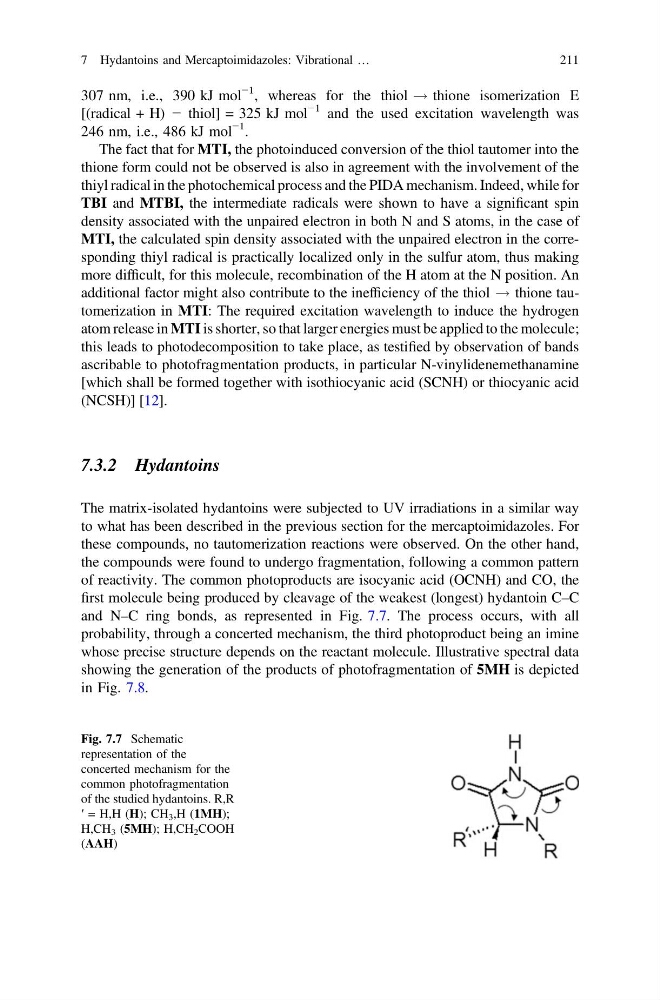
of reactivity. The common photoproducts are isocyanic acid (OCNH) and CO, the
first molecule being produced by cleavage of the weakest (longest) hydantoin C–C
and N–C ring bonds, as represented in Fig. 7.7. The process occurs, with all
probability, through a concerted mechanism, the third photoproduct being an imine
whose precise structure depends on the reactant molecule. Illustrative spectral data
showing the generation of the products of photofragmentation of 5MH is depicted
in Fig. 7.8.
Fig. 7.7 Schematic
representation of the
concerted mechanism for the
common photofragmentation
of the studied hydantoins. R,R
′ = H,H (H); CH 3 ,H (1MH);
H,CH 3 (5MH); H,CH 2 COOH
(AAH)
7 Hydantoins and Mercaptoimidazoles: Vibrational …
211
−1 , whereas for the thiol ! thione isomerization E
[(radical + H) − thiol] = 325 kJ mol
−1 and the used excitation wavelength was
246 nm, i.e., 486 kJ mol
−1 .
The fact that for MTI, the photoinduced conversion of the thiol tautomer into the
thione form could not be observed is also in agreement with the involvement of the
thiyl radical in the photochemical process and the PIDA mechanism. Indeed, while for
TBI and MTBI, the intermediate radicals were shown to have a significant spin
density associated with the unpaired electron in both N and S atoms, in the case of
MTI, the calculated spin density associated with the unpaired electron in the corresponding thiyl radical is practically localized only in the sulfur atom, thus making
more difficult, for this molecule, recombination of the H atom at the N position. An
additional factor might also contribute to the inefficiency of the thiol ! thione tautomerization in MTI: The required excitation wavelength to induce the hydrogen
atom release in MTI is shorter, so that larger energies must be applied to the molecule;
this leads to photodecomposition to take place, as testified by observation of bands
ascribable to photofragmentation products, in particular N-vinylidenemethanamine
[which shall be formed together with isothiocyanic acid (SCNH) or thiocyanic acid
(NCSH)] [12].
7.3.2 Hydantoins
The matrix-isolated hydantoins were subjected to UV irradiations in a similar way
to what has been described in the previous section for the mercaptoimidazoles. For
these compounds, no tautomerization reactions were observed. On the other hand,
the compounds were found to undergo fragmentation, following a common pattern
of reactivity. The common photoproducts are isocyanic acid (OCNH) and CO, the
first molecule being produced by cleavage of the weakest (longest) hydantoin C–C
and N–C ring bonds, as represented in Fig. 7.7. The process occurs, with all
probability, through a concerted mechanism, the third photoproduct being an imine
whose precise structure depends on the reactant molecule. Illustrative spectral data
showing the generation of the products of photofragmentation of 5MH is depicted
in Fig. 7.8.
Fig. 7.7 Schematic
representation of the
concerted mechanism for the
common photofragmentation
of the studied hydantoins. R,R
′ = H,H (H); CH 3 ,H (1MH);
H,CH 3 (5MH); H,CH 2 COOH
(AAH)
7 Hydantoins and Mercaptoimidazoles: Vibrational …
211